Topic 1.1 Notes – Introduction to Ecosystems
What Ecosystems Are
An ecosystem includes three things together:
- Living organisms
- The nonliving environment
- The interactions among them
That last part matters. A forest is not just trees and animals sitting in one place. It is a system where organisms affect each other and respond to conditions like water, light, and temperature.
A quick organization reminder helps place ecosystems in context:
- Organism = one individual
- Population = members of one species in one area
- Community = all the populations in that area
- Ecosystem = the community plus the abiotic environment
Biotic components are the living or once-living parts of the system, such as plants, animals, fungi, bacteria, and dead organic matter.
Abiotic components are the nonliving physical and chemical factors, including:
- sunlight
- temperature
- water
- air
- soil minerals
- salinity
- pH
- dissolved oxygen
- physical space
A pond is a good example because you can see both sides of the system at once. The organisms in and around the water interact with abiotic factors like water, sediment, light, and dissolved oxygen.
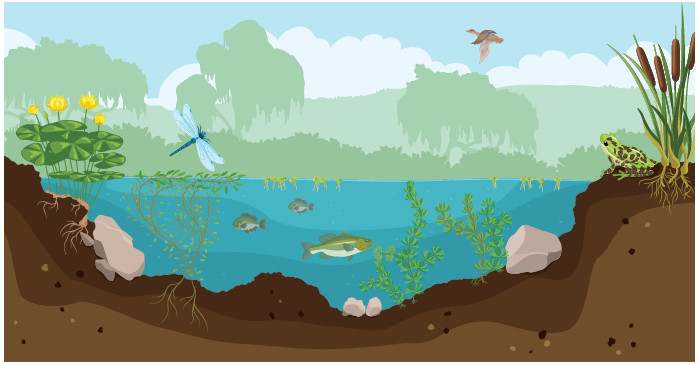
Pond ecosystem
Ecosystems can exist at many scales. A rotting log, pond, forest, watershed, or ocean can all count. Their boundaries are not sealed off. Organisms, matter, and energy move across them, which is why changes outside an ecosystem can still affect it.
The APES idea you want to keep in your head is this: abiotic conditions affect resource availability, and resource availability shapes species interactions.
Resources and the Main Types of Species Interactions
A resource is something an organism uses that can become less available when other organisms use it too.
Common resources include:
- food
- water
- mineral nutrients
- sunlight
- nesting sites
- shelter
- territory
- space
Some abiotic factors are better described as conditions than resources. For example, organisms do not “use up” temperature or pH the way they use up food or water. Still, those conditions strongly affect where species can live and how they interact.
Availability is more than just amount. A resource may exist but still be hard to use because of:
- distribution across space
- timing across seasons or day/night
- accessibility
- whether a species can actually use it
Interaction signs are worth memorizing exactly:
- = benefit
- = harm
- = no significant effect
The five interactions in this topic are:
| Interaction | Effect |
|---|---|
| Predation | |
| Mutualism | |
| Commensalism | |
| Parasitism | |
| Competition |
Predation, Symbiosis, and Competition
Predation
Predation happens when a predator eats prey. The predator benefits, and the prey is harmed and usually killed.
If prey becomes more available, predator survival and reproduction often rise too. That is why predator and prey populations often cycle.
In population graphs like the hare-lynx example below, the prey population usually rises first and the predator population follows after a short lag.
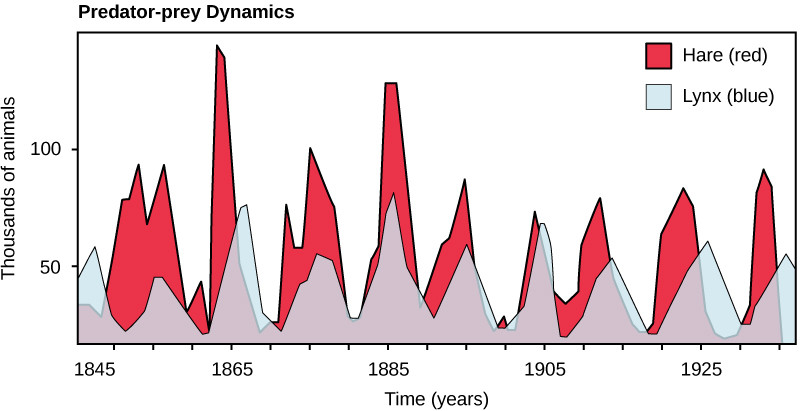
Predator-prey population cycles
On graphs, prey peaks usually come first and predator peaks lag behind. Students often miss that lag.
Do not confuse predation with parasitism. Predators usually kill and eat multiple prey. Parasites live on or in a host over time.
Symbiosis
Symbiosis is a close, long-term interaction between two different species.
- Mutualism
Both benefit. Example: mycorrhizal fungi and plant roots. The fungus helps the plant absorb water and minerals, and the plant provides sugars. - Commensalism
One benefits, the other is not significantly affected. Example: barnacles attached to a whale. - Parasitism
The parasite benefits, the host is harmed. The host is usually not killed right away. Examples: a tick feeding on a deer and a tapeworm in a vertebrate intestine.
Competition
Competition happens when organisms rely on the same limited resource and reduce each other’s access to it.
It can be for food, water, sunlight, nutrients, nesting sites, shelter, territory, mates, or space.
- Intraspecific competition = within the same species
- Interspecific competition = between different species
Competition can be indirect through shared resource use or direct through interference like defending territory. If niches overlap strongly and the same limiting resource is used in the same place and time, competitive exclusion can happen.
Niches and Resource Partitioning
A niche is how a species uses resources, tolerates conditions, and functions in its ecosystem. A habitat is where it lives.
More niche overlap means more potential competition, especially when a resource is limited.
Resource partitioning reduces competition by changing how species use a shared resource:
- Spatial partitioning = different places
- Temporal partitioning = different times
- Functional or dietary partitioning = different methods, sizes, or parts of the resource
Classic example: MacArthur’s warblers fed in different parts of the same spruce tree. They still used the same general resource, but with less overlap.
Extra examples:
- Temporal: one predator hunts during the day, another at night
- Dietary: seed-eating birds specialize on different seed sizes
Partitioning does not create more resource. It changes resource use and makes coexistence more likely.
How Resource Availability Shapes Interaction Outcomes
This whole topic comes together in cause-and-effect form:
- Scarce shared resources increase competition.
- Abundant resources usually reduce competition.
- More prey can support more predators.
- More hosts can support more parasites.
- Mutualistic partners can improve access to limiting resources.
A strong APES explanation usually sounds like this in your head: identify the resource, say whether it is limited or available, name the interaction, then explain the effect on each species.
Key Takeaways
Ecosystem
The living organisms in an area, the abiotic environment, and the interactions among them
Population
Individuals of the same species living in the same area
Community
All populations of different species living and interacting in an area
Biotic Component (Biotic Factor)
A living or once-living biological component of an ecosystem
Abiotic Component (Abiotic Factor)
A nonliving physical or chemical component of an ecosystem, such as water, sunlight, temperature, or soil minerals
Resource
Something an organism uses whose availability may decrease through use, such as food, water, nutrients, light, or space
Resource Availability
The usable supply of a resource as determined by its amount, distribution, timing, and accessibility
Predator-Prey Relationship (Predation)
A +/− interaction in which a predator captures and eats prey, benefiting while the prey is harmed and generally killed
Symbiosis
A close, long-term interaction between individuals of two different species
Mutualism
A +/+ symbiotic interaction in which both species receive a net benefit
Commensalism
A +/0 symbiotic interaction in which one species benefits and the other is not significantly affected
Parasitism
A +/− symbiotic interaction in which a parasite obtains resources from a host and harms it without normally killing it immediately
Competition
A −/− interaction in which organisms require the same limited resource and each reduces the other's access to it
Intraspecific Competition
Competition among individuals of the same species
Interspecific Competition
Competition between individuals of different species
Competitive Exclusion Principle
Prolonged competition between species with nearly identical niches can prevent stable coexistence, with one species locally excluding the other
Ecological Niche
How a species uses resources, tolerates environmental conditions, and functions in relationships with other organisms
Niche Overlap
The extent to which organisms use the same limiting resources, with greater overlap creating greater potential for competition
Resource Partitioning
Competing species use shared resources in different ways, places, or times, reducing niche overlap and interspecific competition
Notes
Ecosystem
The living organisms in an area, the abiotic environment, and the interactions among them
Population
Individuals of the same species living in the same area
Community
All populations of different species living and interacting in an area
Biotic Component (Biotic Factor)
A living or once-living biological component of an ecosystem
Abiotic Component (Abiotic Factor)
A nonliving physical or chemical component of an ecosystem, such as water, sunlight, temperature, or soil minerals
Resource
Something an organism uses whose availability may decrease through use, such as food, water, nutrients, light, or space
Resource Availability
The usable supply of a resource as determined by its amount, distribution, timing, and accessibility
Predator-Prey Relationship (Predation)
A +/− interaction in which a predator captures and eats prey, benefiting while the prey is harmed and generally killed
Symbiosis
A close, long-term interaction between individuals of two different species
Mutualism
A +/+ symbiotic interaction in which both species receive a net benefit
Commensalism
A +/0 symbiotic interaction in which one species benefits and the other is not significantly affected
Parasitism
A +/− symbiotic interaction in which a parasite obtains resources from a host and harms it without normally killing it immediately
Competition
A −/− interaction in which organisms require the same limited resource and each reduces the other's access to it
Intraspecific Competition
Competition among individuals of the same species
Interspecific Competition
Competition between individuals of different species
Competitive Exclusion Principle
Prolonged competition between species with nearly identical niches can prevent stable coexistence, with one species locally excluding the other
Ecological Niche
How a species uses resources, tolerates environmental conditions, and functions in relationships with other organisms
Niche Overlap
The extent to which organisms use the same limiting resources, with greater overlap creating greater potential for competition
Resource Partitioning
Competing species use shared resources in different ways, places, or times, reducing niche overlap and interspecific competition
