Topic 9.7 Notes – Ocean Acidification
What Ocean Acidification Is
Ocean acidification means the ocean’s pH is decreasing because it absorbs extra CO₂ from the atmosphere. The key cause to remember is human activity increasing atmospheric carbon dioxide.
A couple quick reminders make the term easier to understand:
- Lower pH = higher concentration.
- The pH scale is logarithmic, so even a small drop matters chemically.
- Ocean water is still slightly basic overall because its pH is still above 7, but it is becoming less basic over time.
A common mix-up on tests is confusing acidification with warming.
- Ocean warming is a temperature problem linked to the greenhouse effect.
- Ocean acidification is a seawater chemistry problem linked to dissolved CO₂ and pH.
This is also a good example of local actions causing global effects. CO₂ released by human activities mixes widely in the atmosphere, and the ocean exchanges gases with that atmosphere worldwide.
Where the Extra CO₂ Comes From
The major human sources are usually grouped together because they all raise atmospheric CO₂.
Burning fossil fuels
Burning coal, oil, and natural gas for electricity, industry, heating, and transportation releases large amounts of carbon dioxide.
Vehicle emissions
Cars, trucks, ships, and other transportation that burn gasoline or diesel are another major CO₂ source.
Deforestation
Deforestation adds to the problem in two ways:
- Burning or decomposition of cleared biomass releases stored carbon.
- Fewer trees means less photosynthesis, so less CO₂ is removed from the air.
The ocean acts as a carbon sink, meaning it absorbs a large share of human-produced CO₂. That helps slow how fast CO₂ builds up in the atmosphere, but it shifts part of the problem into ocean chemistry.
How CO₂ Lowers Ocean pH and Reduces Carbonate
Here is the full cause-and-effect chain you need to know:
- More atmospheric CO₂
- More CO₂ dissolves in seawater
- Carbonic acid forms
- concentration rises
- pH falls
- Carbonate ions become less available
- Making calcium carbonate gets harder
The core equations are:
What matters biologically is this part. Extra grabs carbonate ions , so there is less carbonate available to make calcium carbonate . Calcium is still plentiful. Carbonate availability is the limiting problem.
Since preindustrial times, average surface ocean pH has dropped from about 8.2 to 8.1. That seems tiny, but it means about a 26 percent increase in concentration.
Effects on Marine Organisms and Reefs
The main organisms affected are calcifiers, which build shells or skeletons from calcium carbonate.
- Corals build calcium carbonate skeletons. Acidification slows calcification and weakens reef growth. If a question says corals form “shells,” think skeletons.
- Mollusks include oysters, clams, and mussels. Their larvae are especially vulnerable because they must build shells quickly.
- Other calcifiers include marine snails such as pteropods, some plankton, and sea urchins and other echinoderms.
Common effects include:
- reduced shell or skeleton formation
- thinner or weaker structures
- slower growth
- lower reproductive success or larval survival
- dissolution of existing calcium carbonate in more corrosive water
Do not confuse this with coral bleaching. Bleaching happens when heat stress causes corals to lose their symbiotic algae. Acidification reduces their ability to build and maintain calcium carbonate structures.
Why It Matters for Ecosystems and People
When reefs are damaged, they lose their 3-D structure. That means less shelter, nursery space, and feeding habitat, which lowers biodiversity and disrupts food webs.
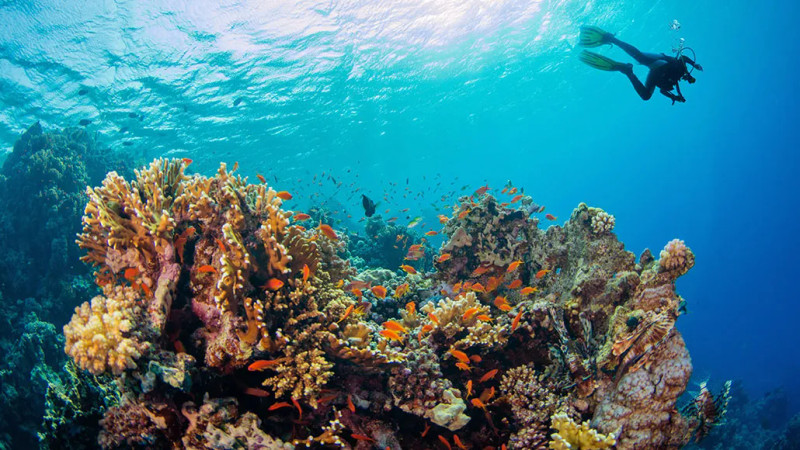
Coral reef habitat structure
That reef structure supports many fish and invertebrates, so when it breaks down, the effects spread through the whole ecosystem.
Pteropods are a classic example because declines in these small shell-formers can ripple upward to fish and other predators. That is why acidification can affect fisheries and aquaculture, especially shellfish production.
Human impacts include:
- reduced fishery productivity
- shellfish aquaculture problems
- lower tourism and recreation value
- weaker coastal protection from waves, storms, and erosion
A common graph on tests shows rising atmospheric CO₂ paired with falling ocean pH. The long-term solution is reducing CO₂ emissions. Local actions can reduce stress, such as protecting habitat, reducing pollution, and monitoring or buffering hatchery water.
Key Takeaways
Ocean Acidification
Ongoing decrease in ocean pH as absorbed excess atmospheric CO₂ forms carbonic acid and H⁺; H⁺ reduces carbonate availability, hindering calcium carbonate shell and skeleton formation
Carbon Sink
A reservoir that absorbs more carbon than it releases; the ocean absorbs roughly one-quarter of anthropogenic CO₂ emissions
Calcifying Organisms
Organisms that build calcium carbonate shells or skeletons, including corals, mollusks, pteropods, some plankton, and echinoderms
Notes
Ocean Acidification
Ongoing decrease in ocean pH as absorbed excess atmospheric CO₂ forms carbonic acid and H⁺; H⁺ reduces carbonate availability, hindering calcium carbonate shell and skeleton formation
Carbon Sink
A reservoir that absorbs more carbon than it releases; the ocean absorbs roughly one-quarter of anthropogenic CO₂ emissions
Calcifying Organisms
Organisms that build calcium carbonate shells or skeletons, including corals, mollusks, pteropods, some plankton, and echinoderms
