Topic 3.1 Notes – Generalist and Specialist Species
What Generalist and Specialist Species Are
The core idea here is niche breadth. A species’ niche is more than its food. It includes:
- the resources it uses
- the habitat it lives and reproduces in
- the abiotic conditions it can tolerate, like temperature or moisture
- the ecological role it performs, like predator, decomposer, or pollinator partner
A generalist species has a broad niche. It can often:
- use many resources
- live in different habitats
- tolerate a wider range of conditions
- adjust behavior when conditions change
A specialist species has a narrow niche. It often depends on:
- a limited food source
- a specific habitat
- narrow abiotic conditions
- a particular ecological relationship
These are not two hard boxes. They are a continuum. A species can be a specialist in one way and a generalist in another. Also, niche breadth does not tell you whether a species is common everywhere. A specialist can be abundant where its exact needs are met.
How to Tell Them Apart
You want to judge the whole niche, not just diet.
Resource and diet breadth
- Generalist: uses many foods or resources
- Specialist: depends on one or a few key foods/resources
Habitat breadth
- Generalist: lives and reproduces in many habitat types
- Specialist: depends on one restricted habitat
Tolerance breadth
- Generalist: can grow and reproduce across a wide range of temperature, moisture, salinity, pH, and other conditions
- Specialist: can grow and reproduce only across a narrow range
The exam likes this detail: survival alone is not enough. The species has to be able to grow and reproduce.
Dependence on other organisms
- Specialist: may rely on one host, prey, or pollinator
- Generalist: has more flexible relationships
Ability to respond to change
- Generalist: can often switch foods, habitats, or behavior
- Specialist: may decline if its exact requirement disappears
Standard examples
| Species | Type | Why |
|---|---|---|
| Raccoon | Generalist | Eats many foods and lives in forests, farms, suburbs, and cities |
| Giant panda | Specialist | Depends heavily on bamboo and bamboo forest habitat |
A species might be a dietary specialist but a habitat generalist, so always classify from evidence.
Stable Habitats and Changing Habitats
This is the rule you most need to know.
- Specialists tend to be advantaged in stable habitats
- Generalists tend to be advantaged in changing habitats
Why specialists do well in stable habitats
When resources and conditions stay predictable, narrow adaptations can pay off.
- specialists may use one resource very efficiently
- specialization can reduce competition through niche partitioning
- stable conditions let those narrow needs keep being met
Why generalists do well in changing habitats
If food, habitat, or conditions shift, generalists often have backups.
- they can use alternatives
- they often handle disturbed or human-modified places better
- this helps explain success in urban and agricultural environments
Important caveats
- “Tend to be advantaged” means usually, not always
- severe disturbance can hurt both
- a change could help a specialist if it increases the exact resource it needs
How Disturbance Changes Outcomes
This is the reasoning chain the exam wants. The graph here is a good visual reminder that generalists usually have a broader tolerance range, and specialists tend to do best under a narrower set of conditions.
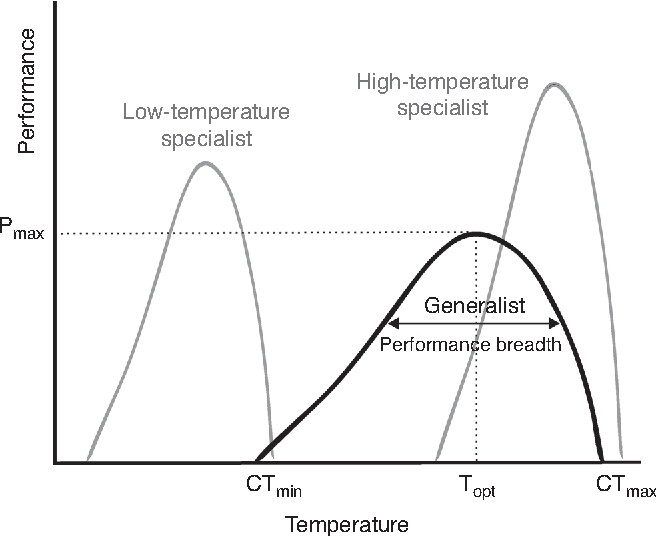
Generalist and specialist tolerance curves
- Decide if the environment is stable or disturbed.
- Decide if the species has a broad or narrow niche.
- Connect niche breadth to resource access or tolerance.
- Conclude how survival and reproduction will change.
Disturbances the exam could describe
- fires
- floods
- droughts
- storms
- climate shifts
- habitat conversion
- pollution
- fragmentation
- new competitors
- new predators
Why specialists are often more vulnerable
If the exact food, host, nesting site, or microclimate disappears, the species may decline. Fragmentation is especially rough because the few suitable patches left may become isolated.
Why generalists often persist
They may switch foods, shift habitat use, or tolerate altered conditions. That flexibility is why many generalists succeed in cities and farms.
Graphs, Wording, and Common Mix-Ups
A broad tolerance curve means wider tolerance. It does not mean the species is “better at everything.” Specialists may perform extremely well near their optimum.
Also watch the wording around adaptation. Generalists do not instantly evolve new traits. They often survive change because they already have broad tolerance or behavioral flexibility. Acclimation during one lifetime is different from genetic adaptation across generations.
Keep this topic separate from:
- r-selected vs. K-selected strategies
- survivorship curves
Those are different classifications.
Key Takeaways
Niche Breadth
The range of resources, habitats, environmental conditions, and ecological relationships included in a species’ niche
Generalist Species
A species with a broad niche that can use varied resources, tolerate many conditions, or occupy multiple habitats; it tends to be advantaged in changing habitats
Specialist Species
A species with a narrow niche that depends on restricted resources, conditions, habitats, or relationships; it tends to be advantaged in stable habitats
Notes
Niche Breadth
The range of resources, habitats, environmental conditions, and ecological relationships included in a species’ niche
Generalist Species
A species with a broad niche that can use varied resources, tolerate many conditions, or occupy multiple habitats; it tends to be advantaged in changing habitats
Specialist Species
A species with a narrow niche that depends on restricted resources, conditions, habitats, or relationships; it tends to be advantaged in stable habitats
