Topic 5.9 Notes – Impacts of Mining
What Mining Is
Mining means extracting economically valuable minerals, ores, and geologic fuels from Earth. An ore is rock that contains a valuable substance in a high enough concentration to be worth extracting.
Whether a deposit counts as a usable reserve depends on a mix of factors:
- Ore grade which means how concentrated the valuable material is
- Depth and accessibility of the deposit
- Overburden which is the soil and rock above it
- Extraction and processing costs
- Available technology
- Market price of the resource
- Regulations and cleanup requirements
Mining has a built-in trade-off. It provides low-cost energy and raw materials for things like electricity, buildings, electronics, and transportation. But getting those materials usually means land clearing, excavation, crushing rock, using lots of water and energy, and producing a lot of waste.
The big APES pattern is simple. As the high-grade, easy-to-reach ores get used up, mining shifts to lower-grade or harder-to-reach deposits.
Ore Grade and Mining Methods
A lower ore grade means there is less valuable material in each amount of rock. So to get the same amount of copper, gold, or coal, you have to mine and process more material.
That cause-and-effect chain shows up a lot on tests:
- Lower ore grade
- More rock mined and processed
- More water and energy used
- More waste and pollution
- Higher cost
As shallow, accessible deposits are depleted, companies move to deposits that are deeper, poorer, or both.
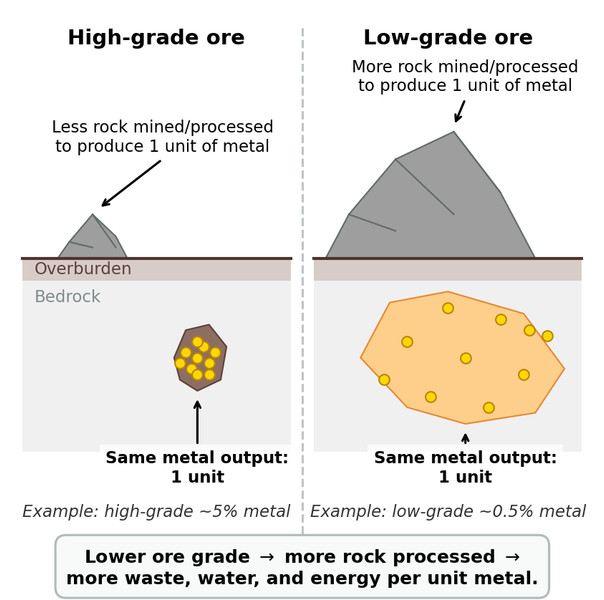
Keep that pattern in mind as you compare surface and subsurface mining.
Surface mining
Surface mining removes vegetation, soil, and rock to reach shallow deposits. The material above the deposit is overburden.
Surface mining is usually cheaper than underground mining, but it causes major land disturbance.
Strip mining
Strip mining is used for shallow horizontal deposits, especially coal seams. Miners remove vegetation and overburden in long strips.
- The named impact you should know is erosion
- When vegetation is removed, roots no longer hold soil in place
- That makes the land much more vulnerable to erosion and sediment runoff
Other surface methods
- Open-pit mining digs a large pit to remove broadly distributed metal ores.
- Mountaintop removal blasts away the top of a mountain to reach coal, and waste may be dumped into valleys.
- Heap leaching uses chemical solutions to pull metals from low-grade ore piles.
The coal diagram below gives you a quick visual of several surface methods, especially contour mining, area mining, highwall or auger mining, and mountaintop mining.
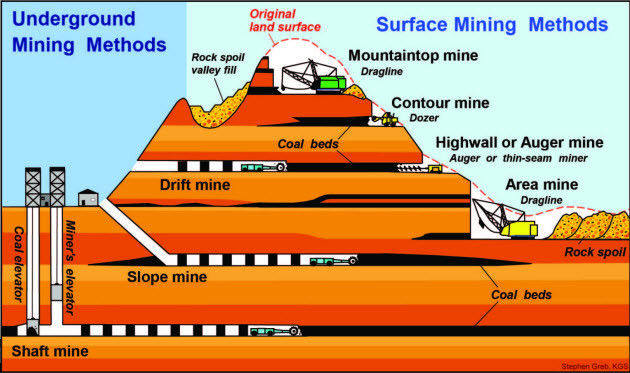
Coal mining methods
Subsurface mining
Subsurface mining uses shafts and tunnels to reach deeper deposits.
In that same diagram, the shaft, slope, and drift mines are the subsurface examples.
It disturbs less land at the surface, but it is more expensive and more dangerous than surface mining. Hazards include:
- Collapse
- Explosions
- Dust
- Toxic gases
- Subsidence which is sinking of the ground surface
For coal, this matters a lot. As shallow coal runs out, companies rely more on subsurface mining, which raises extraction costs. Coal seams can also release methane, which is both an explosion hazard and a greenhouse gas.
Mining Waste
Mining produces much more waste than useful product. You need to know the three major categories together.
| Waste type | What it is | Main problems |
|---|---|---|
| Overburden and waste rock | Soil and rock removed to reach the deposit, or rock with too little valuable material to process | Erosion, buried habitat, sediment pollution |
| Tailings | Finely crushed waste left after minerals are separated from ore | Toxic metals, sulfides, processing chemicals, seepage, dam failure |
| Slag | Waste left after smelting heated ore concentrate | May still contain pollutants |
Environmental and Economic Impacts
Mining can destroy habitat and reduce biodiversity because it removes vegetation, changes land shape, builds roads, and creates waste piles. Strip mining is especially tied to erosion and sedimentation because removing plant cover exposes loose soil.
Water pollution is another major issue:
- Groundwater and surface water can be contaminated by exposed rock, mine waste, and chemicals
- Acid mine drainage happens when sulfide minerals are exposed to oxygen and water, producing sulfuric acid
- That acidic water can dissolve and carry toxic metals
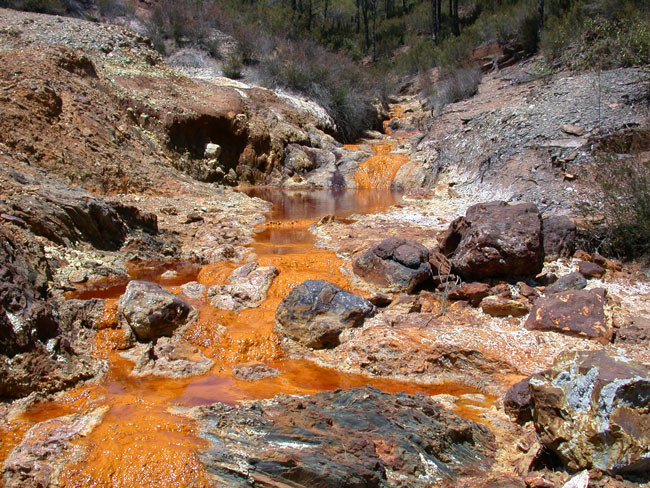
Acid mine drainage
This kind of iron-stained, acidic runoff is a common visible sign of acid mine drainage. Mining also creates dust and particulate matter during blasting, crushing, hauling, and storage. Coal mining is especially linked to four impacts you should be ready to name:
- Habitat destruction
- Groundwater contamination
- Dust particles
- Methane release
Economically, mining provides:
- Jobs
- Tax revenue
- Low-cost energy
- Raw materials for products
But there are long-term costs too, including pollution control, cleanup, health effects, reclamation, and abandoned-mine management. Over time, depletion makes mining both more environmentally intensive and more expensive.
Ways to Reduce Mining Damage
Reclamation means restoring mined land to a stable, usable condition. Common steps usually happen in this order:
- Backfilling excavated areas
- Regrading land to stable contours
- Replacing topsoil
- Controlling erosion
- Replanting vegetation
- Restoring drainage
Progressive reclamation helps by restoring land in sections instead of leaving the whole site disturbed at once.
Other damage-reduction methods include:
- Lined storage and engineered tailings containment
- Monitoring wells, protective covers, and runoff control
- Treating acid mine drainage with limestone or sometimes constructed wetlands
- Reducing dust by wetting roads and covering trucks
- Capturing methane where possible
- Reducing demand for virgin ore through reuse, recycling, repair, and recovering metals from electronics
Key Takeaways
Mining
Removal of economically valuable minerals, ores, and geologic fuels from Earth
Ore
Rock containing a valuable substance at a concentration high enough for profitable extraction under current conditions
Ore Grade
Concentration of the desired substance in ore; recovering the same amount from lower-grade ore requires mining and processing more rock, using more water and energy, and producing more waste and pollution
Surface Mining
Removal of vegetation and large portions of soil and rock to reach a shallow mineral deposit
Overburden
Soil and rock above a mineral deposit that must be removed to reach it; displaced overburden may be called spoil
Strip Mining
Surface mining that clears vegetation and removes overburden in long strips to expose shallow, horizontal deposits; the exposed soil is especially susceptible to erosion
Open-Pit Mining
Surface mining that extracts a broadly distributed deposit by excavating a large, often stepped pit
Mountaintop Removal
Surface coal mining that removes a mountain’s upper portion to expose coal seams, often placing waste in nearby valleys
Heap Leaching
Processing crushed ore on a lined pile with a chemical solution that dissolves and carries away the target metal
Subsurface Mining (Underground Mining)
Extraction of deposits too deep for economical surface mining through shafts, tunnels, and underground chambers; it usually disturbs less surface land but is more complex and expensive
Subsidence
Sinking or collapse of the land surface into underground spaces left by mining
Waste Rock
Excavated rock containing too little valuable material to be processed economically
Tailings
Finely crushed waste left after valuable minerals are separated from ore, often stored as a water-based slurry
Slag
Solid, often glasslike waste formed during high-temperature smelting of concentrated ore
Acid Mine Drainage
Acidic, metal-contaminated water formed when exposed sulfide minerals react with oxygen and water, producing sulfuric acid that dissolves metals
External Costs of Mining
Environmental and social costs not included in mining products’ market prices and instead borne by governments or affected communities
Notes
Mining
Removal of economically valuable minerals, ores, and geologic fuels from Earth
Ore
Rock containing a valuable substance at a concentration high enough for profitable extraction under current conditions
Ore Grade
Concentration of the desired substance in ore; recovering the same amount from lower-grade ore requires mining and processing more rock, using more water and energy, and producing more waste and pollution
Surface Mining
Removal of vegetation and large portions of soil and rock to reach a shallow mineral deposit
Overburden
Soil and rock above a mineral deposit that must be removed to reach it; displaced overburden may be called spoil
Strip Mining
Surface mining that clears vegetation and removes overburden in long strips to expose shallow, horizontal deposits; the exposed soil is especially susceptible to erosion
Open-Pit Mining
Surface mining that extracts a broadly distributed deposit by excavating a large, often stepped pit
Mountaintop Removal
Surface coal mining that removes a mountain’s upper portion to expose coal seams, often placing waste in nearby valleys
Heap Leaching
Processing crushed ore on a lined pile with a chemical solution that dissolves and carries away the target metal
Subsurface Mining (Underground Mining)
Extraction of deposits too deep for economical surface mining through shafts, tunnels, and underground chambers; it usually disturbs less surface land but is more complex and expensive
Subsidence
Sinking or collapse of the land surface into underground spaces left by mining
Waste Rock
Excavated rock containing too little valuable material to be processed economically
Tailings
Finely crushed waste left after valuable minerals are separated from ore, often stored as a water-based slurry
Slag
Solid, often glasslike waste formed during high-temperature smelting of concentrated ore
Acid Mine Drainage
Acidic, metal-contaminated water formed when exposed sulfide minerals react with oxygen and water, producing sulfuric acid that dissolves metals
External Costs of Mining
Environmental and social costs not included in mining products’ market prices and instead borne by governments or affected communities
