Topic 7.7 Notes – Acid Rain
What Acid Deposition Is
Acid deposition includes both wet and dry forms of acidic material reaching Earth’s surface. Acid rain is only the wet form.
A few distinctions matter a lot here:
- Normal rain is already a little acidic, usually about pH 5.6, because atmospheric dissolves in water and forms weak carbonic acid.
- Acid rain usually means precipitation with a pH below about 5.6, not just anything below pH 7.
- The main primary pollutants are nitrogen oxides and sulfur oxides , especially sulfur dioxide .
- The main secondary pollutants are nitric acid , sulfuric acid , plus nitrates and sulfates formed in the air.
The pH scale is logarithmic, which is where students often miss the real size of the change:
A drop of 1 pH unit means 10 times more hydrogen ions. So pH 4.6 is 10 times more acidic than pH 5.6.
Do not mix this up with ocean acidification, which is mostly about oceans absorbing extra atmospheric .
Sources and How It Forms
Acid deposition makes the most sense as a chain of events.
- or is released
- Motor vehicles are a major source.
- Coal-burning power plants are a major source and also emit .
- Other fossil-fuel facilities also contribute.
- Natural sources include volcanoes for , and lightning, wildfires, and soil microbes for .
- Winds carry the pollutants
- They react with oxygen and water vapor in the atmosphere
- They return to Earth by deposition
- Wet deposition includes rain, snow, sleet, fog, and cloud water.
- Dry deposition is acidic gas or particles settling onto soil, plants, water, or buildings.
- Damage depends on acid amount and local buffering capacity
The diagram ties that whole sequence together, from emissions of and to oxidation in the atmosphere and then wet and dry deposition back to Earth.
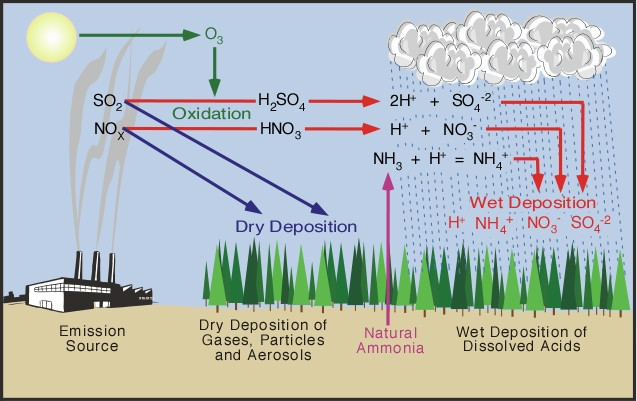
Acid deposition formation and pathways
One detail teachers love to test is spring snowmelt. Acids stored in snow can be released quickly, causing an acidic pulse in runoff. Also, total acid load depends on both pH and how much precipitation falls.
Why Acid Deposition Is a Regional Problem
This is not just a local pollution issue. Pollutants can travel long distances, so the place with damage may be far from the place that emitted them.
In the United States, prevailing winds often move air west to east. That created a classic pattern:
- Source regions were often the Midwest and Ohio River Valley with many coal-burning power plants.
- Receptor regions included the northeastern United States and eastern Canada.
The map below shows that eastward pattern clearly, with much higher wet sulfate deposition across the eastern United States than in the West.
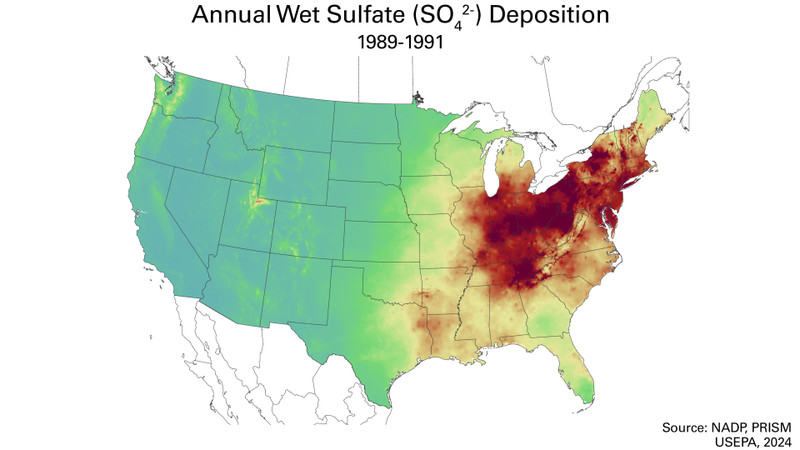
Wet sulfate deposition in the United States
The Adirondack Mountains of New York are the classic example of a downwind area with sensitive lakes and watersheds.
Tall smokestacks can spread pollution farther away. They lower local concentration near the plant, but they do not remove the pollution.
Effects on Soils, Water, and Structures
Soils
Acid deposition lowers soil pH and changes soil chemistry.
- ions displace nutrients like calcium, magnesium, and potassium
- Those nutrients are then leached out of the root zone
- Aluminum becomes more soluble, which can damage roots and reduce nutrient uptake
Forests are often weakened, not instantly killed.
Lakes, ponds, and streams
Acidified runoff lowers water pH, and aluminum can wash into surface waters.
- Fish eggs and juveniles are often the most sensitive
- Reproduction drops
- Gills can be damaged
- Food webs are disrupted
- Species richness falls
A lake can look clear and still be unhealthy.
Buildings and monuments
Acid reacts with limestone and marble, which contain calcium carbonate. That dissolves stone details and damages monuments, gravestones, and buildings. Metals can corrode, and paint/exterior surfaces can wear down too.
Buffering Capacity and Reducing Acid Deposition
Buffering capacity is the ability of soil, water, or rock to neutralize acid. This is why two places with similar deposition can have very different damage.
- Limestone or carbonate-rich soils have high buffering capacity
- Granite and thin soils have low buffering capacity
The neutralization reaction is:
That same reaction protects lakes but slowly wears away limestone structures.
Major solutions target emissions at the source:
- Scrubbers on power plants
- Catalytic converters on vehicles
- Lower-sulfur fuels
- Energy efficiency and less coal use
- Emissions standards and cap-and-trade
The key policy example is the 1990 Clean Air Act amendments, especially the Acid Rain Program.
Liming lakes or soils can temporarily raise pH, but it must be repeated and does not stop emissions.
Key Takeaways
Acid Deposition
Transfer of acidic substances from the atmosphere to Earth’s surface through wet or dry deposition, principally after SO₂ and NOₓ form sulfuric and nitric acids
Acid Rain
The wet form of acid deposition, commonly identified as precipitation below about pH 5.6; ordinary rain is already mildly acidic from dissolved CO₂.
Wet Deposition
Delivery of acidic substances to Earth’s surface in rain, snow, sleet, fog, or cloud water
Dry Deposition
Settling of acidic gases and particles onto surfaces without precipitation, sometimes followed by their being washed into soil or water
Nitrogen Oxides (NOₓ)
Acid-deposition precursors produced mainly by high-temperature combustion in vehicles and power plants; natural sources include lightning, wildfires, and soil microbes
Sulfur Oxides (SOₓ), Especially Sulfur Dioxide (SO₂)
Acid-deposition precursors released especially by burning sulfur-containing coal; volcanoes are a natural source, and atmospheric reactions form sulfuric acid
Leaching
Loss of dissolved soil nutrients as hydrogen ions displace calcium, magnesium, potassium, and other positive ions that percolating water carries from the root zone
Buffering Capacity
A soil or water body’s ability to neutralize added acid; carbonate-rich limestone provides high buffering, while granite and thin soils provide little
Soil Acidification
Lowering of soil pH by acid deposition, causing nutrient leaching and the mobilization of aluminum that can harm plants and aquatic systems
Surface-Water Acidification
Lowering of lake, pond, or stream pH by acid deposition and acidic runoff, harming acid-sensitive organisms and reducing species richness
Notes
Acid Deposition
Transfer of acidic substances from the atmosphere to Earth’s surface through wet or dry deposition, principally after SO₂ and NOₓ form sulfuric and nitric acids
Acid Rain
The wet form of acid deposition, commonly identified as precipitation below about pH 5.6; ordinary rain is already mildly acidic from dissolved CO₂.
Wet Deposition
Delivery of acidic substances to Earth’s surface in rain, snow, sleet, fog, or cloud water
Dry Deposition
Settling of acidic gases and particles onto surfaces without precipitation, sometimes followed by their being washed into soil or water
Nitrogen Oxides (NOₓ)
Acid-deposition precursors produced mainly by high-temperature combustion in vehicles and power plants; natural sources include lightning, wildfires, and soil microbes
Sulfur Oxides (SOₓ), Especially Sulfur Dioxide (SO₂)
Acid-deposition precursors released especially by burning sulfur-containing coal; volcanoes are a natural source, and atmospheric reactions form sulfuric acid
Leaching
Loss of dissolved soil nutrients as hydrogen ions displace calcium, magnesium, potassium, and other positive ions that percolating water carries from the root zone
Buffering Capacity
A soil or water body’s ability to neutralize added acid; carbonate-rich limestone provides high buffering, while granite and thin soils provide little
Soil Acidification
Lowering of soil pH by acid deposition, causing nutrient leaching and the mobilization of aluminum that can harm plants and aquatic systems
Surface-Water Acidification
Lowering of lake, pond, or stream pH by acid deposition and acidic runoff, harming acid-sensitive organisms and reducing species richness
