Topic 4.1 Notes – Plate Tectonics
What Plate Tectonics Is
Earth’s lithosphere is the rigid outer layer made of the crust and uppermost mantle. It is broken into tectonic plates that move slowly over the softer asthenosphere below.
A few core ideas hold the whole topic together:
- A plate is not the same thing as a continent. A plate can carry:
- oceanic lithosphere
- continental lithosphere
- or both
- Plate motion is driven by heat from Earth’s interior.
- Over long time scales, Earth stays in a kind of balance:
- new oceanic crust forms at some boundaries
- old oceanic crust is recycled into the mantle at others
- Most major geologic activity is concentrated at plate boundaries.
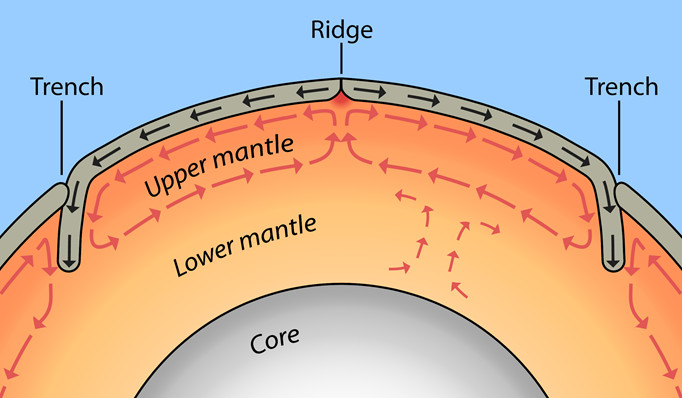
This cross-section ties those ideas together by showing mantle convection, crust forming at a ridge, and older oceanic crust sinking at trenches.
There are three boundary types, and you need to know them together:
- Convergent boundaries: plates move toward each other
- Divergent boundaries: plates move apart
- Transform boundaries: plates slide past each other horizontally
What Each Plate Boundary Produces
All three boundary types can produce earthquakes, so earthquakes alone do not identify the boundary. You have to use the other features too.
Convergent boundaries
These involve compression. Plates push together, causing deformation and often subduction, where one plate sinks beneath another.
Oceanic-continental convergence
The denser oceanic plate subducts beneath the continental plate. This usually creates:
- an offshore trench
- earthquakes
- a continental volcanic mountain chain
Example: Andes Mountains
Oceanic-oceanic convergence
One oceanic plate subducts beneath the other, usually the older, denser one. This produces:
- a trench
- a curved chain of volcanic islands called an island arc
- many earthquakes along the subduction zone
Examples: Mariana Trench, Mariana Islands, Aleutian Islands, Japan
Continental-continental convergence
Neither plate subducts easily because continental crust is relatively buoyant. Instead, the crust crumples and uplifts.
- forms large mountain ranges
- causes strong earthquakes
- has much less subduction-related volcanism
Example: Himalayas
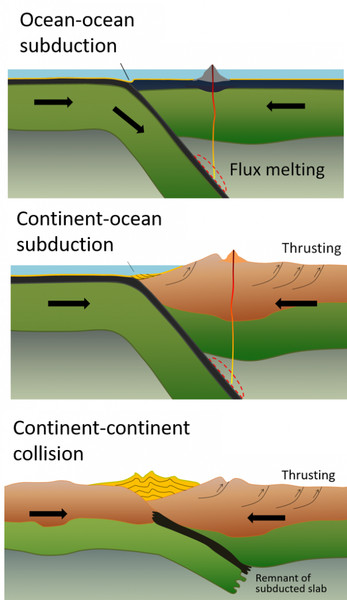
The diagram below compares those three convergent settings. Focus on the middle panel for oceanic-continental subduction and the bottom panel for continental collision.
Divergent boundaries
These involve tension. Plates pull apart, magma rises, and new crust forms.
Oceanic divergence
At a mid-ocean ridge, new basaltic crust forms and seafloor spreading moves older crust away from the ridge.
- youngest seafloor is nearest the ridge
- produces volcanoes and earthquakes
Examples: Mid-Atlantic Ridge, Iceland
Continental divergence
Continental crust stretches, thins, and drops along faults.
- forms rift valleys
- can produce volcanoes and earthquakes
- may eventually open a new ocean basin
Example: East African Rift
Transform boundaries
Here plates slide past each other horizontally.
- mainly produce faults and earthquakes
- do not usually create or destroy much lithosphere
- usually do not form volcanic chains
Example: San Andreas Fault system
How Earthquakes Happen
A fault is a fracture in rock where movement has occurred. Many plate boundaries are fault zones, but not every fault is a plate boundary.
Earthquakes happen through elastic rebound:
- Plate motion applies stress
- Friction locks part of the fault
- Rocks deform and store elastic energy
- Stress exceeds friction or rock strength
- The fault slips suddenly
- Energy is released as seismic waves
This is why earthquakes happen at convergent, divergent, and transform boundaries for different tectonic reasons.
Volcanoes, Hot Spots, and Reading Plate Maps
Most volcanoes occur at convergent subduction zones or divergent boundaries.
- At convergent boundaries, water from the subducting plate helps mantle rock melt.
- At divergent boundaries, melting happens because pressure drops as plates separate.
A hot spot is volcano formation within a plate above rising hot mantle. It is not a fourth boundary type.
Example: Hawaiian Islands
When you read a tectonic map, look for clusters of earthquakes and the type of plate boundary marked there. This map is especially useful for spotting the Pacific Ring of Fire and the arcs along convergent margins.
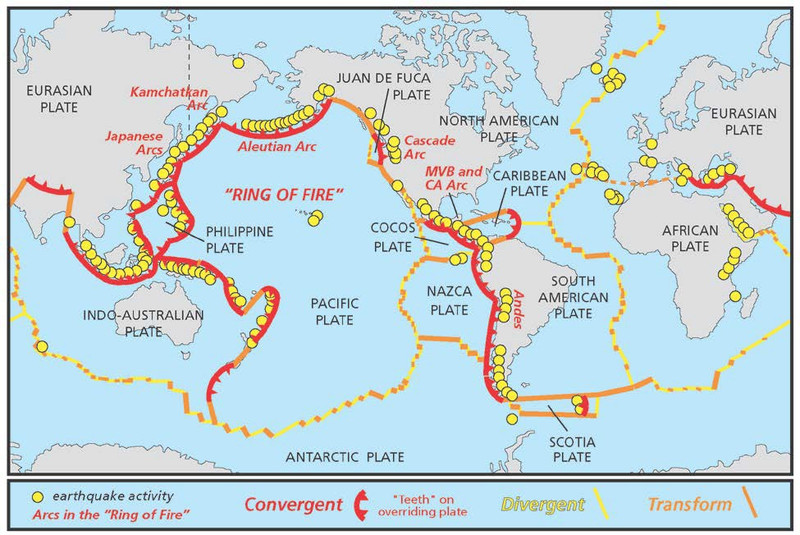
Global tectonic plate map and Pacific Ring of Fire
Map patterns AP loves:
- trench + nearby earthquakes + volcanoes = convergent subduction zone
- curved volcanic islands parallel to trench = oceanic-oceanic island arc
- ridge + shallow earthquakes + volcanism = oceanic divergent boundary
- rift valley + faults + volcanoes = continental divergence
- narrow earthquake line + little volcanism = transform boundary
The Pacific Ring of Fire is the major belt of volcanoes and earthquakes around the Pacific basin, mostly tied to plate boundaries.
Key Takeaways
Plate Tectonics
The model explaining how movement of Earth’s outer solid shell produces major geological features and events
Lithosphere
Earth’s rigid outer layer, consisting of the crust and uppermost solid mantle and divided into tectonic plates
Asthenosphere
The hot, deformable mantle material beneath the lithosphere over which tectonic plates move
Tectonic Plate
A moving section of lithosphere that may contain oceanic lithosphere, continental lithosphere, or both
Plate Boundary
A region where tectonic plates interact and where geological activity is concentrated
Convergent Plate Boundary
A boundary where plates move toward one another, causing compression, deformation, earthquakes, and mountain building
Subduction
The process in which one plate bends and descends beneath another into the mantle
Oceanic–Continental Convergence
Convergence in which denser oceanic lithosphere subducts beneath continental lithosphere, forming an offshore trench, earthquakes, and a continental volcanic mountain chain
Oceanic–Oceanic Convergence
Convergence in which one oceanic plate subducts beneath another, forming a deep-ocean trench, earthquakes, and a volcanic island arc
Continental–Continental Convergence
Collision of two buoyant continental masses that compresses, folds, thickens, and uplifts crust into large mountain ranges and causes strong earthquakes
Deep-Ocean Trench
A long, deep seafloor depression formed where an oceanic plate bends downward into a subduction zone
Island Arc
A curved chain of volcanic islands formed on the overriding plate at an oceanic–oceanic subduction boundary
Divergent Plate Boundary
A boundary where plates move apart and rising magma forms new crust, with volcanism, faulting, and earthquakes
Oceanic Divergence
Separation of oceanic plates as magma rises and solidifies into new oceanic crust along a mid-ocean ridge
Mid-Ocean Ridge
An underwater mountain system at an oceanic divergent boundary where rising magma creates new oceanic crust
Seafloor Spreading
The production of new oceanic crust at a mid-ocean ridge and its outward movement away from the ridge
Continental Divergence
Separation of continental lithosphere that stretches and thins the crust, producing faults, rift valleys, volcanoes, and earthquakes
Rift Valley
An elongated depression formed when stretching continental crust causes blocks to drop along faults
Transform Plate Boundary
A boundary where plates slide horizontally past one another without creating or destroying substantial lithosphere, commonly producing earthquakes
Fault
A fracture or zone of fractures in rock along which movement has occurred
Earthquake
Sudden fault movement and release of stored elastic energy when stress overcomes friction or rock strength
Elastic Rebound
The process in which stress deforms rocks around a locked fault until sudden slip releases stored energy and the rocks rebound toward a less strained shape
Focus / Hypocenter
The point within Earth where an earthquake rupture begins
Epicenter
The point on Earth’s surface directly above an earthquake’s focus
Hot Spot
A localized area where unusually hot mantle material rises and produces magma beneath a plate, potentially forming a volcanic chain as the plate moves
Pacific Ring of Fire
A broad belt of frequent earthquakes and volcanoes around the Pacific Ocean that largely follows plate boundaries, especially convergent subduction boundaries
Notes
Plate Tectonics
The model explaining how movement of Earth’s outer solid shell produces major geological features and events
Lithosphere
Earth’s rigid outer layer, consisting of the crust and uppermost solid mantle and divided into tectonic plates
Asthenosphere
The hot, deformable mantle material beneath the lithosphere over which tectonic plates move
Tectonic Plate
A moving section of lithosphere that may contain oceanic lithosphere, continental lithosphere, or both
Plate Boundary
A region where tectonic plates interact and where geological activity is concentrated
Convergent Plate Boundary
A boundary where plates move toward one another, causing compression, deformation, earthquakes, and mountain building
Subduction
The process in which one plate bends and descends beneath another into the mantle
Oceanic–Continental Convergence
Convergence in which denser oceanic lithosphere subducts beneath continental lithosphere, forming an offshore trench, earthquakes, and a continental volcanic mountain chain
Oceanic–Oceanic Convergence
Convergence in which one oceanic plate subducts beneath another, forming a deep-ocean trench, earthquakes, and a volcanic island arc
Continental–Continental Convergence
Collision of two buoyant continental masses that compresses, folds, thickens, and uplifts crust into large mountain ranges and causes strong earthquakes
Deep-Ocean Trench
A long, deep seafloor depression formed where an oceanic plate bends downward into a subduction zone
Island Arc
A curved chain of volcanic islands formed on the overriding plate at an oceanic–oceanic subduction boundary
Divergent Plate Boundary
A boundary where plates move apart and rising magma forms new crust, with volcanism, faulting, and earthquakes
Oceanic Divergence
Separation of oceanic plates as magma rises and solidifies into new oceanic crust along a mid-ocean ridge
Mid-Ocean Ridge
An underwater mountain system at an oceanic divergent boundary where rising magma creates new oceanic crust
Seafloor Spreading
The production of new oceanic crust at a mid-ocean ridge and its outward movement away from the ridge
Continental Divergence
Separation of continental lithosphere that stretches and thins the crust, producing faults, rift valleys, volcanoes, and earthquakes
Rift Valley
An elongated depression formed when stretching continental crust causes blocks to drop along faults
Transform Plate Boundary
A boundary where plates slide horizontally past one another without creating or destroying substantial lithosphere, commonly producing earthquakes
Fault
A fracture or zone of fractures in rock along which movement has occurred
Earthquake
Sudden fault movement and release of stored elastic energy when stress overcomes friction or rock strength
Elastic Rebound
The process in which stress deforms rocks around a locked fault until sudden slip releases stored energy and the rocks rebound toward a less strained shape
Focus / Hypocenter
The point within Earth where an earthquake rupture begins
Epicenter
The point on Earth’s surface directly above an earthquake’s focus
Hot Spot
A localized area where unusually hot mantle material rises and produces magma beneath a plate, potentially forming a volcanic chain as the plate moves
Pacific Ring of Fire
A broad belt of frequent earthquakes and volcanoes around the Pacific Ocean that largely follows plate boundaries, especially convergent subduction boundaries
