Topic 7.6 Notes – Reduction of Air Pollutants
How Air Pollutants Are Reduced at the Source
This topic is about reducing emissions, not just moving pollution somewhere else. A taller smokestack can spread pollution over a wider area, but the same total amount is still released.
There are five ways this happens:
- Prevention means using less fuel or energy, so fewer pollutants form in the first place.
- Substitution means switching to a cleaner fuel or energy source.
- Capture means trapping pollutants before they escape.
- Conversion means changing harmful chemicals into less harmful ones.
- Regulation means laws and standards that make the other four happen.
This also connects to secondary pollutants. If you reduce primary pollutants like VOCs and NOx, you also reduce the ingredients needed to form photochemical smog and ground-level ozone.
Main Ways to Reduce Air Pollution
Regulatory practices
Governments reduce pollution by setting:
- ambient air standards for outdoor air quality
- emission limits for cars, factories, and power plants
- fuel standards such as sulfur or lead limits
- permits, monitoring, and reporting
- required control technologies
In the U.S., the key framework is the Clean Air Act, enforced by the EPA.
Important examples:
- Leaded gasoline phaseout reduced atmospheric lead and also protected catalytic converters, since lead damages the catalyst.
- Sulfur dioxide allowance trading under the 1990 Clean Air Act amendments capped total SO₂ emissions and let power plants trade allowances.
Regulation only works when monitoring and enforcement are real.
Conservation and efficiency
When less fuel is burned, fewer pollutants are produced.
Transportation examples
- public transit, carpooling, walking, cycling
- fewer trips
- fuel-efficient vehicles
- engine maintenance
Energy examples
- insulation and weather sealing
- efficient lights and appliances
- thermostat changes
- less electricity use
- waste-heat recovery in industry
These can cut several pollutants at once, depending on the fuel being avoided.
Alternative fuels and energy sources
What matters on APES is which pollutant goes down.
- Low-sulfur coal or diesel lowers SO₂
- Natural gas usually lowers SO₂ and particulate matter compared with coal, but still emits CO₂ and NOx
- Wind, solar, hydroelectric, geothermal avoid many combustion emissions during operation
- Electric vehicles have no tailpipe emissions, but power plant emissions may still exist upstream
- Hydrogen fuel cells release water at point of use, but making hydrogen can still create emissions
- Biofuels reduce petroleum use, but burning them still releases pollutants
Pollution Control Devices and What Each One Targets
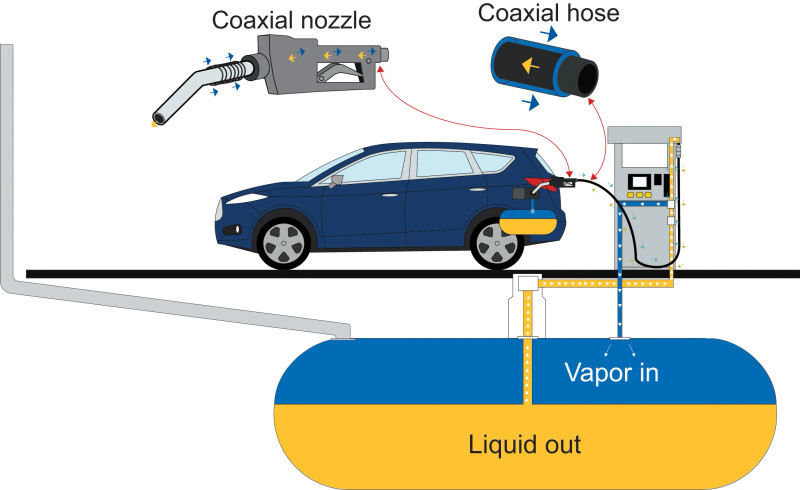
Vapor recovery nozzles
These are on gasoline pumps. They capture gasoline vapors during refueling and send them back to storage. The diagram here shows vapors being pulled back through the hose instead of escaping into the air. That cuts VOCs, which helps reduce smog precursors. They do not treat tailpipe exhaust.
Catalytic converters
These are in vehicle exhaust systems. The honeycomb catalyst in the converter changes harmful exhaust gases into less harmful products. They convert:
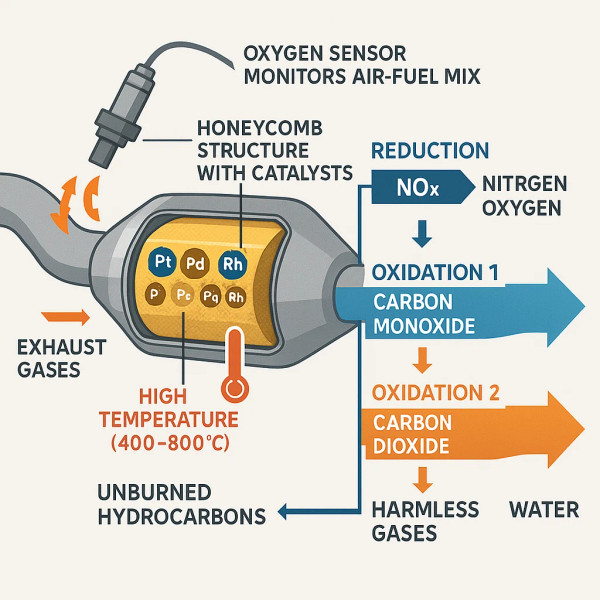
- CO into CO₂
- NOx into N₂ and O₂
- hydrocarbons into CO₂ and H₂O
Limits you should know:
- they do not remove CO₂
- they work poorly when cold
- lead can damage them
Wet and dry scrubbers
These treat industrial exhaust, especially from coal-burning power plants.
- Wet scrubbers use water or alkaline slurry to remove particulates and gases, especially SO₂
- Dry scrubbers use dry or slightly wet alkaline reagents that react with acidic gases to form collectible solids
Both create waste like sludge, wastewater, or solids that must be handled.
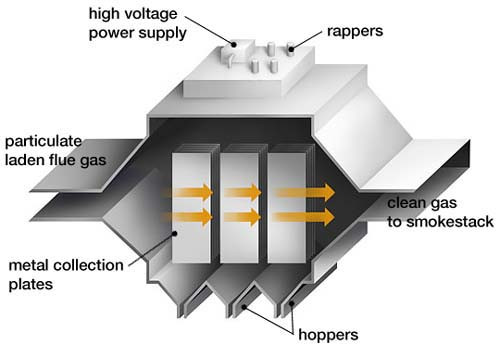
Electrostatic precipitators
These remove particulate matter such as fly ash from smokestacks. In the diagram, particles stick to collection plates and then fall into hoppers below. They do not remove gases like SO₂, CO, or NOx.
Matching the Control to the Pollutant
The best APES reasoning is to match the device to the pollutant’s form.
- vapor recovery nozzle → VOCs from refueling
- catalytic converter → CO, NOx, hydrocarbons in vehicle exhaust
- scrubber → gases and/or particulates in industrial exhaust
- electrostatic precipitator → particulate matter from smokestacks
Coal plants often use both scrubbers and electrostatic precipitators because one device cannot remove everything.
Limits, Trade-Offs, and Evaluating Effectiveness
No single method removes every pollutant. Many controls still allow fossil-fuel use, so CO₂ emissions may continue.
Pollution control also has costs:
- energy use
- maintenance
- equipment cost
- another waste stream to manage
To measure performance, use percent removal:
A high percent removal still does not mean zero emissions.
Key Takeaways
Source Reduction
Preventing pollutants from being produced or capturing or converting them before they enter the atmosphere
Regulatory Practices
Government standards, permits, monitoring, required controls, and incentives used to limit air pollution
Clean Air Act of 1970
Federal law that established the modern U.S. air-pollution program and authorized the EPA to set and enforce air-quality and emission standards
1990 Clean Air Act Amendments
Expansion of the Clean Air Act that included a cap-and-trade allowance system for sulfur dioxide emissions from power plants
National Ambient Air Quality Standards (NAAQS)
Federal outdoor-air standards for CO, lead, NO₂, ground-level ozone, particulate matter, and SO₂.
Emission Allowance Trading (Cap-and-Trade)
A system that caps total emissions and lets sources buy, sell, or use allowances, rewarding facilities that reduce emissions
Conservation and Energy Efficiency
Reducing fuel and electricity demand so fewer pollutants are produced through combustion
Alternative Fuels and Energy Sources (Fuel Substitution)
Replacing a highly polluting fuel or process with a lower-emission fuel or noncombustion energy source
Vapor Recovery Nozzle
A gasoline-pump device that returns displaced VOC-containing fuel vapors from a vehicle tank to the station’s storage system
Catalytic Converter (Three-Way Catalytic Converter)
An engine-exhaust device that converts CO, NOₓ, and hydrocarbons into less harmful CO₂, N₂, O₂, and H₂O.
Wet Scrubber
An industrial-exhaust device that uses water or an alkaline slurry to capture particles and dissolve or react with gases such as SO₂.
Dry Scrubber
An industrial-exhaust device that uses a dry or nearly dry alkaline reagent to convert acidic gases into collectible solid particles
Electrostatic Precipitator
A device that electrically charges particles in industrial exhaust, attracts them to collection plates, and drops them into hoppers
Percent Removal (Removal Efficiency)
(pollutant entering − pollutant leaving) ÷ pollutant entering × 100
Notes
Source Reduction
Preventing pollutants from being produced or capturing or converting them before they enter the atmosphere
Regulatory Practices
Government standards, permits, monitoring, required controls, and incentives used to limit air pollution
Clean Air Act of 1970
Federal law that established the modern U.S. air-pollution program and authorized the EPA to set and enforce air-quality and emission standards
1990 Clean Air Act Amendments
Expansion of the Clean Air Act that included a cap-and-trade allowance system for sulfur dioxide emissions from power plants
National Ambient Air Quality Standards (NAAQS)
Federal outdoor-air standards for CO, lead, NO₂, ground-level ozone, particulate matter, and SO₂.
Emission Allowance Trading (Cap-and-Trade)
A system that caps total emissions and lets sources buy, sell, or use allowances, rewarding facilities that reduce emissions
Conservation and Energy Efficiency
Reducing fuel and electricity demand so fewer pollutants are produced through combustion
Alternative Fuels and Energy Sources (Fuel Substitution)
Replacing a highly polluting fuel or process with a lower-emission fuel or noncombustion energy source
Vapor Recovery Nozzle
A gasoline-pump device that returns displaced VOC-containing fuel vapors from a vehicle tank to the station’s storage system
Catalytic Converter (Three-Way Catalytic Converter)
An engine-exhaust device that converts CO, NOₓ, and hydrocarbons into less harmful CO₂, N₂, O₂, and H₂O.
Wet Scrubber
An industrial-exhaust device that uses water or an alkaline slurry to capture particles and dissolve or react with gases such as SO₂.
Dry Scrubber
An industrial-exhaust device that uses a dry or nearly dry alkaline reagent to convert acidic gases into collectible solid particles
Electrostatic Precipitator
A device that electrically charges particles in industrial exhaust, attracts them to collection plates, and drops them into hoppers
Percent Removal (Removal Efficiency)
(pollutant entering − pollutant leaving) ÷ pollutant entering × 100
