Topic 7.2 Notes – Photochemical Smog
What Photochemical Smog Is
Photochemical smog is a mixture of secondary pollutants that forms in the troposphere when nitrogen oxides and VOCs react in sunlight and heat.
A quick reminder helps here:
- Primary pollutants are emitted directly into the air.
- Secondary pollutants form in the atmosphere after reactions happen.
Photochemical smog matters because it is not emitted fully formed. Cars do not release “smog” or ozone directly. They release the ingredients.
The core relationship is:
You may also hear it called brown smog or Los Angeles-type smog. The brown haze is partly due to nitrogen dioxide, and the photo below shows the kind of urban haze that gave Los Angeles-type smog its name.
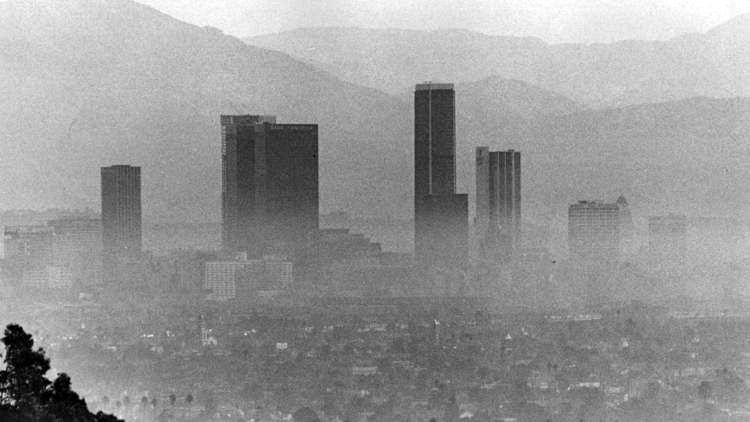
Los Angeles smog over an urban basin
Keep it separate from gray industrial smog, which comes more from coal burning, sulfur dioxide, particulates, and cool humid air.
One AP trap shows up all the time. Ground-level ozone is harmful pollution, but stratospheric ozone is the protective ozone layer. Same molecule, different place, different effect.
The Main Precursors and Products
Nitrogen oxides
NOx means nitrogen oxides, especially NO and NO₂.
They form mainly during high-temperature combustion, so big human sources are:
- Motor vehicles
- Fossil-fuel power plants
- Industrial boilers
- Off-road engines
Nitrogen oxides are often highest early in the day, especially during morning traffic.
Volatile organic compounds
VOCs are carbon-containing compounds that evaporate or sublime at room temperature.
Illustrative examples you should know:
- Formaldehyde
- Gasoline
Major human sources include:
- Gasoline vapors
- Vehicle exhaust
- Solvents, paints, and adhesives
- Industrial emissions
A natural source also matters on tests. Trees and other vegetation release VOCs too.
Main products
The atmosphere turns those precursors into:
- Ground-level ozone
- Nitrogen dioxide
- Aldehydes and other oxidized organics
- PANs and other photochemical oxidants
How Smog Forms and Why It Peaks Later
This daily pattern is one of the most tested parts of the topic.
- Morning traffic releases lots of NOx and VOCs.
- As the sun gets stronger, reactions involving NO₂ speed up.
- Oxygen and sunlight help form ozone.
- VOCs let ozone build up instead of getting used up quickly in the NO-NO₂ cycle.
- After several hours of reaction time, ozone peaks in the afternoon.
So the key point is simple. Ozone is not emitted directly by cars. It forms later.
Patterns to remember:
- Daily
- NOx higher early
- Ozone peaks later
- Ozone drops after sunset as photochemical production slows
- Seasonal
- Smog is usually worse in summer because of stronger sunlight, warmer temperatures, and faster VOC evaporation
- Urban and downwind
- Smog often starts in cities with many vehicles
- Ozone can be carried downwind, so highest levels may occur away from the original source
What Affects Smog Severity
Several conditions control how bad an episode gets:
- Sunlight increases photochemical reactions.
- Temperature speeds reactions and raises VOC evaporation.
- Precursor concentration matters because more NOx and VOCs mean more smog potential.
- Wind and mixing can disperse pollution, but can also move ozone downwind.
- Topography like mountains and basins traps polluted air.
- Thermal inversions trap pollutants near the ground.
- Precipitation and storm mixing usually reduce smog.
The classic example is Los Angeles. Heavy traffic, sunny warm weather, and basin topography make it a classic smog city.
Effects and Ways to Reduce It
Human health effects include:
- Respiratory problems
- Eye irritation
- Coughing, wheezing, chest discomfort
- Shortness of breath
- Worsened asthma and lower lung function
Environmental effects include:
- Reduced visibility
- Plant damage from ozone
- Lower photosynthesis
- Slower growth
- Reduced crop yields
Reducing smog means cutting both precursor groups.
Reducing nitrogen oxides
- Less vehicle use, public transit, carpooling
- Catalytic converters
- Vehicle emission standards and engine maintenance
- Lower-emission electricity and industrial controls
Reducing VOCs
- Vapor recovery at gas stations
- Sealed fuel storage
- Low-VOC paints, solvents, and products
- Industrial leak detection and emission controls
The prevention idea ties the whole topic together. Lower morning and daytime NOx and VOC emissions, and you lower afternoon ozone peaks.
Key Takeaways
Photochemical Smog (Brown Smog; Los Angeles–Type Smog)
Brownish pollutant mixture formed when NOₓ and VOCs react in the sunlit lower atmosphere, producing ground-level ozone and other photochemical oxidants
Nitrogen Oxides (NOₓ)
Nitrogen compounds, especially NO and NO₂, produced mainly by high-temperature combustion and acting as primary precursors of photochemical smog
Volatile Organic Compounds (VOCs)
Carbon-containing compounds that readily evaporate or sublime near room temperature; gasoline, formaldehyde, solvents, and tree emissions provide smog-forming VOCs
Tropospheric Ozone (Ground-Level Ozone)
Harmful secondary O₃ formed in the lower atmosphere by sunlight-driven reactions involving NOₓ and VOCs; a major component of photochemical smog
Notes
Photochemical Smog (Brown Smog; Los Angeles–Type Smog)
Brownish pollutant mixture formed when NOₓ and VOCs react in the sunlit lower atmosphere, producing ground-level ozone and other photochemical oxidants
Nitrogen Oxides (NOₓ)
Nitrogen compounds, especially NO and NO₂, produced mainly by high-temperature combustion and acting as primary precursors of photochemical smog
Volatile Organic Compounds (VOCs)
Carbon-containing compounds that readily evaporate or sublime near room temperature; gasoline, formaldehyde, solvents, and tree emissions provide smog-forming VOCs
Tropospheric Ozone (Ground-Level Ozone)
Harmful secondary O₃ formed in the lower atmosphere by sunlight-driven reactions involving NOₓ and VOCs; a major component of photochemical smog
