Topic 3.5 Notes – Population Growth and Resource Availability
What Resource Availability Means for Population Growth
A population changes through births, deaths, immigration, and emigration, but here the key idea is that resources affect whether organisms survive and reproduce in the first place.
Total resource base means the total amount, or rate of supply, of needed resources in an environment.
Resource availability means the part organisms can actually use.
That difference matters a lot. A resource can exist and still be unavailable if it is:
- polluted
- frozen
- defended by other organisms
- fragmented by habitat loss
- outside an organism’s territory
- otherwise unusable
Resources and usable space are finite, even when they are renewable. Renewable just means replenished over time, not unlimited.
Common limiting resources and space needs include:
- Food or nutrients for energy and growth
- Freshwater for metabolism and survival
- Light for photosynthetic organisms
- Oxygen for respiration
- Soil nutrients for plant growth
- Shelter for protection
- Nesting or breeding sites for reproduction
- Territory for animals that defend area
- Living, feeding, or reproductive space for both plants and animals
Environmental conditions also change how useful resources are:
- Temperature
- Precipitation
- Salinity
- Disturbance such as fire or flood
Those limits help explain why populations do not all grow the same way. When resources are abundant, growth can look exponential for a time. As limiting factors become stronger, population growth levels off near carrying capacity.
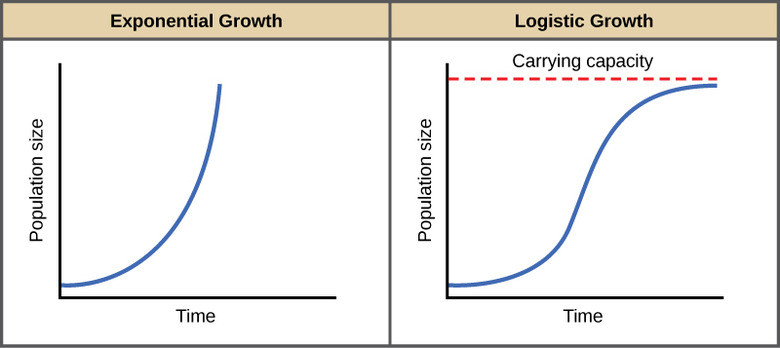
Exponential vs. logistic population growth
What Makes Resources Limiting
A population is limited by the essential resource in shortest supply relative to demand. If food is plentiful but nesting sites are full, adding more food will not increase growth.
Resource distribution matters too. When resources shrink, access becomes less equal. Dominant individuals or organisms in better territories may get enough, while others do not.
Intraspecific competition
This is competition within the same species. It is often intense because individuals need nearly the same resources.
Interspecific competition
This is competition between different species for the same limited resource.
Space can also be limiting even when food is still available:
- animals may need territory
- plants compete for root space, light, and soil moisture
- some species need specific breeding habitat, like cliff ledges or spawning areas
Resource availability can drop because of:
- depletion by the population itself
- increasing population size
- competition
- drought, winter, fire, flood, or other disturbances
- seasonal change
- habitat loss, degradation, or fragmentation
- pollution that makes resources unusable
How Resource Availability Changes Growth
When resources are abundant compared with population size:
- survival increases
- fecundity increases
- individuals may mature sooner or produce more offspring
- population growth accelerates
When resources become scarce:
- organisms spend more energy getting resources
- fecundity drops
- mortality rises directly through starvation, dehydration, or exposure
- mortality also rises indirectly through disease, predation, and stress
- growth slows, stops, or becomes negative
That causal chain shows up all over APES. One detail students miss is that slower growth does not mean the population is shrinking. It may still be increasing, just less quickly.
Exponential Growth, Logistic Growth, and Carrying Capacity
Exponential growth
With abundant resources and space, populations can grow near their intrinsic rate of increase, . This produces a J-shaped curve.
The same proportion is added each time interval, so the actual number added gets bigger over time.
Logistic growth
As resources become limiting, growth shifts to logistic growth, which forms an S-shaped curve. Growth starts fast, then slows as density rises.
Carrying capacity, , is the maximum population size the environment can sustain over time. At , births and deaths are roughly balanced, so net growth is about zero.
Environmental resistance
This is the combined effect of limiting factors such as resource scarcity, competition, disease, predation, limited territory, and physical conditions.
Carrying capacity can change
rises with more usable habitat, food, or water. It falls with drought, habitat destruction, depletion, or new competition. A resource-based estimate may suggest one support level, but another factor may set the real limit lower.
Overshoot, Dieback, and Reading Population Graphs
Overshoot happens when a population temporarily exceeds carrying capacity. This usually comes from time lags. Reproduction responds to earlier good conditions, but resource depletion shows up later.
Dieback is a major decline after overshoot or resource loss. Overshoot can even damage the resource base and lower itself.
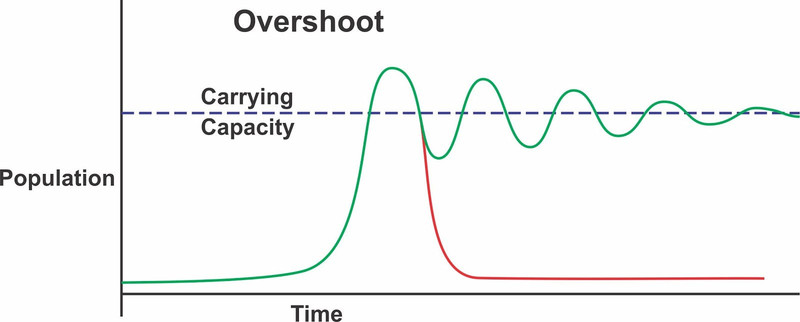
Overshoot and dieback on a population graph
On a graph, overshoot shows up when the population rises above the carrying capacity line, and dieback shows up as the drop that follows. Some populations then oscillate around carrying capacity for a while, and others crash much more sharply.
The classic example is St. Matthew Island reindeer. Reindeer had abundant lichen and no major predators, so the population grew rapidly. Then lichen was depleted, a harsh winter hit, and the population crashed.
Reading graphs
- J-shaped curve = accelerating growth with temporarily abundant resources
- S-shaped curve = growth slowing near carrying capacity
- Plateau = net growth near zero, not zero births and deaths
- Curve above then falling = overshoot followed by decline
- Falling line = worsening conditions or declining resource base
Key Takeaways
Total Resource Base (Resource Base)
The total amount or rate of supply of resources capable of supporting a population
Resource Availability
The portion of the resource base that members of a population can actually access and use
Limiting Factor
An environmental condition or scarce resource that restricts population growth; another abundant resource cannot compensate for it
Fecundity
An individual’s or population’s reproductive output or capacity to produce offspring
Mortality
The incidence of death in a population
Density Dependence
A relationship in which a limiting factor’s effect becomes stronger as population density increases
Intraspecific Competition
Competition among members of the same species for limited resources
Interspecific Competition
Competition between different species that use the same limited resource
Intrinsic Rate of Increase (r)
The potential per-capita rate of population increase under favorable conditions, reflecting reproduction minus mortality
Exponential Growth
Growth by approximately the same proportion per interval, producing increasing absolute additions and a J-shaped curve; Nₜ = N₀(1 + r)ᵗ.
Logistic Growth
S-shaped growth that slows as limiting factors intensify and the population approaches carrying capacity
Carrying Capacity (K)
The maximum population size an environment can sustain over time under its current conditions and resource base
Environmental Resistance
The combined effect of limiting factors that prevent a population from reaching its unrestricted growth potential
Overshoot
A temporary increase of a population above its carrying capacity
Time Lag in Population Response
A delay between a resource change and the resulting change in population size, mortality, or reproduction
Dieback
A substantial population decline following overshoot or a major reduction in resource availability
Notes
Total Resource Base (Resource Base)
The total amount or rate of supply of resources capable of supporting a population
Resource Availability
The portion of the resource base that members of a population can actually access and use
Limiting Factor
An environmental condition or scarce resource that restricts population growth; another abundant resource cannot compensate for it
Fecundity
An individual’s or population’s reproductive output or capacity to produce offspring
Mortality
The incidence of death in a population
Density Dependence
A relationship in which a limiting factor’s effect becomes stronger as population density increases
Intraspecific Competition
Competition among members of the same species for limited resources
Interspecific Competition
Competition between different species that use the same limited resource
Intrinsic Rate of Increase (r)
The potential per-capita rate of population increase under favorable conditions, reflecting reproduction minus mortality
Exponential Growth
Growth by approximately the same proportion per interval, producing increasing absolute additions and a J-shaped curve; Nₜ = N₀(1 + r)ᵗ.
Logistic Growth
S-shaped growth that slows as limiting factors intensify and the population approaches carrying capacity
Carrying Capacity (K)
The maximum population size an environment can sustain over time under its current conditions and resource base
Environmental Resistance
The combined effect of limiting factors that prevent a population from reaching its unrestricted growth potential
Overshoot
A temporary increase of a population above its carrying capacity
Time Lag in Population Response
A delay between a resource change and the resulting change in population size, mortality, or reproduction
Dieback
A substantial population decline following overshoot or a major reduction in resource availability
