Topic 6.5 Notes – Fossil Fuels
What Fossil Fuels Are and Why They Release Energy
Fossil fuels are nonrenewable energy resources formed from ancient organic matter over millions of years. They are nonrenewable because we burn them far faster than Earth can remake them.
The three major fossil fuels are:
- Coal
A carbon-rich solid formed mainly from ancient land plants. - Petroleum
A liquid mixture of hydrocarbons. It is drilled out of the ground and then refined into usable fuels like gasoline and diesel. - Natural gas
A gaseous fuel, mostly methane . It burns more cleanly than coal or petroleum, but it still causes pollution.
What all three have in common is stored chemical potential energy in their carbon-containing bonds. When those bonds are broken and new bonds form during combustion, energy is released.
Methane is the standard example:
This is an exothermic reaction, which means it releases energy, mostly as heat.
A common test point is complete vs. incomplete combustion:
- Complete combustion happens with enough oxygen and mainly makes carbon dioxide and water.
- Incomplete combustion happens when oxygen is limited and can make carbon monoxide and unburned hydrocarbons.
From Combustion to Electricity
Most fossil-fuel power plants are thermal power plants. The fuel does not become electricity directly. It becomes heat first.
A coal-fired steam plant follows the sequence shown here:
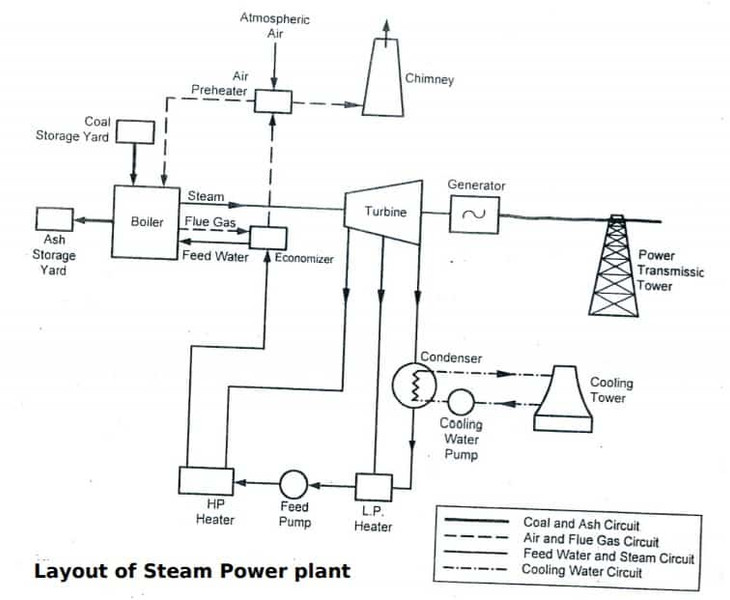
Steam power plant layout
Here’s the full sequence:
- Burn fuel
- Release heat
- Boil water into steam
- Steam spins a turbine
- Turbine spins a generator
- Generator produces electricity
- Steam is cooled, condensed, and reused
The energy changes are:
chemical energy → thermal energy → mechanical energy → electrical energy
One detail students mix up all the time:
- Turbine = provides motion
- Generator = turns that motion into electricity
Power plants are not 100% efficient. Some energy leaves as waste heat in exhaust gases and cooling water.
Natural gas can also work a little differently:
- In a gas turbine, hot combustion gases spin the turbine directly.
- In a combined-cycle system, that hot exhaust is used to make steam for a second turbine, which increases efficiency.
How Fossil Fuels Are Extracted
Extraction depends on the fuel.
Coal
Coal is mined by:
- Surface mining
Includes strip mining, open-pit mining, and mountaintop removal. Major impacts include habitat loss, erosion, sediment runoff, and land damage. - Subsurface mining
Uses shafts and tunnels. It can cause land subsidence and acidic drainage when exposed sulfur minerals react with water and oxygen.
Petroleum and natural gas
These are usually obtained by drilling wells on land or offshore. Conventional deposits are often in porous rock beneath an impermeable layer.
Major impacts include:
- habitat disturbance
- leaks and pipeline failures
- contamination from drilling fluids or produced water
- oil spills
Hydraulic fracturing
Fracking is used for oil and natural gas trapped in low-permeability rock such as shale.
The basic process is:
- Drill vertically
- Often turn horizontally
- Add steel casing and cement
- Inject high-pressure fluid
- Crack the rock
- Fuel flows back to the well
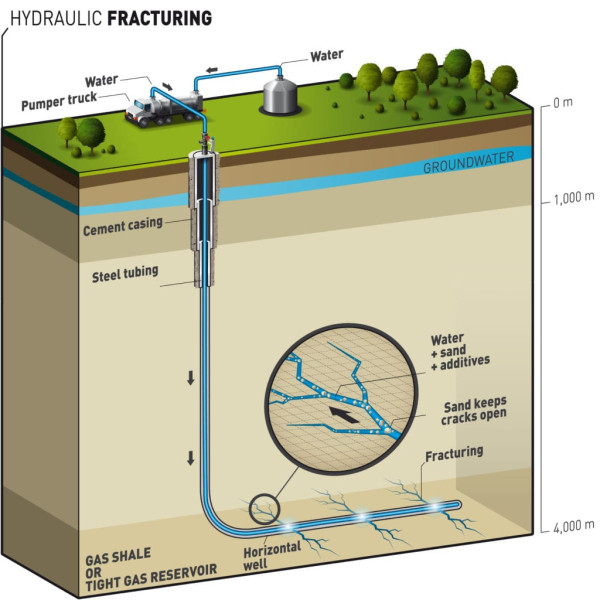
Hydraulic fracturing
Fracking fluid contains water, sand, and chemical additives.
Major fracking concerns:
- Groundwater contamination
- defective casing or cement
- chemical spills
- spills of flowback or produced water
- improper wastewater disposal
- methane migration
- VOCs released from wells, tanks, compressors, wastewater, and loading operations
VOCs can be toxic and help form ground-level ozone - other effects include habitat fragmentation, high water use, methane leakage, and induced seismicity
Environmental Effects of Burning Fossil Fuels
Burning fossil fuels moves carbon from geologic storage into the atmosphere.
- Carbon dioxide
All fossil fuels release it. It strengthens the greenhouse effect and contributes to climate change. Per unit of energy, coal emits the most, petroleum is in the middle, and natural gas emits the least. - Sulfur dioxide
Mostly comes from sulfur impurities in coal and petroleum. It contributes to respiratory irritation, sulfate particulates, and acid deposition. - Nitrogen oxides
Form during high-temperature combustion. They contribute to smog, ground-level ozone, acid deposition, respiratory problems, and fine particulates. - Particulate matter, carbon monoxide, and hazardous substances
Coal can release soot, fly ash, fine particles, and mercury. Incomplete combustion can release carbon monoxide. - Solid waste and water impacts
Coal combustion produces bottom ash and fly ash, which can contaminate soil or water. Thermal power plants use lots of cooling water, and warm discharge can cause thermal pollution and lower dissolved oxygen.
Comparing Coal, Petroleum, and Natural Gas
| Fuel | Main strength | Main environmental issues |
|---|---|---|
| Coal | Reliable for continuous electricity | Highest air pollution and carbon emissions; major mining damage |
| Petroleum | Very useful liquid transportation fuel | Air pollution from burning; spills during drilling and transport |
| Natural gas | Lowest emissions of the three; little or ash | Still emits and ; methane leakage and fracking impacts matter |
One rule helps on almost every question here. Keep extraction impacts separate from combustion impacts. A fuel can burn more cleanly at the power plant and still cause serious environmental damage when it is extracted.
Key Takeaways
Combustion
An exothermic reaction in which fuel reacts with oxygen, releasing energy; complete hydrocarbon combustion produces CO₂ and H₂O.
Complete vs. Incomplete Combustion
Complete combustion has sufficient oxygen and chiefly produces CO₂ and H₂O; incomplete combustion can produce toxic CO and unburned hydrocarbons
Thermal Power Plant
Burns fossil fuel to heat water into steam; the steam spins a turbine that drives a generator, converting chemical energy → thermal energy → mechanical energy → electrical energy
Gas Turbine
A turbine spun directly by hot combustion gases, commonly using natural gas to drive a generator
Combined-Cycle Power Plant
Uses a gas turbine first, then uses its hot exhaust to make steam that drives a second turbine, increasing efficiency
Surface Mining
Removal of overburden—soil and rock—to expose shallow coal deposits, causing substantial land and habitat disturbance
Subsurface Mining
Use of shafts and tunnels to reach deep coal deposits, with risks including worker hazards, subsidence, and acidic drainage
Conventional Drilling
Drilling a well into porous rock beneath an impermeable layer to recover accumulated petroleum or natural gas
Hydraulic Fracturing (Fracking)
High-pressure water, sand, and chemicals fracture low-permeability rock so oil or gas can enter a well; it can contaminate groundwater and release VOCs
Volatile Organic Compounds (VOCs)
Carbon-containing chemicals that readily evaporate; fracking operations can emit them, and some are toxic or help form ground-level ozone
Notes
Combustion
An exothermic reaction in which fuel reacts with oxygen, releasing energy; complete hydrocarbon combustion produces CO₂ and H₂O.
Complete vs. Incomplete Combustion
Complete combustion has sufficient oxygen and chiefly produces CO₂ and H₂O; incomplete combustion can produce toxic CO and unburned hydrocarbons
Thermal Power Plant
Burns fossil fuel to heat water into steam; the steam spins a turbine that drives a generator, converting chemical energy → thermal energy → mechanical energy → electrical energy
Gas Turbine
A turbine spun directly by hot combustion gases, commonly using natural gas to drive a generator
Combined-Cycle Power Plant
Uses a gas turbine first, then uses its hot exhaust to make steam that drives a second turbine, increasing efficiency
Surface Mining
Removal of overburden—soil and rock—to expose shallow coal deposits, causing substantial land and habitat disturbance
Subsurface Mining
Use of shafts and tunnels to reach deep coal deposits, with risks including worker hazards, subsidence, and acidic drainage
Conventional Drilling
Drilling a well into porous rock beneath an impermeable layer to recover accumulated petroleum or natural gas
Hydraulic Fracturing (Fracking)
High-pressure water, sand, and chemicals fracture low-permeability rock so oil or gas can enter a well; it can contaminate groundwater and release VOCs
Volatile Organic Compounds (VOCs)
Carbon-containing chemicals that readily evaporate; fracking operations can emit them, and some are toxic or help form ground-level ozone
