Topic 8.8 Notes – Bioaccumulation and Biomagnification
What Bioaccumulation and Biomagnification Are
These two terms are connected, but they are not the same thing.
- Bioaccumulation means a pollutant builds up within one organism over time because uptake is faster than breakdown or excretion.
- Example: an older fish can have more mercury in its tissues than a younger fish of the same species.
- Biomagnification means pollutant concentration per unit of body tissue increases at higher trophic levels in a food chain or food web.
- Reminder: a trophic level is an organism’s feeding level, like producer, primary consumer, secondary consumer, and so on.
Quick distinction
- Bioaccumulation = within an individual
- Biomagnification = across trophic levels
They fit together like this: prey organisms bioaccumulate pollutants, then predators eat many contaminated prey, which causes biomagnification.
A huge APES point is that concentration matters, not just total pollutant amount. Water may contain a tiny amount of mercury, but fish tissue can contain much more. This aquatic food chain example shows that pattern clearly, with pollutant concentration rising from water and producers up to fish-eating birds. Also, trophic position matters more than size alone. A large herbivore is not automatically at greater risk than a smaller carnivore. Top carnivores usually face the highest risk because they eat many contaminated organisms over long periods.
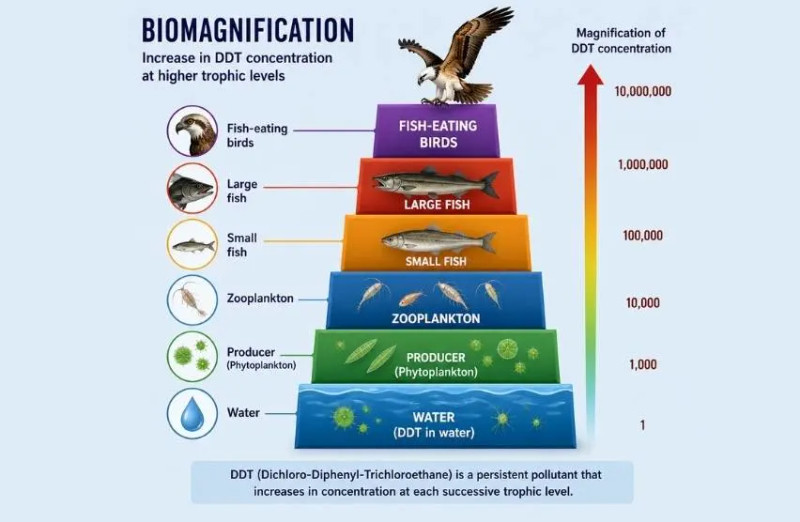
Biomagnification in an aquatic food chain
What Makes a Pollutant Likely to Build Up
A pollutant is most likely to accumulate and magnify when it is:
- Persistent and resistant to breakdown in the environment
- Readily absorbed by organisms
- Stored in fat or bound strongly to tissues
- Metabolized or excreted slowly
- Transferred effectively from prey to predator
- Present in organisms through repeated exposure over time
Feeding amplifies the pattern because higher-level consumers must eat many organisms from lower levels. Every prey item adds another pollutant load.
Routes of uptake
- Producers absorb contaminants from water, soil, or sediment
- Aquatic organisms absorb dissolved substances across gills or body surfaces
- Consumers take in pollutants by eating food or sediment
One boundary to remember is that not every pollutant biomagnifies. If a substance is broken down quickly or excreted easily, it usually will not show this pattern.
Major Pollutants and Classic Examples
The three APES examples are DDT, mercury, and PCBs.
DDT
DDT is a persistent, fat-soluble insecticide. It accumulates in organisms and magnifies through food webs. Its breakdown product, DDE, interferes with calcium deposition in bird eggs.
- Main effect: eggshell thinning
- Result: reduced hatching success
- Classic examples: bald eagles, ospreys, peregrine falcons
Mercury
In aquatic systems, microorganisms convert mercury into methylmercury, the form that enters food webs and biomagnifies strongly.
- Highest concentrations often occur in tuna, swordfish, sharks, and freshwater game fish
- Human exposure usually comes from contaminated fish and shellfish
- Classic case: Minamata disease in Minamata Bay, Japan, caused by mercury-contaminated seafood
PCBs
PCBs are synthetic industrial compounds once used in electrical equipment and insulating fluids.
- They are persistent and fat-soluble
- They remain in sediments for long periods
- They magnify in aquatic and terrestrial food webs
- Main effects include reproductive, developmental, and immune problems
Effects on Ecosystems and Humans
When persistent pollutants biomagnify, ecosystems can show:
- Eggshell thinning
- Developmental deformities
- Impaired growth and development
- Reduced fertility and reproductive failure
- Neurological impairment
- Increased illness or mortality
Top predators are hit hardest because they have the highest tissue concentrations and often live long enough to keep accumulating pollutants. That can lower hatching success, reduce offspring, and change prey populations and trophic interactions.
Humans are exposed mainly by repeatedly eating contaminated animal products, especially predatory fish. Health effects can involve the reproductive, nervous, and circulatory systems. Developing embryos and children are especially vulnerable.
How to Read Data and Investigate It
When you look for biomagnification, compare pollutant concentration per unit of tissue across trophic levels. The expected pattern is increasing concentration from producers or low-level consumers up to top predators.
This kind of trophic-level pattern is what you should expect to see in a biomagnification diagram or data table.
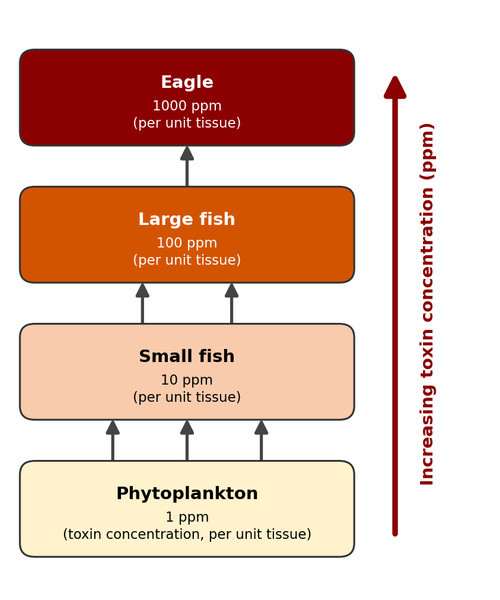
Biomagnification across trophic levels
When you look for bioaccumulation, compare individuals of the same species across age or time. The expected pattern is that older organisms have higher concentrations.
Watch for three common mistakes:
- Use consistent tissue type and units
- Follow food-web arrows from food to consumer
- Do not confuse tissue concentration with concentration in the surrounding water
For an investigation:
- Independent variable = trophic level
- Dependent variable = pollutant concentration per unit of tissue
- Sample multiple organisms at each trophic level
- Use the same ecosystem and similar time period
- Control for age, size, sex, diet, migration, and location
A solid hypothesis sounds like this: if a persistent pollutant biomagnifies in a food web, then its concentration per unit of tissue will increase with trophic level and be highest in the top predator.
Key Takeaways
Bioaccumulation
Buildup of a substance within one organism over time because uptake exceeds metabolism and excretion
Biomagnification
Increase in a substance’s concentration per unit of tissue at successively higher trophic levels
DDT (Dichlorodiphenyltrichloroethane)
Persistent, fat-soluble synthetic insecticide that biomagnifies; its metabolite DDE causes eggshell thinning and reduced hatching success in birds
Mercury
Persistent pollutant that aquatic microorganisms can convert into bioaccumulating methylmercury
Methylmercury
Biologically available form of mercury that binds strongly to tissues, biomagnifies in aquatic food webs, and damages nervous-system development
PCBs (Polychlorinated Biphenyls)
Persistent, fat-soluble synthetic industrial compounds that biomagnify and can cause reproductive, developmental, and immune effects
Minamata Disease
Severe neurological illness caused by eating seafood contaminated with industrial methylmercury that biomagnified in Minamata Bay, Japan
Notes
Bioaccumulation
Buildup of a substance within one organism over time because uptake exceeds metabolism and excretion
Biomagnification
Increase in a substance’s concentration per unit of tissue at successively higher trophic levels
DDT (Dichlorodiphenyltrichloroethane)
Persistent, fat-soluble synthetic insecticide that biomagnifies; its metabolite DDE causes eggshell thinning and reduced hatching success in birds
Mercury
Persistent pollutant that aquatic microorganisms can convert into bioaccumulating methylmercury
Methylmercury
Biologically available form of mercury that binds strongly to tissues, biomagnifies in aquatic food webs, and damages nervous-system development
PCBs (Polychlorinated Biphenyls)
Persistent, fat-soluble synthetic industrial compounds that biomagnify and can cause reproductive, developmental, and immune effects
Minamata Disease
Severe neurological illness caused by eating seafood contaminated with industrial methylmercury that biomagnified in Minamata Bay, Japan
