Topic 8.1 Notes – Sources of Pollution
What Point and Nonpoint Sources Are
When you read a pollution scenario, think in three parts:
- Source means where the pollutant came from.
- Pathway means how it traveled, like a pipe, runoff, groundwater flow, or wind.
- Receptor means what gets exposed, such as a river, lake, forest, or people.
That helps because point and nonpoint are about the source and pathway, not how harmful the pollutant is.
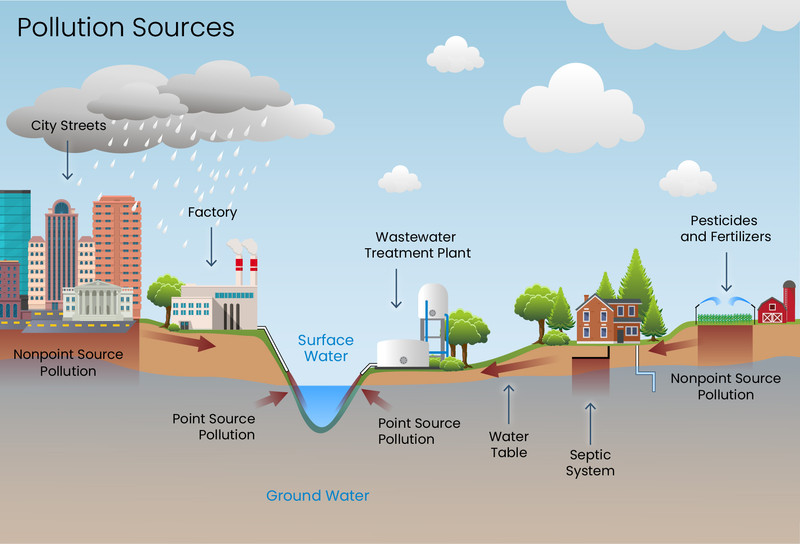
This watershed diagram pulls those ideas together by showing both kinds of sources feeding into the same surface water and groundwater system.
Point source
A point source is a single, identifiable origin. You can usually point to the exact release spot.
In the diagram, the factory discharge and wastewater treatment plant are point sources because each release comes from one clear outlet.
Examples you need to know:
- smokestack releasing air pollution
- waste discharge pipe
- industrial discharge pipe
- wastewater-treatment outfall
- pipe carrying waste into a lake or stream
Nonpoint source
A nonpoint source is diffuse. Pollution comes from many scattered places or across a broad area.
By contrast, runoff from city streets and from fields treated with pesticides or fertilizers is nonpoint because it washes off broad land surfaces instead of entering through one discrete outlet.
Examples you need to know:
- pesticide spraying
- pesticide spray drift
- urban runoff
- agricultural runoff
- fertilizer washed from fields
- manure washed from fields
- sediment from erosion
- contaminants from residential lawns
- oil and metals washed from streets and parking lots
The central question is simple. Did the pollutant enter from one discrete outlet, or from distributed land surfaces and scattered origins?
Point Sources and Nonpoint Sources Side by Side
Point sources
Point sources usually have:
- one identifiable stack, pipe, ditch, or outfall
- a release that can be sampled at that location
- responsibility tied to a specific discharger
A pollutant can spread after release and still be point source. A pipe dumping waste into a river is still point source even if the pollution later mixes through the whole river.
A plume is pollution carried away in air or water from the source. It can help locate a source, but you do not need a visible plume for it to count as point source.
Nonpoint sources
Nonpoint sources usually have:
- a broad-area release
- transport by runoff, erosion, or widespread application
- no easy way to trace pollution to one exact field, lawn, road, or landowner
- pollution that is often episodic, meaning it spikes during storms or snowmelt
Quick comparison table
| Feature | Point source | Nonpoint source |
|---|---|---|
| Origin | Single outlet | Diffuse area |
| Common pathway | Direct discharge | Runoff, erosion, drift |
| Monitoring | Easier at one location | Harder across watershed |
| Control | Permits, treatment equipment | Land-management practices |
How to Classify a Pollution Scenario
Use the description carefully.
- Find the release point or pattern.
- Separate the pollutant from the source type. Fertilizer, pesticides, oil, sediment, pathogens, and heavy metals can be either one.
- Look at the pathway.
- one pipe or smokestack = point
- washing off fields, lawns, streets, or disturbed land = nonpoint
- Do not classify by where pollution is found. One river sample can contain both.
- In a mixed watershed, classify each release separately:
- industrial pipe into river = point
- farm-field runoff into tributaries = nonpoint
- town runoff from many paved surfaces = nonpoint
- wastewater-treatment plant effluent pipe = point
One common trap is the storm-drain/outfall. Runoff across streets is nonpoint at first. If the scenario emphasizes discharge from one identifiable outfall, that outfall may be treated as point source.
Why the Distinction Matters
Point sources are usually easier to identify, monitor, and regulate. Agencies can sample the discharge, compare it to permit limits, and require treatment. In water pollution questions, this connects to the Clean Water Act, which commonly regulates point-source discharges through permits.
Nonpoint sources are harder because pollution depends on weather, land use, soil, and topography. Control usually means broader land-management approaches:
- reducing fertilizer and pesticide use
- limiting erosion
- using vegetated buffer zones
- improving soil management
- reducing urban runoff
The source type tells you how pollution is tracked and controlled. It does not tell you toxicity, concentration, persistence, visibility, or total harm.
Common Misclassifications to Avoid
- A visible release is not automatically point source.
- A factory is not itself the point source. The specific stack or pipe is.
- One property can still create nonpoint pollution if contaminants leave diffusely across land.
- One pipe releasing many pollutants is still point source.
- Nonpoint does not mean small or unimportant. Many diffuse releases can add up to major pollution.
- Point and nonpoint describe spatial origin, not severity.
Key Takeaways
Point Source Pollution
Pollution released from a single, discrete, identifiable location, such as a smokestack or discharge pipe
Nonpoint Source Pollution
Pollution released diffusely across a broad area or from many scattered locations, such as agricultural or urban runoff
Notes
Point Source Pollution
Pollution released from a single, discrete, identifiable location, such as a smokestack or discharge pipe
Nonpoint Source Pollution
Pollution released diffusely across a broad area or from many scattered locations, such as agricultural or urban runoff
