Topic 9.1 Notes – Stratospheric Ozone Depletion
What Stratospheric Ozone Is
Ozone is , a form of oxygen made of three oxygen atoms. Most atmospheric ozone is found in the stratosphere, mostly about 15 to 35 km above Earth.
The ozone layer is not a solid sheet. It is just a region where ozone concentration is higher than in the rest of the atmosphere, mixed in with other gases.
Why its location matters:
- Stratospheric ozone is helpful because it absorbs harmful ultraviolet radiation.
- Tropospheric ozone (ground-level ozone) is harmful. It is part of photochemical smog and irritates lungs.
That same chemical can be good or bad depending on where it is.
UV radiation
The ozone layer protects life by filtering different types of UV radiation to different degrees.
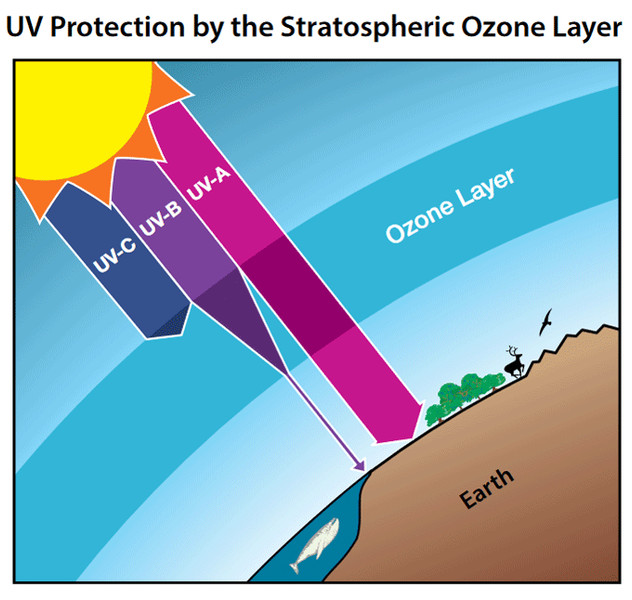
Ultraviolet radiation comes in three categories:
- UV-A
Longest wavelength, lowest energy of the three. It passes through the atmosphere more easily. - UV-B
More damaging to living tissue. Ozone absorbs much of it, but some reaches Earth naturally. This is the one that increases when ozone is depleted. - UV-C
Shortest wavelength, highest energy. Oxygen and ozone absorb essentially all of it before it reaches the surface.
Why ozone matters to life:
- It absorbs most UV-B and essentially all UV-C.
- As oxygen and ozone built up in Earth’s atmosphere, life could survive more easily on land.
- It still protects land organisms and organisms near the surface of water.
How the Ozone Layer Works
The ozone layer is dynamic. Ozone is always being made and broken apart.
Natural cycle:
Under normal conditions, these reactions stay in rough balance. Ozone depletion happens when destruction becomes faster than formation.
One more piece matters here. When ozone absorbs UV, that energy is turned into heat in the stratosphere.
What Causes Ozone Depletion
Two causes named here are human-caused CFCs and natural seasonal Antarctic conditions.
CFCs and catalytic ozone destruction
CFCs were used as:
- refrigerants
- aerosol propellants
- cleaning solvents
- foam-blowing agents
They are very stable in the lower atmosphere, so they can survive long enough to drift into the stratosphere.
There, UV breaks them apart:
Then chlorine radicals destroy ozone:
Net effect:
The key idea is catalyst. The chlorine is regenerated, so one chlorine atom can destroy many ozone molecules.
Why Antarctica gets the ozone hole
The ozone hole is not a real hole. It is a region of severe seasonal thinning.
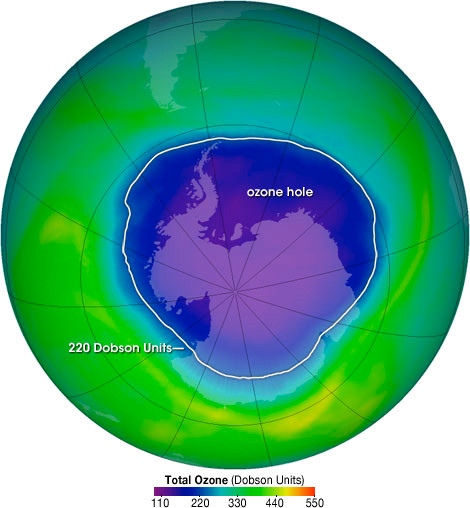
Antarctic ozone hole map
Why Antarctica is hit hardest:
- The stratosphere gets extremely cold in winter.
- A strong polar vortex traps and isolates the air.
- Polar stratospheric clouds form from ice crystals and other particles.
- Reactions on those particles change inactive chlorine into reactive forms.
- When sunlight returns in Antarctic spring, reactive chlorine is released and ozone destruction speeds up.
- The course specifically names the melting or disappearance of atmospheric ice crystals at the beginning of Antarctic spring as the natural seasonal factor involved.
This depletion is strongest in Southern Hemisphere spring, then weakens as the air warms and mixes.
Effects of Ozone Depletion
The chain is simple:
- less stratospheric ozone
- less UV absorption
- more UV-B reaches Earth
- more biological damage
Human health effects you must know:
- Skin cancer because UV damages DNA in skin cells
- Cataracts because UV damages proteins in the eye lens, making it cloudy
Ecological effects:
- damage to plant tissues
- reduced photosynthesis
- lower crop productivity in sensitive species
- harm to phytoplankton and other near-surface aquatic organisms
- ripple effects through aquatic food webs and carbon cycling
What Not to Confuse It With
Ozone depletion is different from the greenhouse effect.
- Ozone depletion lets in more incoming UV
- Greenhouse gases trap outgoing infrared radiation
It is also different from ground-level ozone pollution.
- Stratospheric ozone protects life
- Tropospheric ozone harms life
This is a classic APES idea. Local and regional CFC emissions can create a global problem because those chemicals persist in the atmosphere and circulate widely.
Key Takeaways
Ozone (O₃)
A molecule of three oxygen atoms; protective in the stratosphere but a harmful pollutant near the ground
Ozone Layer / Stratospheric Ozone Layer
The broad region mostly 15–35 km above Earth whose ozone absorbs much UV-B and, together with oxygen, essentially all UV-C, protecting life and helping make life on land possible
Stratospheric Ozone vs. Tropospheric Ozone
Stratospheric ozone protects life by absorbing ultraviolet radiation; tropospheric, or ground-level, ozone is a harmful secondary pollutant in photochemical smog
UV-A Radiation
The longest-wavelength ultraviolet radiation, transmitted through the atmosphere relatively easily
UV-B Radiation
Biologically damaging ultraviolet radiation partly absorbed by stratospheric ozone; ozone depletion allows more of it to reach Earth’s surface
UV-C Radiation
The shortest-wavelength, highest-energy ultraviolet radiation, essentially all of which is absorbed by atmospheric oxygen and ozone
Stratospheric Ozone Depletion
A reduction in protective stratospheric ozone that allows more UV-B to reach the surface, increasing risks such as skin cancer and cataracts
Chlorofluorocarbons (CFCs)
Stable synthetic compounds containing carbon, chlorine, and fluorine that reach the stratosphere, where ultraviolet radiation releases ozone-destroying chlorine
Catalytic Ozone Destruction by Chlorine
Cl• reacts with O₃, is regenerated through later reactions, and repeatedly catalyzes the net conversion O₃ + O → 2O₂.
Ozone Hole
Severe seasonal thinning—not a literal absence—of stratospheric ozone over Antarctica, strongest during Southern Hemisphere spring
Notes
Ozone (O₃)
A molecule of three oxygen atoms; protective in the stratosphere but a harmful pollutant near the ground
Ozone Layer / Stratospheric Ozone Layer
The broad region mostly 15–35 km above Earth whose ozone absorbs much UV-B and, together with oxygen, essentially all UV-C, protecting life and helping make life on land possible
Stratospheric Ozone vs. Tropospheric Ozone
Stratospheric ozone protects life by absorbing ultraviolet radiation; tropospheric, or ground-level, ozone is a harmful secondary pollutant in photochemical smog
UV-A Radiation
The longest-wavelength ultraviolet radiation, transmitted through the atmosphere relatively easily
UV-B Radiation
Biologically damaging ultraviolet radiation partly absorbed by stratospheric ozone; ozone depletion allows more of it to reach Earth’s surface
UV-C Radiation
The shortest-wavelength, highest-energy ultraviolet radiation, essentially all of which is absorbed by atmospheric oxygen and ozone
Stratospheric Ozone Depletion
A reduction in protective stratospheric ozone that allows more UV-B to reach the surface, increasing risks such as skin cancer and cataracts
Chlorofluorocarbons (CFCs)
Stable synthetic compounds containing carbon, chlorine, and fluorine that reach the stratosphere, where ultraviolet radiation releases ozone-destroying chlorine
Catalytic Ozone Destruction by Chlorine
Cl• reacts with O₃, is regenerated through later reactions, and repeatedly catalyzes the net conversion O₃ + O → 2O₂.
Ozone Hole
Severe seasonal thinning—not a literal absence—of stratospheric ozone over Antarctica, strongest during Southern Hemisphere spring
