Topic 5.13 Notes – Methods to Reduce Urban Runoff
What Urban Runoff Is
Urban runoff or stormwater runoff is water that flows over developed surfaces instead of infiltrating into soil. In natural land, some precipitation is caught by plants, some infiltrates into soil, some percolates down to recharge groundwater, and some returns to the air by evapotranspiration.
Urbanization changes that because it adds impervious surfaces, surfaces water cannot easily pass through:
- roads and highways
- conventional asphalt and concrete pavement
- sidewalks
- parking lots
- building roofs
One big result is that streams get a faster, higher surge of water after rainfall instead of a slower, lower peak.
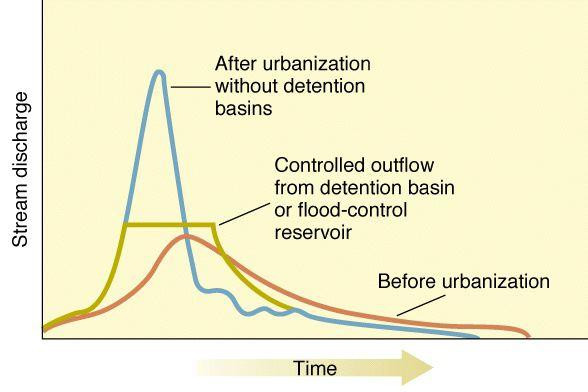
Hydrograph of stream discharge before and after urbanization
That leads to a chain of effects:
- More flooding because water reaches drains and streams faster
- Less groundwater recharge because less water infiltrates
- More streambank erosion because fast pulses of water wear channels away
- More pollutant transport into waterways
- More stress on storm drains and sewer systems
Urban runoff is also a nonpoint-source pollution problem. It can carry oil and fuel residues, heavy metals, road salt, fertilizers, pesticides, pet waste, sediment, and trash. Since these pollutants come from many scattered surfaces, there usually is no single pipe to blame.
The central idea for this whole topic is simple. Reduce runoff by increasing infiltration and reducing impervious surface area.
Methods to Increase Infiltration and Reduce Runoff
Permeable pavement
Permeable pavement lets water pass through instead of sending it straight to gutters.
Examples you need to know:
- porous asphalt
- pervious concrete
- paving blocks with water-permeable joints
These are usually built over gravel or crushed stone that stores water for a short time before it infiltrates. The diagram shows that layered design, with the surface over a stone reservoir that temporarily holds water.
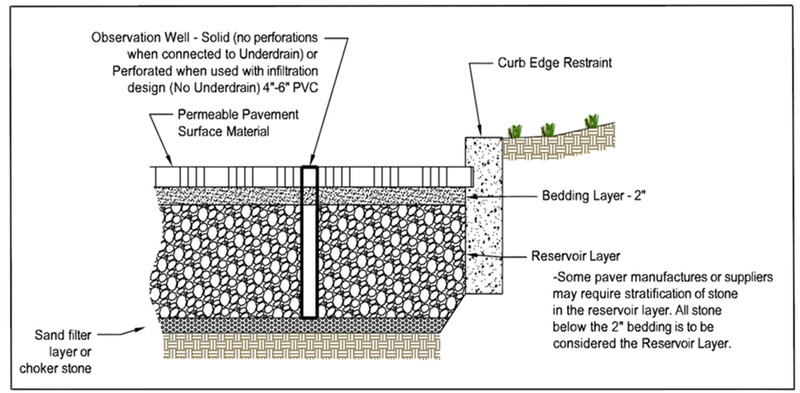
Permeable pavement cross-section
What it does:
- lowers runoff volume
- slows water delivery to storm drains
- lowers peak discharge
- may increase groundwater recharge
Best places include parking spaces, sidewalks, plazas, driveways, and some low-traffic streets. Limits matter too. It can clog with sediment, needs maintenance, may cost more, and works best where underlying soil is permeable.
Planting and preserving trees
Trees reduce runoff in three ways:
- Interception
The canopy catches rainfall and slows it down. - Infiltration
Roots and soil organisms keep spaces open in the soil so water can enter. - Evapotranspiration
Water returns to the atmosphere, freeing up soil storage for the next storm.
Leaf litter also adds organic matter and reduces compaction and erosion. Trees work best when they have enough uncompacted soil. They also give extra benefits like shade, habitat, carbon storage, and lower urban heat. Young trees help less at first, and all trees need space, water, and maintenance.
Increasing public transportation
This one is often tested in a sneaky way. Public transportation helps indirectly. Buses and rail do not make pavement permeable by themselves. The benefit comes from reducing the need for roads, highways, driveways, and especially parking lots. Less land devoted to cars means less impervious surface.
Building up rather than out
Compact vertical development uses less land for the same number of people. That reduces urban sprawl and preserves more open, permeable land. Tall buildings still create impervious surfaces, so the benefit is the smaller total land footprint, not zero runoff. This often works together with public transportation.
How These Methods Work Together
Two of these methods change the site itself:
- permeable pavement
- trees
Two reduce how much impervious surface gets built in the first place:
- public transportation
- building up rather than out
They all work through one shared mechanism. They make developed land behave more like vegetated land.
A common real-world example is redeveloping a low-density shopping area into a multistory mixed-use building near transit, with fewer parking spaces, more trees, and permeable pavement. The result is less total runoff, slower runoff, lower peak flow, and less pollutant transport.
Limits and What A Good Experiment Would Measure
No method eliminates runoff completely. Runoff still happens when rainfall exceeds infiltration rate, or when soil is saturated or frozen. Effectiveness depends on storm intensity, storm duration, soil type, slope, maintenance, vegetation, and percent impervious cover. Also, reducing runoff is different from fully treating pollution.
A good experiment compares conventional and modified surfaces under the same water input.
- Independent variable: surface type or runoff-control method
- Dependent variables:
- total runoff volume
- runoff rate
- peak runoff rate
- time until runoff begins
- infiltration volume
- soil moisture or groundwater response
- Controls:
- equal area
- same slope
- same water input
- same storm duration
- same antecedent moisture
- same collection time
Expected result: permeable or vegetated surfaces produce less runoff and a later, lower peak than conventional pavement.
Key Takeaways
Urban Runoff (Stormwater Runoff)
Rainwater or snowmelt that flows over developed land instead of infiltrating into soil
Impervious Surface
A human-made surface that prevents or greatly reduces water from reaching soil, increasing surface runoff
Infiltration
Movement of water from the land surface into soil, leaving less water available for immediate runoff
Permeable Pavement
Pavement with pores or openings that let water pass into underlying gravel and soil, reducing runoff volume and peak flow
Planting and Preserving Trees
Trees reduce runoff by intercepting rainfall, improving soil infiltration through their roots, and returning water to the atmosphere through evapotranspiration
Increased Use of Public Transportation
Using mass transit to reduce demand for roads and parking, preserving more vegetated and permeable land
Building Up Rather Than Out (Compact Vertical Development)
Concentrating development in taller buildings so the same activity occupies less land, preserving permeable open space
Green Infrastructure
Vegetation, soil, and permeable surfaces used to capture, slow, store, or infiltrate stormwater
Rain Gardens and Bioswales
Shallow vegetated areas that receive runoff, slow it, and allow it to infiltrate into amended soil
Green Roof
A rooftop layer of growing medium and vegetation that retains precipitation and delays and reduces roof runoff
Vegetated Buffer Strip
A strip of vegetation that slows runoff and promotes infiltration before water reaches a stream or storm drain
Infiltration Basin
A basin that temporarily stores stormwater so it can soak into the ground
Detention Pond
A pond that temporarily stores stormwater and releases it gradually, reducing peak discharge and flood risk
Retention Pond
A pond that maintains a permanent pool and provides additional storage for stormwater
Notes
Urban Runoff (Stormwater Runoff)
Rainwater or snowmelt that flows over developed land instead of infiltrating into soil
Impervious Surface
A human-made surface that prevents or greatly reduces water from reaching soil, increasing surface runoff
Infiltration
Movement of water from the land surface into soil, leaving less water available for immediate runoff
Permeable Pavement
Pavement with pores or openings that let water pass into underlying gravel and soil, reducing runoff volume and peak flow
Planting and Preserving Trees
Trees reduce runoff by intercepting rainfall, improving soil infiltration through their roots, and returning water to the atmosphere through evapotranspiration
Increased Use of Public Transportation
Using mass transit to reduce demand for roads and parking, preserving more vegetated and permeable land
Building Up Rather Than Out (Compact Vertical Development)
Concentrating development in taller buildings so the same activity occupies less land, preserving permeable open space
Green Infrastructure
Vegetation, soil, and permeable surfaces used to capture, slow, store, or infiltrate stormwater
Rain Gardens and Bioswales
Shallow vegetated areas that receive runoff, slow it, and allow it to infiltrate into amended soil
Green Roof
A rooftop layer of growing medium and vegetation that retains precipitation and delays and reduces roof runoff
Vegetated Buffer Strip
A strip of vegetation that slows runoff and promotes infiltration before water reaches a stream or storm drain
Infiltration Basin
A basin that temporarily stores stormwater so it can soak into the ground
Detention Pond
A pond that temporarily stores stormwater and releases it gradually, reducing peak discharge and flood risk
Retention Pond
A pond that maintains a permanent pool and provides additional storage for stormwater
