Topic 8.10 Notes – Waste Reduction Methods
What Waste Reduction Methods Are
Waste reduction means changing how materials are made, used, collected, and processed so less waste needs final disposal.
The usual hierarchy goes from best to least preferred:
- Source reduction
- Reuse
- Recycling and composting
- Energy recovery
- Treatment/disposal
That order matters because these methods act at different points in the waste stream.
- Source reduction prevents waste from being created in the first place.
- Reuse keeps an item in service longer.
- Recycling and composting happen after waste has already been generated.
- Energy recovery and landfill restoration reduce harm after disposal, so they are mitigation, not prevention.
A common test trap is mixing up waste diversion with waste prevention.
- Diversion means keeping waste out of landfills or incinerators.
- Prevention is better because you avoid collection, transport, and processing too.
The diversion rate is
Be careful with categories. If composting is already included in a recycling/diversion total, don’t add it again.
Main Waste Reduction and Mitigation Methods
Source reduction and reuse
Source reduction cuts waste before it exists.
- less packaging
- durable or repairable products
- reusable items instead of disposable ones
- buying only what is needed
This has the biggest benefit because it avoids impacts from resource extraction, manufacturing, transport, and disposal.
Reuse extends product life with little reprocessing.
- refillable containers
- repaired appliances
- donated computers
- salvaged building materials
Drawbacks do exist.
- items may need collection, cleaning, storage, or repair
- older products may be less efficient or less safe
Recycling
Recycling converts certain solid wastes into new products.
Common materials include:
- metals
- glass
- paper
- cardboard
- some plastics
The process usually goes in this order. Transport to a recycling facility often comes right after collection, as the diagram shows.
- collection
- sorting/separation
- contaminant removal
- cleaning/preparation
- reprocessing into feedstock
- manufacturing into new products
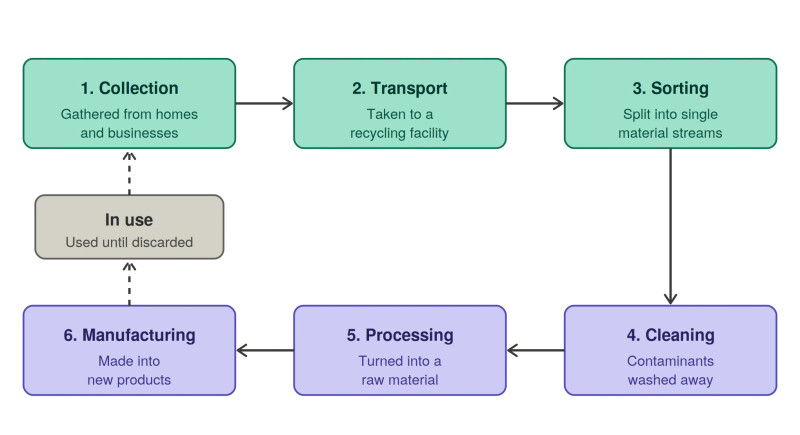
Recycling process flowchart
Benefits:
- lowers demand for virgin raw materials and minerals
- reduces some mining impacts
- conserves landfill space
Drawbacks and limits:
- energy-intensive and costly
- transportation and processing create emissions
- contamination can ruin loads
- some materials are downcycled into lower-quality products instead of recycled in a closed loop
Composting
Composting is the decomposition of organic matter such as food scraps, paper, and yard waste. The product is compost, which can be used as fertilizer or a soil amendment.
It needs:
- organic feedstock
- decomposers
- moisture
- oxygen
- a mix of carbon-rich and nitrogen-rich materials
Benefits:
- diverts biodegradable waste from landfills
- returns nutrients and organic matter to soil
- can reduce methane formation compared with landfill disposal
Drawbacks:
- odor
- rodents
- contamination
- management and labor needs
E-waste reduction
E-waste includes computers, cell phones, televisions, and monitors.
Best options together:
- reuse
- repair
- refurbish
- donate
- recover components
- recycle through proper facilities
Important materials:
| Recoverable | Hazardous |
|---|---|
| copper | lead |
| aluminum | mercury |
| gold |
This matters because lead and mercury can leach from landfills into groundwater if e-waste is improperly disposed of.
Energy Recovery and Landfill Mitigation
Waste-to-energy combustion
This means burning municipal solid waste to heat water, make steam, turn turbines, and generate electricity.
Benefits:
- greatly reduces waste volume
- produces energy
Drawbacks:
- expensive
- creates ash
- can release CO2, particulates, nitrogen oxides, and heavy metals
It can also compete with recycling and source reduction if the facility needs a steady supply of trash.
Landfill gas-to-energy
In landfills, organic waste decomposes anaerobically and forms methane and carbon dioxide. Wells and pipes collect the gas, and methane is combusted for heat or electricity. The diagram below shows that flow from buried waste to gas collection, cleanup, electricity generation, and the grid.
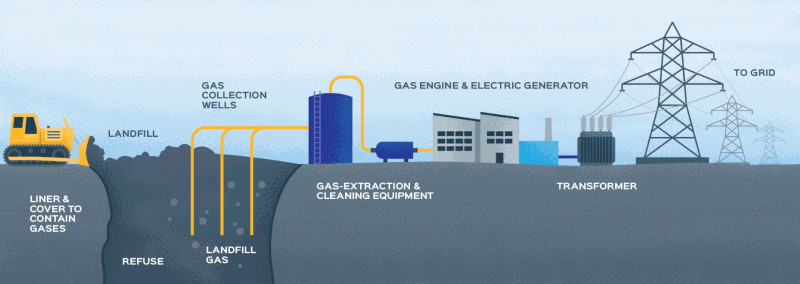
Landfill gas-to-energy system
Benefits:
- captures useful energy
- reduces uncontrolled methane release
- combustion of landfill gas can turn turbines and generate electricity
- this process reduces landfill volume
Drawbacks:
- not all methane is captured
- systems need monitoring
- combustion still produces CO2 and other pollutants
Restoring former landfills
Closed landfills can be capped, revegetated, and reused as parks, habitat, open space, or solar sites. Freshkills Park is the classic example.
Benefits:
- habitat
- recreation
- improved appearance
- less pressure to develop undeveloped land
Drawbacks:
- buried waste remains
- methane and leachate monitoring continue
- settling and land-use limits remain
Matching Each Method to Its Benefit and Drawback
This section is often tested as “propose one method and explain one benefit and one drawback.”
- Recycling reduces virgin mineral demand, but it is energy-intensive and costly.
- Composting creates useful soil amendment, but it may cause odor and attract rodents.
- E-waste reuse/recycling keeps lead and mercury out of landfills and groundwater, but it needs specialized safe processing.
- Waste combustion reduces waste volume and produces electricity, but it causes air pollution and ash.
- Landfill gas recovery reduces methane emissions and generates electricity, but it only manages waste after burial.
- Landfill restoration recovers land for use, but it does not remove existing waste or long-term monitoring needs.
Key Takeaways
Waste Reduction
Changing how materials are produced, used, collected, or processed so less waste requires disposal and fewer virgin resources are extracted
Waste Stream
The flow of discarded materials from homes, businesses, institutions, industries, and other sources
Waste-Management Hierarchy
The preferred order of source reduction, reuse, recycling and composting, energy recovery, then treatment and disposal
Source Reduction (Reduce)
Preventing waste before it is created, such as by using less packaging or choosing durable, repairable, or reusable products
Reuse
Keeping an item or component in service without first converting it back into raw material
Waste Diversion
Redirecting generated waste away from landfills or incinerators through reuse, recycling, or composting; unlike source reduction, it does not prevent waste generation
Diversion Rate
Diversion rate = mass reused, recycled, or composted ÷ total mass of waste generated × 100
Recycling
Processing discarded materials into feedstock for new products, reducing demand for virgin resources and landfill space but requiring energy and money
Composting
Controlled, usually aerobic decomposition of organic waste into nutrient-containing compost used as fertilizer or a soil amendment; drawbacks include odors and rodents
Electronic Waste (E-Waste)
Discarded electronic devices that can be reused or recycled to recover materials and keep hazardous substances such as lead and mercury from leaching into groundwater
Waste-to-Energy
Burning solid waste to produce heat, steam, and electricity while reducing waste volume; it leaves ash and can emit carbon dioxide and other air pollutants
Landfill Gas-to-Energy
Capturing methane-rich gas from anaerobic landfill decomposition and combusting it to generate electricity or useful heat, limit methane release, and reduce landfill volume
Landfill Restoration
Capping, monitoring, revegetating, and converting a closed landfill into habitat, parkland, open space, or another use while continuing gas and leachate controls
Closed-Loop Recycling
Recycling a material into the same general kind of product, such as an aluminum can becoming another aluminum can
Downcycling
Recycling a material into a lower-quality product with fewer future uses
Notes
Waste Reduction
Changing how materials are produced, used, collected, or processed so less waste requires disposal and fewer virgin resources are extracted
Waste Stream
The flow of discarded materials from homes, businesses, institutions, industries, and other sources
Waste-Management Hierarchy
The preferred order of source reduction, reuse, recycling and composting, energy recovery, then treatment and disposal
Source Reduction (Reduce)
Preventing waste before it is created, such as by using less packaging or choosing durable, repairable, or reusable products
Reuse
Keeping an item or component in service without first converting it back into raw material
Waste Diversion
Redirecting generated waste away from landfills or incinerators through reuse, recycling, or composting; unlike source reduction, it does not prevent waste generation
Diversion Rate
Diversion rate = mass reused, recycled, or composted ÷ total mass of waste generated × 100
Recycling
Processing discarded materials into feedstock for new products, reducing demand for virgin resources and landfill space but requiring energy and money
Composting
Controlled, usually aerobic decomposition of organic waste into nutrient-containing compost used as fertilizer or a soil amendment; drawbacks include odors and rodents
Electronic Waste (E-Waste)
Discarded electronic devices that can be reused or recycled to recover materials and keep hazardous substances such as lead and mercury from leaching into groundwater
Waste-to-Energy
Burning solid waste to produce heat, steam, and electricity while reducing waste volume; it leaves ash and can emit carbon dioxide and other air pollutants
Landfill Gas-to-Energy
Capturing methane-rich gas from anaerobic landfill decomposition and combusting it to generate electricity or useful heat, limit methane release, and reduce landfill volume
Landfill Restoration
Capping, monitoring, revegetating, and converting a closed landfill into habitat, parkland, open space, or another use while continuing gas and leachate controls
Closed-Loop Recycling
Recycling a material into the same general kind of product, such as an aluminum can becoming another aluminum can
Downcycling
Recycling a material into a lower-quality product with fewer future uses
