Topic 1.8 Notes – Primary Productivity
What Primary Productivity Is
Primary productivity is the rate at which autotrophs convert solar energy into chemical energy stored in organic compounds through photosynthesis. Autotrophs are producers, organisms that make their own food, and they form the energy base for ecosystems.
That stored energy then becomes the starting point for consumers and decomposers. So when you hear primary, think production by producers first, not by animals that eat other organisms.
Main photosynthesizers you should know:
- Terrestrial plants
- Algae
- Phytoplankton
- Cyanobacteria
Photosynthesis is the core process:
This diagram shows that basic input-output pattern of photosynthesis in a producer.
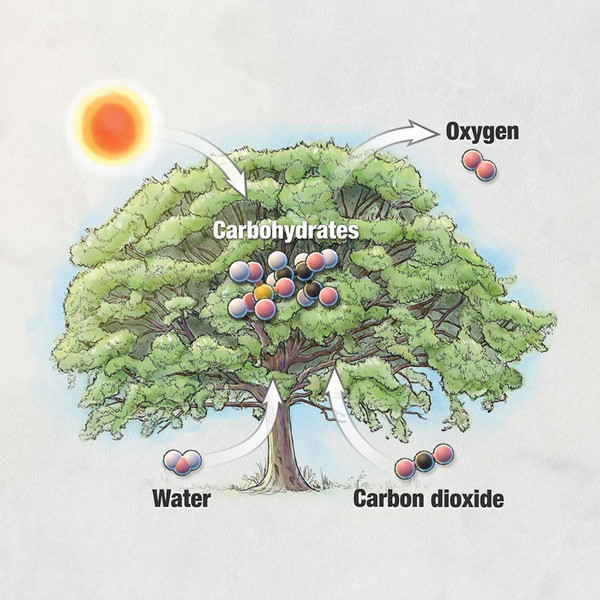
Only a small fraction of incoming sunlight becomes stored chemical energy. Some light is reflected, passes through leaves or water, or becomes heat. Photosynthesis can also be limited by water, nutrients, temperature, and carbon dioxide.
GPP, NPP, and Respiration
Here’s the energy story. Sunlight comes in, producers capture some of it, then they use part of that captured energy themselves.
Gross primary productivity
GPP is the total rate of photosynthesis in a given area. It includes all energy captured before subtracting what producers use.
Net primary productivity
NPP is the rate of energy storage as new biomass after respiration is subtracted. This shows up as new leaves, roots, wood, fruits, or algal cells. It is the part potentially available to herbivores, detritivores, and decomposers.
Respiration
Respiration is the energy producers use for maintenance, repair, transport, growth, and reproduction. That use releases energy and heat, so less remains stored as biomass.
Core relationship
Also know the rearrangements:
A common mistake is subtracting respiration from NPP. Don’t. Respiration is subtracted from GPP.
Biomass vs productivity
- Standing biomass = amount present at one moment
- Productivity = rate of new production over time
That distinction matters in water. Phytoplankton can have high productivity but low standing biomass because they are produced and consumed quickly.
How Primary Productivity Is Measured
Productivity uses energy per unit area per unit time.
Examples:
- kcal/m²/yr
- J/m²/yr
- g C/m²/yr as a carbon proxy
If time is missing, it is not productivity.
Biomass accumulation
On land, scientists can estimate productivity by measuring increase in dry biomass over time. Dry mass matters because water content can change a lot.
An increase in producer biomass estimates NPP, since respiration has already happened. This method can miss some production unless you account for:
- herbivory
- leaf fall
- death and decomposition
- belowground growth like roots
Light-and-dark bottle method
This is used in aquatic systems with phytoplankton.
- Measure initial dissolved oxygen.
- Put water in a light bottle. Photosynthesis and respiration both happen, so oxygen change shows net productivity.
- Put water in a dark bottle. No photosynthesis happens, so oxygen decline shows respiration.
- Add net productivity and respiration to get GPP.
The setup below shows the illuminated bottle comparison used to track dissolved oxygen changes.
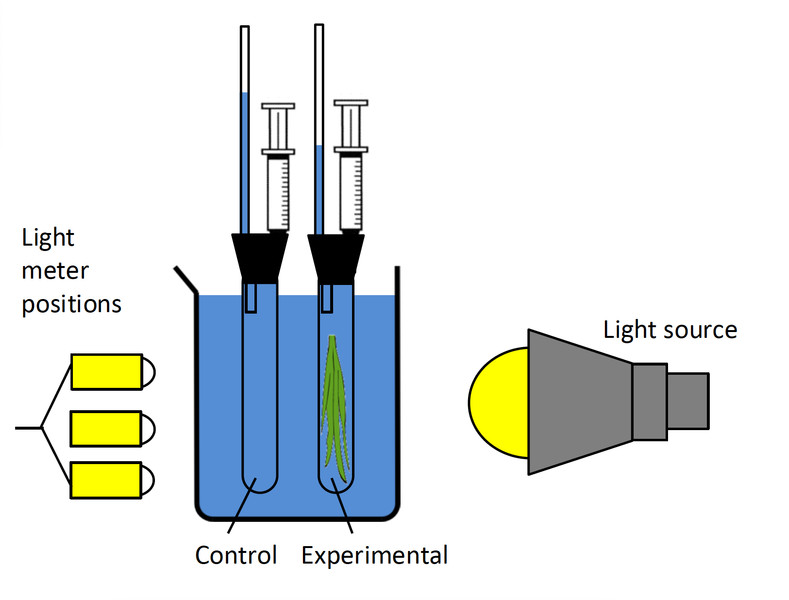
Light-and-dark bottle productivity setup
What Controls Productivity
A limiting factor is the factor in shortest effective supply.
Major controls include:
- light intensity and duration
- water availability
- temperature
- carbon dioxide availability
- nutrient availability, especially nitrogen and phosphorus
- length of growing season
- water clarity and depth in aquatic systems
Nutrient patterns that get tested a lot:
- Nitrogen often limits terrestrial and marine productivity
- Phosphorus often limits freshwater productivity
Ecosystem patterns:
- High productivity: tropical rainforests, wetlands, estuaries, shallow nutrient-rich waters
- Low productivity: deserts, tundra, much of the open ocean per unit area
Higher NPP means more energy enters food webs, which can support greater biomass and more trophic levels.
Light and Productivity in Aquatic Ecosystems
In water, light decreases with depth because water absorbs and scatters it.
Two facts to memorize:
- Most red light is absorbed in the upper 1 m
- Blue light penetrates deepest and only goes beyond 100 m in the clearest water
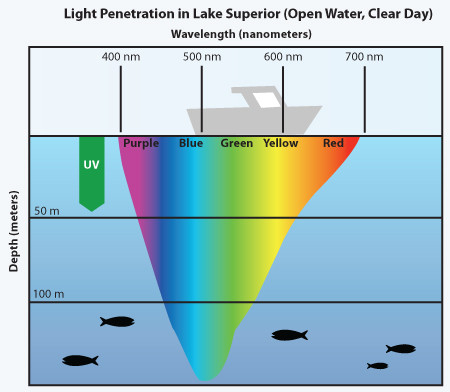
Light penetration by wavelength in clear lake water
This pattern helps explain why photosynthesis drops with depth, especially in murky water.
Turbidity from sediment, plankton, or dissolved organic matter reduces light penetration, so photosynthesis drops below the surface.
The photic or euphotic zone is the upper layer with enough light for photosynthesis. The compensation depth is where gross photosynthesis equals respiration, so NPP is about zero. Below that depth, producers cannot maintain positive net production over time.
Adaptations that help aquatic photosynthesizers:
- accessory pigments
- buoyancy structures like oils or gas spaces
- flagella for movement
- broad or thin photosynthetic surfaces
- shallow placement of attached algae and aquatic plants
Key Takeaways
Primary Productivity
Rate at which producers convert solar energy into chemical energy stored in organic compounds, measured as energy per unit area per unit time
Gross Primary Productivity (GPP)
Total rate at which photosynthesis captures and stores energy in a given area before producer respiration is subtracted
Net Primary Productivity (NPP)
Rate of energy storage as new producer biomass after respiration; NPP = GPP − producer respiration
Standing Biomass
Quantity of living material present at a particular time, unlike productivity, which is the rate at which new material is produced
Biomass Accumulation Method
Measure the change in dry producer biomass per area over a known time; the increase estimates NPP.
Light-and-Dark Bottle Method
Measure dissolved oxygen changes: the light bottle gives NPP, the dark bottle’s oxygen loss gives respiration, and GPP = NPP + respiration
Limiting Factor
Resource or condition in shortest effective supply that restricts primary productivity despite the availability of other requirements
Photic Zone (Euphotic Zone)
Upper region of a body of water where enough light is available for photosynthesis
Compensation Depth
Depth where gross photosynthesis equals producer respiration, making NPP approximately zero
Red vs. Blue Light Penetration in Water
Most red light is absorbed within the upper 1 m, while blue light penetrates deepest but reaches beyond 100 m only in the clearest water
Notes
Primary Productivity
Rate at which producers convert solar energy into chemical energy stored in organic compounds, measured as energy per unit area per unit time
Gross Primary Productivity (GPP)
Total rate at which photosynthesis captures and stores energy in a given area before producer respiration is subtracted
Net Primary Productivity (NPP)
Rate of energy storage as new producer biomass after respiration; NPP = GPP − producer respiration
Standing Biomass
Quantity of living material present at a particular time, unlike productivity, which is the rate at which new material is produced
Biomass Accumulation Method
Measure the change in dry producer biomass per area over a known time; the increase estimates NPP.
Light-and-Dark Bottle Method
Measure dissolved oxygen changes: the light bottle gives NPP, the dark bottle’s oxygen loss gives respiration, and GPP = NPP + respiration
Limiting Factor
Resource or condition in shortest effective supply that restricts primary productivity despite the availability of other requirements
Photic Zone (Euphotic Zone)
Upper region of a body of water where enough light is available for photosynthesis
Compensation Depth
Depth where gross photosynthesis equals producer respiration, making NPP approximately zero
Red vs. Blue Light Penetration in Water
Most red light is absorbed within the upper 1 m, while blue light penetrates deepest but reaches beyond 100 m only in the clearest water
