Topic 5.3 Notes – The Green Revolution
What the Green Revolution Is
The Green Revolution was not one seed, one machine, or one invention. It was an agricultural system built to raise yield, which means crop harvested per unit of land.
That point matters. A country can grow more food in two different ways:
- Increase land area farmed
- Increase yield on the same land
The Green Revolution is mainly about the second one.
Its central trade-off was clear:
- Benefit: more food, more efficiently, from the same farmland
- Cost: more dependence on water, fossil fuels, fertilizers, pesticides, machinery, and money
Historical examples
One of the best-known figures from this period is Norman Borlaug, shown here working with wheat.
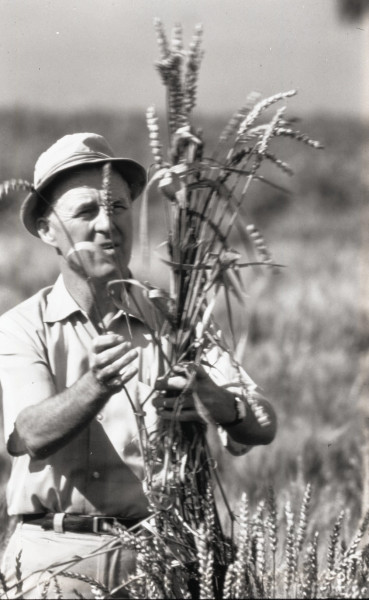
Norman Borlaug with wheat
- Norman Borlaug in Mexico helped develop semidwarf wheat, a major early success.
- That wheat was adopted in India and Pakistan, where grain production rose sharply.
- IR8 rice, developed in the Philippines, spread across parts of Asia.
Semidwarf crops
These were a huge deal because they had:
- Less lodging. Lodging means tall plants fall over, often after wind or heavy grain growth.
- More growth into grain instead of tall stems.
- A stronger response to fertilizer and irrigation, so extra inputs translated into bigger harvests.
One easy test point here: early Green Revolution crops came mostly from selective breeding and hybridization, not modern gene editing. In APES, GMOs are still included as part of the broader continuation of this high-input farming shift.
Main Green Revolution Practices
The biggest yield gains usually came from an input package. The parts worked together.
High-yield varieties and GMOs
- High-yield varieties were bred for traits like more grain, disease resistance, shorter growing seasons, and resistance to lodging.
- A shorter growing season can allow multiple cropping, meaning more than one harvest per year.
- GMOs are organisms whose DNA has been changed through genetic engineering.
- GMO traits can include:
- Insect resistance
- Herbicide tolerance
- Disease resistance
- Improved durability
- Altered nutrition
A common mistake is saying GM crops automatically have higher yield. They often improve effective yield by reducing losses.
Major risk:
- Lower genetic diversity
- More monoculture vulnerability if one pest or disease can hit all the similar plants
Mechanization
Machines like tractors, combines, seed drills, irrigation pumps, fertilizer applicators, and pesticide sprayers let farms plant and harvest large areas fast. That raises labor efficiency and can increase profits, especially on large farms. It also increases fossil fuel use.
Fertilization
Synthetic fertilizers replace nutrients removed by harvest, especially:
- Nitrogen
- Phosphorus
- Potassium
This removes nutrient limits and boosts growth. Nitrogen fertilizer production is very energy intensive and tied to fossil fuels.
Irrigation
Irrigation gives reliable water when rainfall is low or unpredictable. It supports high-yield crops, improves fertilizer uptake, and can allow multiple harvests. The big concern is heavy water withdrawal from rivers and aquifers.
Pesticides
These include insecticides, herbicides, and fungicides. They reduce losses from insects, weeds, and disease, especially in large monocultures.
How the System Increases Food Production
- Improved crop varieties create the potential for bigger harvests.
- Fertilizer supplies nutrients for fast growth.
- Irrigation removes water limits.
- Pesticides prevent losses to pests, weeds, and disease.
- Machinery makes planting, treating, and harvesting fast over large areas.
- The result is higher yield, more reliable harvests, and more output per worker.
The caveat is important. Higher production usually comes from the combined effect of seeds, water, fertilizer, pesticides, machinery, infrastructure, and management, not one single cause.
Benefits and Costs of the Green Revolution
Major benefits
- Higher yield per unit land
- Larger, more dependable harvests
- Lower crop losses
- Greater labor efficiency
- Potentially higher farm profits
- Lower staple food prices
- Greater food availability and food security
- Possible land-sparing, meaning less pressure to convert forests or grasslands into cropland
One limit students forget: more food production does not automatically end hunger. Poverty, conflict, and unequal distribution still matter.
Major environmental and social costs
- More fossil fuel use and greenhouse gas emissions
- Nutrient runoff, groundwater contamination, and eutrophication
- Pesticide pollution and harm to nontarget organisms
- Evolution of pesticide-resistant pests
- Water depletion from rivers and aquifers
- Salinization and waterlogging from poor irrigation
- Loss of crop genetic diversity
- High capital costs and unequal access to inputs
- Reduced demand for some farm labor
How to Read Green Revolution Evidence and Claims
When you see data, check what is being measured.
- Yield = crop harvested per unit land
- Total production = total crop harvested
A graph of rising total production does not prove yield increased, because farmed land area may also have increased. This comparison makes that distinction easy to spot.
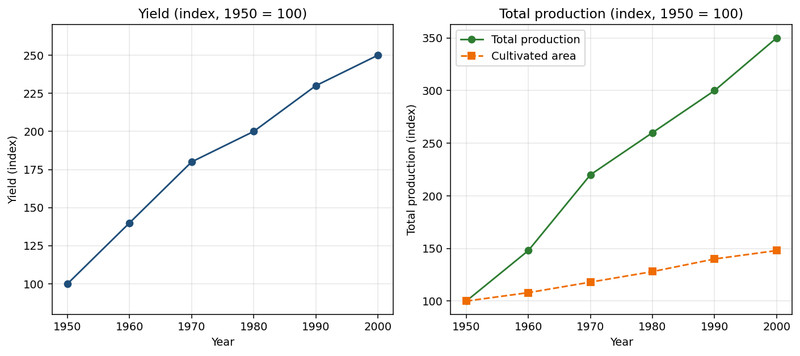
Yield vs. total production over time
Also watch for other lines rising at the same time, like:
- fertilizer use
- irrigated area
- pesticide use
- energy input
That means you should avoid single-cause claims.
A favorable view may stress avoided famine, lower food prices, and technological success. A critical view may stress pollution, fossil fuel dependence, unequal benefits, and long-term ecological costs. The best APES conclusion usually combines both. The Green Revolution increased food production by increasing external inputs and altering natural systems.
Key Takeaways
Green Revolution
Mid-20th-century shift to high-yield crops, mechanization, synthetic fertilizers, irrigation, pesticides, and later GMOs that increased food production but also increased resource use and environmental harm
Crop Yield
Amount of crop harvested per unit of land, unlike total production, which is the total mass harvested
Norman Borlaug
Father of the Green Revolution who helped develop high-yield, disease-resistant wheat varieties in Mexico and received the 1970 Nobel Peace Prize
High-Yield Variety
Crop strain bred to produce more harvestable food under favorable conditions, usually with sufficient fertilizer, water, and pest control
Semidwarf Variety
Short, sturdy crop variety that directs more growth into grain and is less likely to fall over when heavily fertilized
Lodging
Falling over of crop stems, especially when tall plants grow heavy after abundant fertilization
Intensive Agriculture
Agriculture that applies large amounts of energy, water, nutrients, chemicals, machinery, or capital per unit of land to obtain high output
Multiple Cropping
Harvesting more than one crop from the same land during a single year
Selective Breeding vs. Genetic Engineering
Selective breeding crosses chosen parents through sexual reproduction; genetic engineering directly alters DNA and may add genes from unrelated organisms
Genetically Modified Organism (GMO)
Organism whose DNA has been altered through genetic engineering to express desired traits such as pest resistance or herbicide tolerance
Mechanization
Replacement or supplementation of human and animal labor with farm machinery, increasing efficiency and potential profit but increasing fossil-fuel reliance
Synthetic Fertilization
Application of manufactured plant nutrients, commonly nitrogen, phosphorus, and potassium, to increase growth and yield; unused nutrients can become pollutants
Irrigation
Artificially supplying crops with water to increase and stabilize production, with possible costs including water depletion, salinization, and waterlogging
Salinization
Accumulation of dissolved salts in soil as irrigation water evaporates
Waterlogging
Saturation of soil by excessive irrigation or a raised water table, limiting oxygen available to plant roots
Pesticide
Substance used to kill or control harmful organisms, protecting crop yields but potentially harming nontarget species and selecting for resistant pests
Food Security
Reliable access to enough safe and nutritious food; greater production can improve it but cannot eliminate hunger caused by poverty, conflict, or unequal distribution
Notes
Green Revolution
Mid-20th-century shift to high-yield crops, mechanization, synthetic fertilizers, irrigation, pesticides, and later GMOs that increased food production but also increased resource use and environmental harm
Crop Yield
Amount of crop harvested per unit of land, unlike total production, which is the total mass harvested
Norman Borlaug
Father of the Green Revolution who helped develop high-yield, disease-resistant wheat varieties in Mexico and received the 1970 Nobel Peace Prize
High-Yield Variety
Crop strain bred to produce more harvestable food under favorable conditions, usually with sufficient fertilizer, water, and pest control
Semidwarf Variety
Short, sturdy crop variety that directs more growth into grain and is less likely to fall over when heavily fertilized
Lodging
Falling over of crop stems, especially when tall plants grow heavy after abundant fertilization
Intensive Agriculture
Agriculture that applies large amounts of energy, water, nutrients, chemicals, machinery, or capital per unit of land to obtain high output
Multiple Cropping
Harvesting more than one crop from the same land during a single year
Selective Breeding vs. Genetic Engineering
Selective breeding crosses chosen parents through sexual reproduction; genetic engineering directly alters DNA and may add genes from unrelated organisms
Genetically Modified Organism (GMO)
Organism whose DNA has been altered through genetic engineering to express desired traits such as pest resistance or herbicide tolerance
Mechanization
Replacement or supplementation of human and animal labor with farm machinery, increasing efficiency and potential profit but increasing fossil-fuel reliance
Synthetic Fertilization
Application of manufactured plant nutrients, commonly nitrogen, phosphorus, and potassium, to increase growth and yield; unused nutrients can become pollutants
Irrigation
Artificially supplying crops with water to increase and stabilize production, with possible costs including water depletion, salinization, and waterlogging
Salinization
Accumulation of dissolved salts in soil as irrigation water evaporates
Waterlogging
Saturation of soil by excessive irrigation or a raised water table, limiting oxygen available to plant roots
Pesticide
Substance used to kill or control harmful organisms, protecting crop yields but potentially harming nontarget species and selecting for resistant pests
Food Security
Reliable access to enough safe and nutritious food; greater production can improve it but cannot eliminate hunger caused by poverty, conflict, or unequal distribution
