Topic 1.11 Notes – Food Chains and Food Webs
What Food Chains and Food Webs Show
A food chain shows one linear feeding pathway. A food web shows multiple connected pathways, which is more realistic because most organisms eat more than one thing and are eaten by more than one thing.
This temperate forest web is a good example. It connects producers, consumers, and decomposers in many overlapping feeding relationships.
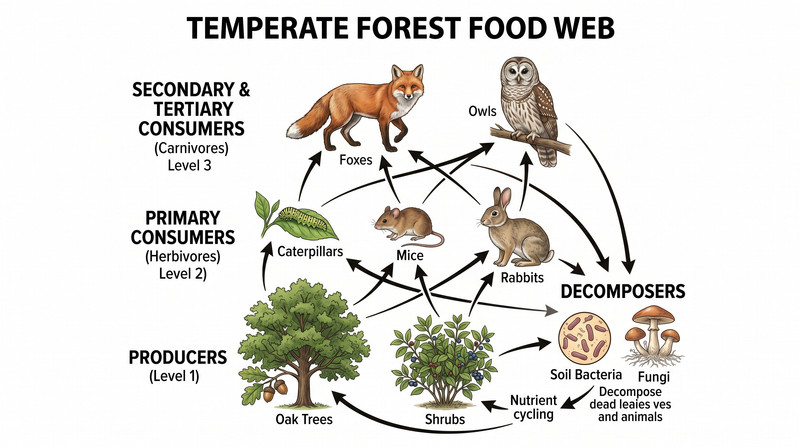
Temperate forest food web
Two ideas from earlier in Unit 1 matter here:
- Energy flows through ecosystems. It enters mostly as sunlight, gets stored as chemical energy in biomass, and is eventually lost as heat.
- Matter cycles. Nutrients move through living things, then return to soil, water, or sediments.
In these diagrams, arrows usually point from the food to the eater.
- grass → rabbit means the rabbit eats the grass
- rabbit → hawk means the hawk eats the rabbit
The arrow shows transfer of energy and matter, not “who is attacking.”
The Sun may have an arrow pointing to producers because it is the original energy source for most ecosystems, but the Sun is not a trophic level.
Trophic Levels and Feeding Roles
A trophic level is an organism’s feeding position in a chain or web.
Producers
Producers are autotrophs. They make organic compounds from inorganic materials, usually by photosynthesis.
- first trophic level
- examples: plants, algae, phytoplankton
They form the base of most food chains and webs.
Primary consumers
Primary consumers eat producers.
- second trophic level
- usually herbivores
- examples: rabbits, grasshoppers, zooplankton, sea urchins, seed-eating animals
Secondary consumers
Secondary consumers eat primary consumers.
- third trophic level
- usually carnivores or omnivores
- examples: frogs eating grasshoppers, small fish eating zooplankton
Tertiary consumers
Tertiary consumers eat secondary consumers.
- fourth trophic level
- often top predators
Be careful here. Top predator and tertiary consumer are not always the same thing. Trophic level depends on what the organism is eating in that pathway.
Herbivores, carnivores, and omnivores
These terms describe diet.
- Herbivores eat producers
- Carnivores eat animals
- Omnivores eat both
An omnivore can be in more than one trophic level depending on what it eats.
Detritus, detritivores, scavengers, and decomposers
Detritus is dead organic matter and waste.
- Detritivores physically break up detritus by eating it
- examples: earthworms, millipedes, dung beetles, aquatic invertebrates
- Scavengers consume large dead animals
- examples: vultures, some crabs
- Decomposers chemically break down organic matter
- examples: bacteria and fungi
Detritivores and decomposers return nutrients to soil or water. One common mistake is putting decomposers only at the “end” of a chain. Dead material from every trophic level reaches them.
How to Read and Build a Food Chain or Food Web
When you read a diagram, move link by link.
- Check the arrow direction and any legend.
- Find the producers, usually at the base.
- Trace arrows from producer to consumer.
- Assign trophic role from what it eats, not from the organism’s name.
- If an organism feeds from more than one trophic level, it may occupy multiple trophic levels.
The number of arrows connected to an organism does not tell you its trophic level.
Some standard food chains:
- grass → rabbit → hawk
- meadow grass → grasshopper → frog → snake
- plant seeds → mouse → snake → hawk
Meadow web organisms:
- producers: grasses, flowering plants
- consumers: grasshoppers, rabbits, seed-eating mice, frogs, snakes, hawks
- detrital pathway: earthworms, soil fungi, bacteria
How Changes Spread Through a Food Web
A change in one species can spread through the whole web.
- Direct effects happen between a consumer and its food.
- Indirect effects pass through intermediate species.
A trophic cascade is a chain of indirect effects across trophic levels, often starting with a predator.
- sea otters decrease → sea urchins increase → kelp decreases
- sea otters increase → sea urchins decrease → kelp increases
The kelp forest web below gives you the classic example to keep in mind. Focus on the otter, urchin, and kelp links first, then remember that changes can ripple outward to many other species too.
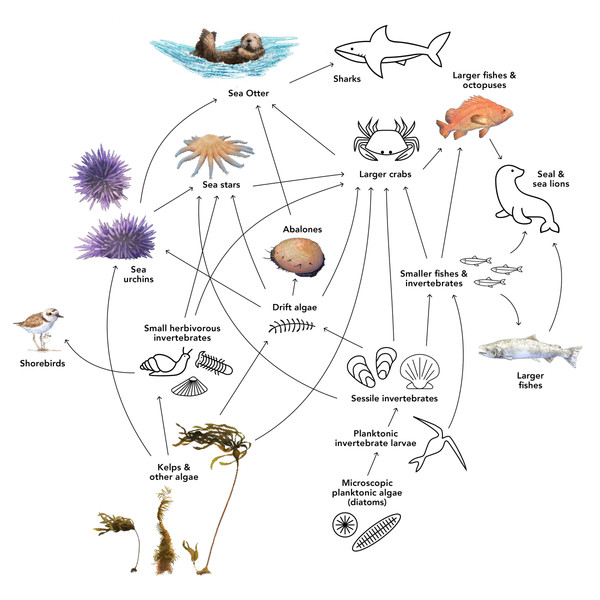
Kelp forest food web
Food webs help you make directional predictions, not exact numerical ones. Strong AP-style reasoning explains one link at a time.
Feedback Loops in Food Webs
A negative feedback loop counteracts the original change and tends to stabilize the system.
- herbivores increase → plants decrease → food shortage increases → herbivores decrease
A positive feedback loop reinforces the original change and tends to reduce stability.
- plant cover decreases → erosion and nutrient loss increase → plant regrowth gets harder → plant cover decreases more
A trophic cascade is not automatically a feedback loop. It becomes feedback only if the later effects circle back and influence the original part of the system.
Key Takeaways
Food Chain
A simplified linear model showing one pathway of energy and matter transfer from a producer through successive consumers
Food Web
A model of two or more interlocking food chains showing multiple pathways of energy and matter transfer in a community
Arrow Direction in a Food Chain or Food Web
An arrow ordinarily points from the organism being consumed to its consumer, the direction in which energy and matter are transferred
Trophic Level
An organism’s feeding position in a food chain or food web, determined by how it obtains energy and matter
Producer (Autotroph)
An organism that makes organic compounds from inorganic materials and occupies the first trophic level
Primary Consumer
A consumer that eats producers and occupies the second trophic level along that pathway
Secondary Consumer
A consumer that eats primary consumers and occupies the third trophic level along that pathway
Tertiary Consumer
A consumer that eats secondary consumers and occupies the fourth trophic level along that pathway
Herbivore
An organism that consumes producers
Carnivore
An organism that consumes animals and may occupy different consumer levels depending on its prey
Omnivore
An organism that consumes both producers and animals and can occupy more than one trophic level
Detritus
Nonliving organic matter such as dead organisms, shed material, leaf litter, and feces
Detritivore
An organism that ingests detritus and physically breaks it into smaller pieces, increasing the surface area available for decomposition
Scavenger
An animal that consumes relatively large pieces of dead animals without completing their chemical decomposition
Decomposer
An organism, especially a bacterium or fungus, that chemically breaks down organic matter and releases nutrients in inorganic forms
Direct Effect vs. Indirect Effect
A direct effect occurs between connected food and consumer populations; an indirect effect reaches another population through one or more intermediate species
Trophic Cascade
A series of indirect effects transmitted across multiple trophic levels after a population changes, often beginning with a top predator
Negative Feedback Loop
A loop in which a system’s response counteracts the initial change and tends to promote relative stability
Positive Feedback Loop
A loop in which a system’s response reinforces the initial change, pushing the system farther in the same direction
Notes
Food Chain
A simplified linear model showing one pathway of energy and matter transfer from a producer through successive consumers
Food Web
A model of two or more interlocking food chains showing multiple pathways of energy and matter transfer in a community
Arrow Direction in a Food Chain or Food Web
An arrow ordinarily points from the organism being consumed to its consumer, the direction in which energy and matter are transferred
Trophic Level
An organism’s feeding position in a food chain or food web, determined by how it obtains energy and matter
Producer (Autotroph)
An organism that makes organic compounds from inorganic materials and occupies the first trophic level
Primary Consumer
A consumer that eats producers and occupies the second trophic level along that pathway
Secondary Consumer
A consumer that eats primary consumers and occupies the third trophic level along that pathway
Tertiary Consumer
A consumer that eats secondary consumers and occupies the fourth trophic level along that pathway
Herbivore
An organism that consumes producers
Carnivore
An organism that consumes animals and may occupy different consumer levels depending on its prey
Omnivore
An organism that consumes both producers and animals and can occupy more than one trophic level
Detritus
Nonliving organic matter such as dead organisms, shed material, leaf litter, and feces
Detritivore
An organism that ingests detritus and physically breaks it into smaller pieces, increasing the surface area available for decomposition
Scavenger
An animal that consumes relatively large pieces of dead animals without completing their chemical decomposition
Decomposer
An organism, especially a bacterium or fungus, that chemically breaks down organic matter and releases nutrients in inorganic forms
Direct Effect vs. Indirect Effect
A direct effect occurs between connected food and consumer populations; an indirect effect reaches another population through one or more intermediate species
Trophic Cascade
A series of indirect effects transmitted across multiple trophic levels after a population changes, often beginning with a top predator
Negative Feedback Loop
A loop in which a system’s response counteracts the initial change and tends to promote relative stability
Positive Feedback Loop
A loop in which a system’s response reinforces the initial change, pushing the system farther in the same direction
