Topic 9.9 Notes – Endangered Species
What Endangered Species Are
A species is extinct when it is gone everywhere on Earth. Extirpation means local extinction, so the species disappears from one area but still exists somewhere else.
Endangered and threatened are close, but not the same.
- Endangered species face a very high risk of extinction.
- Threatened species are likely to become endangered if current trends keep going.
A species becomes endangered when deaths, failed reproduction, habitat loss, or other pressures make long-term survival uncertain. That does not mean every small population is endangered.
What matters is the full picture:
- Is the population shrinking or stable?
- Is its range wide or tiny?
- Can it recover quickly?
- How severe are the threats?
A species’ health depends on both ecosystem conditions and its own traits. The same change, like habitat loss or warming, might barely affect one species and devastate another.
Why Species Become Endangered
These causes often work together rather than one at a time.
Extensive hunting and harvesting
If individuals are removed faster than the population can replace them, numbers fall. This is especially damaging when hunters target reproductive adults, because those are the individuals producing the next generation.
- Poaching means illegal hunting or capture.
- Wildlife trade can keep a species declining even when laws exist.
Passenger pigeon is the classic example. It was once extremely abundant, but heavy hunting plus habitat loss drove it to extinction. APES likes this example because it proves that even a huge population can collapse fast.
Limited diet and narrow niche
A specialist depends on a narrow set of resources or conditions. A generalist can use many.
- Specialists are hit harder when one needed resource disappears.
- Generalists are usually more flexible.
The giant panda is a specialist. It depends heavily on bamboo, so loss of bamboo habitat hurts it much more than it would hurt a broad-diet species.
Specific and limited habitat requirements
Some species need very particular habitat conditions. If that habitat is altered, they lose food, shelter, breeding sites, and territory all at once.
Species with small geographic ranges are especially vulnerable because one disturbance can affect almost the whole species.
Invasive species
Invasive species can:
- outcompete native species for resources
- prey on native species
- introduce disease
They are often generalists with rapid reproduction.
Brown tree snake on Guam is the key example. It preyed on native birds and caused major bird population declines.
Competition for limited resources
Species compete for:
- food
- water
- territory
- habitat
- breeding sites
- shelter
- mates
If a species repeatedly loses access to these, survival and reproduction drop. Competition often combines with habitat loss or invasive species and pushes a species closer to extinction.
Traits That Change Extinction Risk
Not all species respond the same way to environmental change.
Lower risk traits
- broad niche and generalist diet
- ability to adapt behaviorally or over generations
- ability to move to new suitable habitat
- early maturity and rapid reproduction
Higher risk traits
- specialized food or habitat needs
- poor dispersal ability or isolated range
- low reproductive rate and long generation time
- large territory needs or naturally low population density
A selective pressure is any environmental factor that affects survival or reproductive success. Examples include predation, disease, temperature, water availability, food supply, competition, and human harvesting.
One common mistake is thinking selective pressures make organisms instantly develop helpful traits. They do not. They act on existing variation in a population.
Why Small Populations Are Hard to Save
Once a population gets very small, decline can speed up.
- Less genetic diversity means less ability to adapt.
- Inbreeding increases the chance of harmful recessive traits showing up.
- Random events like storms, disease, wildfire, or a bad breeding year matter more.
- Individuals may struggle to find mates.
This self-reinforcing decline is called the extinction vortex. The diagram shows how small population size can trigger a feedback loop of inbreeding, genetic drift, lower fitness, and even smaller population size.
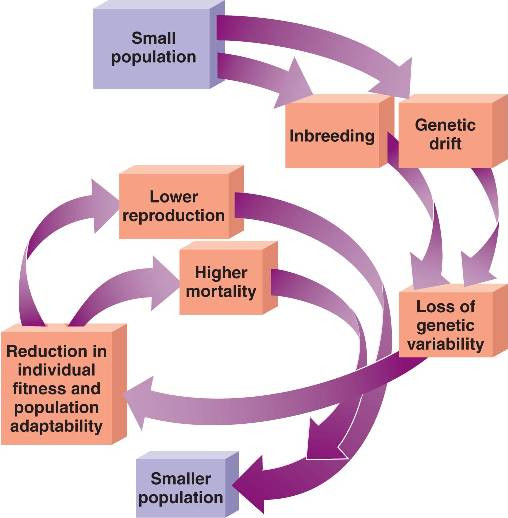
Extinction vortex
Minimum viable population means the smallest estimated population likely to persist under expected conditions. There is no single universal number.
How Conservation Reduces Extinction Risk
The best solution matches the actual cause of decline.
Reducing poaching
This includes criminalizing poaching, patrols, surveillance, penalties, and trade-route enforcement. Laws only work when they are enforced.
Protecting habitat
Habitat protection preserves food, water, shelter, breeding sites, and territory. Restoration can rebuild damaged habitat. Protected areas need to be large enough and include the key resources a species actually uses.
Legislation
- Endangered Species Act protects listed species and critical habitat in the U.S.
- CITES regulates international wildlife trade.
The bald eagle is a recovery success story. Its comeback was helped by legal protection, habitat conservation, and the DDT ban.
Captive breeding and reintroduction
This is ex situ conservation, meaning conservation outside the natural habitat.
- helps prevent immediate extinction
- can rebuild populations
- has limits such as high cost, low genetic diversity, and poor survival after release
Black-footed ferret is the example. Captive breeding helped restore populations, but long-term success still depends on habitat and prey availability.
Using evidence to support a solution usually follows this chain:
- Identify that the population is declining.
- Use data to identify the main cause.
- Choose a strategy that targets that cause.
- Monitor whether the population stabilizes or grows.
Key Takeaways
Extinction
Permanent loss of a species because no living individuals remain anywhere
Extirpation (Local Extinction)
Disappearance of a species from part of its range while it continues to exist elsewhere
Endangered Species
A species facing a very high risk of extinction; under the U.S. ESA, one in danger of extinction throughout all or a significant portion of its range
Threatened Species
A species likely to become endangered if current conditions continue or, under the U.S. ESA, within the foreseeable future
IUCN Red List
A widely used global assessment of species’ extinction risk maintained by the International Union for Conservation of Nature, not a law
Extinct in the Wild
IUCN category for a species surviving only in captivity, cultivation, or populations outside its former natural range
Critically Endangered
IUCN category for a species facing an extremely high risk of extinction in the wild
Vulnerable
IUCN category for a species facing a high risk of extinction in the wild
Near Threatened
IUCN category for a species close to qualifying for a threatened category or likely to do so soon
Least Concern
IUCN category for an assessed species that currently has relatively low extinction risk
IUCN Threatened Categories
Vulnerable, Endangered, and Critically Endangered
Poaching
Illegal hunting of wildlife
Specialist Species
A species with a narrow niche or specific food, habitat, or environmental requirements, making it vulnerable when those conditions disappear
Generalist Species
A species that uses many resources or tolerates a broad range of conditions, making it generally more resilient to change
Competition
Interaction that occurs when organisms’ demand for food, territory, mates, habitat, or another resource exceeds its availability
Selective Pressure
An environmental factor that affects organisms’ behavior, survival, or reproductive success
Fitness
An organism’s relative success in surviving and passing its genes to the next generation
Extinction Vortex
A reinforcing decline in which small population size causes genetic, reproductive, and chance problems that make the population even smaller
Minimum Viable Population
An estimate of the smallest population likely to persist for a specified period under expected environmental conditions
In Situ Conservation
Conservation of a species within its natural habitat
Ex Situ Conservation
Conservation of a species outside its natural habitat, such as in a zoo, aquarium, or breeding facility
Criminalizing and Reducing Poaching
Prohibiting wildlife killing or trade and enforcing the ban through monitoring, patrols, penalties, trade controls, and prosecution
Endangered Species Act of 1973
U.S. law protecting listed threatened and endangered species by restricting taking, protecting critical habitat, and limiting harmful federal actions
Taking
Under the Endangered Species Act, actions such as killing, harming, capturing, or collecting protected wildlife
CITES (Convention on International Trade in Endangered Species of Wild Fauna and Flora)
International agreement that uses permits and trade restrictions to regulate cross-border commerce in wildlife and wildlife products
Captive Breeding
Ex situ breeding of endangered organisms under controlled conditions to increase numbers, preserve genetic diversity, and support possible reintroduction
Habitat Protection
Preserving the food, shelter, breeding sites, territory, and other habitat features a species needs
Habitat Restoration
Reestablishing native vegetation, water flow, nesting sites, or other lost habitat features
Reintroduction
Releasing captive-bred organisms into protected natural habitat to rebuild wild populations
Notes
Extinction
Permanent loss of a species because no living individuals remain anywhere
Extirpation (Local Extinction)
Disappearance of a species from part of its range while it continues to exist elsewhere
Endangered Species
A species facing a very high risk of extinction; under the U.S. ESA, one in danger of extinction throughout all or a significant portion of its range
Threatened Species
A species likely to become endangered if current conditions continue or, under the U.S. ESA, within the foreseeable future
IUCN Red List
A widely used global assessment of species’ extinction risk maintained by the International Union for Conservation of Nature, not a law
Extinct in the Wild
IUCN category for a species surviving only in captivity, cultivation, or populations outside its former natural range
Critically Endangered
IUCN category for a species facing an extremely high risk of extinction in the wild
Vulnerable
IUCN category for a species facing a high risk of extinction in the wild
Near Threatened
IUCN category for a species close to qualifying for a threatened category or likely to do so soon
Least Concern
IUCN category for an assessed species that currently has relatively low extinction risk
IUCN Threatened Categories
Vulnerable, Endangered, and Critically Endangered
Poaching
Illegal hunting of wildlife
Specialist Species
A species with a narrow niche or specific food, habitat, or environmental requirements, making it vulnerable when those conditions disappear
Generalist Species
A species that uses many resources or tolerates a broad range of conditions, making it generally more resilient to change
Competition
Interaction that occurs when organisms’ demand for food, territory, mates, habitat, or another resource exceeds its availability
Selective Pressure
An environmental factor that affects organisms’ behavior, survival, or reproductive success
Fitness
An organism’s relative success in surviving and passing its genes to the next generation
Extinction Vortex
A reinforcing decline in which small population size causes genetic, reproductive, and chance problems that make the population even smaller
Minimum Viable Population
An estimate of the smallest population likely to persist for a specified period under expected environmental conditions
In Situ Conservation
Conservation of a species within its natural habitat
Ex Situ Conservation
Conservation of a species outside its natural habitat, such as in a zoo, aquarium, or breeding facility
Criminalizing and Reducing Poaching
Prohibiting wildlife killing or trade and enforcing the ban through monitoring, patrols, penalties, trade controls, and prosecution
Endangered Species Act of 1973
U.S. law protecting listed threatened and endangered species by restricting taking, protecting critical habitat, and limiting harmful federal actions
Taking
Under the Endangered Species Act, actions such as killing, harming, capturing, or collecting protected wildlife
CITES (Convention on International Trade in Endangered Species of Wild Fauna and Flora)
International agreement that uses permits and trade restrictions to regulate cross-border commerce in wildlife and wildlife products
Captive Breeding
Ex situ breeding of endangered organisms under controlled conditions to increase numbers, preserve genetic diversity, and support possible reintroduction
Habitat Protection
Preserving the food, shelter, breeding sites, territory, and other habitat features a species needs
Habitat Restoration
Reestablishing native vegetation, water flow, nesting sites, or other lost habitat features
Reintroduction
Releasing captive-bred organisms into protected natural habitat to rebuild wild populations
