Topic 5.14 Notes – Integrated Pest Management
What Integrated Pest Management Is
Integrated pest management, or IPM, means using multiple pest-control methods together to keep pest populations at acceptable levels while minimizing environmental disruption and threats to human health.
A pest is any organism that damages something people value or gets in the way of a human goal. In APES, that can include:
- Insects that eat crops
- Weeds that compete with crops
- Fungi that cause plant disease
- Rodents that damage stored grain or fields
- Other organisms that cause economic or health problems
The most tested idea here is simple. IPM manages pests. It does not aim to wipe out every single pest. A few pests may still be present.
A couple common mistakes:
- IPM is not one technique. Crop rotation alone is not IPM.
- IPM is not routine pesticide spraying.
- IPM can include pesticides, so it is not automatically pesticide-free or organic.
That is what makes it a sustainability strategy. You still protect crops, but you reduce dependence on broad chemical control.
Main Parts of an IPM Program
IPM works by combining several kinds of control.
Biological control
Biological control uses living organisms to reduce pest populations.
Examples you need to know:
- Predators such as lady beetles feeding on aphids
- Parasitoids that lay eggs in or on a host, eventually killing it
- Pathogens that infect pests
- Herbivores used against unwanted plants
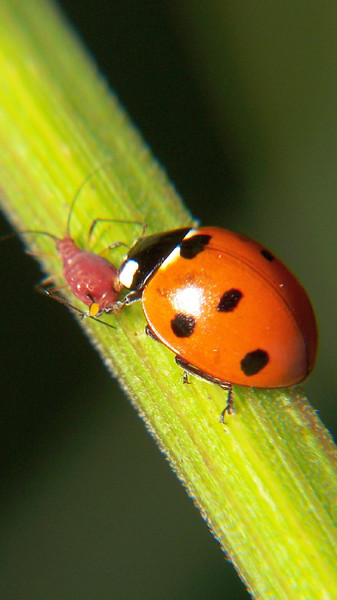
Lady beetle preying on an aphid
That predator-prey example is exactly what the image shows.
Why it helps:
- Can be species-specific
- Can reduce chemical use
Risk to remember:
- An introduced control organism may affect non-target species
- It could even become invasive
Cultural and preventive control
These methods change farming practices so pests are less likely to survive or spread.
Illustrative examples:
- Crop rotation means changing crops from season to season so pests tied to one host crop lose their food source.
- Intercropping means growing multiple crops together, which breaks up large monocultures and can help natural enemies.
Other examples:
- Removing infected plant material
- Cleaning equipment
- Changing planting dates
- Managing habitat for beneficial organisms
Physical and mechanical control
These methods block, trap, remove, or kill pests without mainly relying on toxic chemicals.
Examples:
- Barriers, screens, nets, row covers
- Traps
- Hand-removal
- Weed removal
- Destruction of infested crop residue
Limited chemical control
Pesticides are still allowed in IPM, but only as one part of the plan.
Examples:
- Treat only infested areas
- Spray only after a threshold is reached
- Use the lowest effective amount
- Choose more targeted pesticides
- Time spraying to reduce harm to pollinators and people
This is different from calendar spraying, where fields are sprayed on a schedule whether pests justify it or not.
How IPM Works
IPM is a decision-making process.
- Identify the pest correctly
- Monitor population size and damage with scouting, traps, and plant inspections
- Compare the results to an action threshold
- Choose the best combination of controls
- Evaluate results and adjust the plan
The threshold part is easy to mix up:
- Action threshold means the point where control should begin
- Economic injury level means the point where crop damage costs as much as or more than control
So the action threshold is set below the economic injury level.
This graph shows why. Pest numbers can rise over time, and control should start once they reach the action threshold, before they hit the economic injury level.
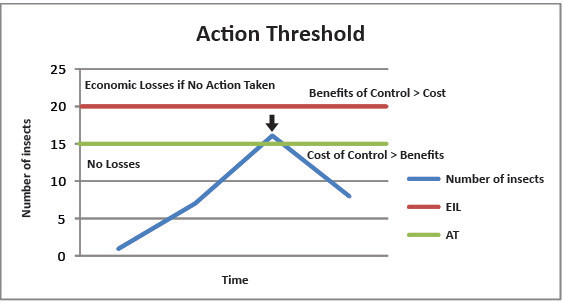
Action threshold and economic injury level
That graph matters because it shows the goal. Keep pest numbers below damaging levels, not at zero.
Why IPM Matters
IPM reduces risks from pesticides by reducing unnecessary chemical use.
It helps protect:
- Wildlife and beneficial organisms such as pollinators, soil organisms, aquatic organisms, and natural pest predators
- Water supplies by reducing runoff, leaching, and drift into streams, lakes, and groundwater
- Human health, especially farmworkers and nearby residents
It also causes less ecological disruption because pest-specific methods preserve more normal food web interactions. Another major benefit is that it can slow pesticide resistance, since pests are not exposed over and over to the same chemical.
Benefits and Drawbacks
| Benefits | Drawbacks |
|---|---|
| Less chemical dependence | More complex and knowledge-intensive |
| More sustainable over time | Can be expensive |
| Protects beneficial organisms and biodiversity | Requires monitoring, recordkeeping, and correct identification |
| Can maintain crop protection with fewer side effects | May require more labor |
| Can slow pesticide resistance | Results may be slower or less predictable |
IPM is still not risk-free. Pesticides in an IPM system can still drift or run off, and poor biocontrol choices can harm non-target species.
When you evaluate whether IPM is working, use both pest-control evidence and environmental evidence:
- pest abundance
- crop damage
- yield
- pesticide use
- beneficial-organism abundance
- water contamination
- total cost
Key Takeaways
Integrated Pest Management (IPM)
Combines biological, cultural, physical, and limited chemical methods to keep pests below damaging levels while reducing environmental and human-health risks; it can require greater cost, labor, knowledge, and coordination
Pest
An organism whose population damages a valued resource or causes unacceptable agricultural, economic, or health-related harm
IPM Process
Identify the pest, monitor its population and damage, compare it with a threshold, combine appropriate controls, and evaluate and adjust the results
Monitoring (Scouting)
Regularly inspecting, counting, trapping, and recording pests, damage, and beneficial organisms to determine whether control is needed and effective
Action Threshold
The pest-population or expected-damage level at which control measures should be applied, set below the economic injury level
Economic Injury Level
The pest level at which the economic value of crop damage equals or exceeds the cost of controlling the pest
Biological Control (Biocontrol)
The use of living predators, parasitoids, pathogens, or herbivores to reduce a pest population
Cultural Control
Changing how crops or managed landscapes are arranged or maintained to hinder pest survival, reproduction, or spread
Crop Rotation
Changing the crop grown in a field between seasons or years to interrupt the life cycles of pests dependent on a particular host
Intercropping
Growing two or more crops together in the same field to reduce host concentration, hinder pest spread, or support natural enemies
Physical or Mechanical Control
Using barriers, traps, hand removal, machinery, or destruction of infested material to block, capture, remove, or kill pests without relying primarily on toxic chemicals
Limited Chemical Control
Selective, targeted pesticide use only when monitoring shows it is needed, using the lowest effective amount while limiting harm to non-target organisms
Notes
Integrated Pest Management (IPM)
Combines biological, cultural, physical, and limited chemical methods to keep pests below damaging levels while reducing environmental and human-health risks; it can require greater cost, labor, knowledge, and coordination
Pest
An organism whose population damages a valued resource or causes unacceptable agricultural, economic, or health-related harm
IPM Process
Identify the pest, monitor its population and damage, compare it with a threshold, combine appropriate controls, and evaluate and adjust the results
Monitoring (Scouting)
Regularly inspecting, counting, trapping, and recording pests, damage, and beneficial organisms to determine whether control is needed and effective
Action Threshold
The pest-population or expected-damage level at which control measures should be applied, set below the economic injury level
Economic Injury Level
The pest level at which the economic value of crop damage equals or exceeds the cost of controlling the pest
Biological Control (Biocontrol)
The use of living predators, parasitoids, pathogens, or herbivores to reduce a pest population
Cultural Control
Changing how crops or managed landscapes are arranged or maintained to hinder pest survival, reproduction, or spread
Crop Rotation
Changing the crop grown in a field between seasons or years to interrupt the life cycles of pests dependent on a particular host
Intercropping
Growing two or more crops together in the same field to reduce host concentration, hinder pest spread, or support natural enemies
Physical or Mechanical Control
Using barriers, traps, hand removal, machinery, or destruction of infested material to block, capture, remove, or kill pests without relying primarily on toxic chemicals
Limited Chemical Control
Selective, targeted pesticide use only when monitoring shows it is needed, using the lowest effective amount while limiting harm to non-target organisms
