Topic 5.17 Notes – Sustainable Forestry
What Sustainable Forestry Is
Sustainable forestry means managing forests so people can harvest wood without reducing the forest’s long-term ability to regrow and do its ecological jobs.
This connects to sustainable yield, which is the amount of a renewable resource you can remove without shrinking the future supply. For forests, harvest rate should not exceed long-term regrowth.
That idea is broader than “plant new trees after cutting.” A forest can still lose major functions even if trees come back.
- Deforestation means the forest is removed or the land is converted, so it is no longer forest.
- Forest degradation means the forest is still there, but its health, biodiversity, structure, or ecological function has declined.
Why unsustainable logging becomes a problem:
- Forests usually regrow slowly compared with how quickly timber can be removed.
- Clearcutting and road building can increase erosion, runoff, stream sediment, habitat fragmentation, and carbon release.
- Replanting alone does not replace old-growth features like layered canopies, large old trees, snags, fallen logs, and high biodiversity.
A large clearcut can leave bare slopes, logging roads, and fragmented patches of remaining forest, which is why harvest methods matter as much as whether trees are replanted later.
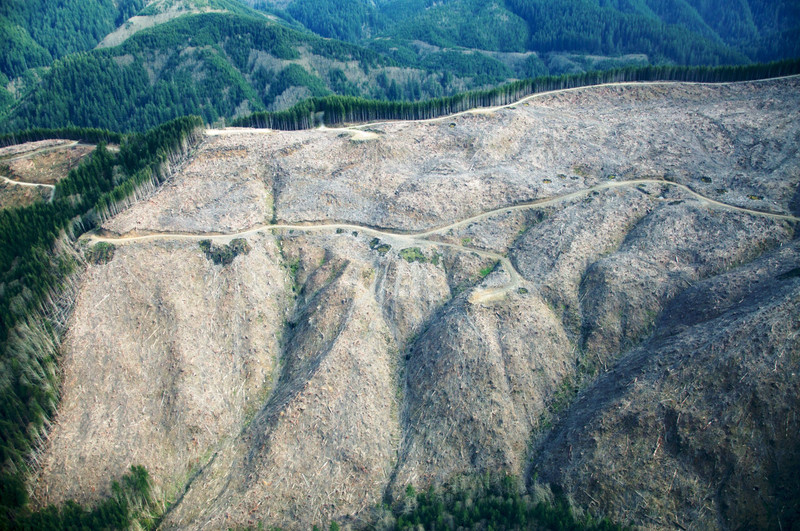
Clearcutting on a steep forested slope
Ways to Reduce Human Impact on Forests
These methods all reduce pressure on forests, but each solves a different part of the problem.
Reforestation
Reforestation is reestablishing trees on land that was recently forested.
- Natural regeneration uses seeds and sprouts already present.
- Active planting means humans plant seedlings.
Benefits:
- replaces harvested trees
- stabilizes soil and reduces erosion
- increases infiltration and shades streams
- restores habitat
- removes CO2 from the atmosphere and stores carbon
Limits:
- It does not quickly recreate mature or old-growth forest.
- Monocultures are less resilient than mixed native species.
- Seedling survival depends on local soil, climate, water, grazing, pests, and management.
Ecologically sustainable timber harvest
This means removing wood while leaving enough forest structure and regenerative capacity for the forest to persist.
Selective cutting removes individual trees or small groups instead of the whole stand.
- usually less canopy loss and less habitat destruction than clearcutting
- still can cause compaction, erosion, and fragmentation if poorly managed
Other sustainable harvest practices include:
- limiting harvest to regrowth
- allowing enough time between harvests
- retaining mature trees, snags, and fallen logs
- protecting rare species and sensitive areas
- leaving riparian buffers along streams
- minimizing logging roads and soil disturbance
- monitoring regeneration after harvest
Buying sustainably harvested wood
Consumer demand can push producers toward better forestry.
- Forest Stewardship Council (FSC) is the key example you should know.
- Certification means wood came from forests managed with environmental safeguards.
- Chain of custody tracks certified wood through processing and sale.
Certification reduces impacts, but logging is still not impact-free.
Reusing wood
Reusing wood lowers demand for newly harvested timber.
Examples you need to know:
- reclaimed structural lumber
- repaired wooden furniture
- remanufactured pallets
- salvaged boards in new construction
Benefits include fewer trees cut, less energy used in harvesting/processing, and less landfill waste. Limits include damage, contamination, and failure to meet structural standards.
Protecting Forests from Pests and Disease
Forests can be damaged by insects and pathogens, so management tries to control outbreaks without creating even more harm.
Integrated pest management in forests
IPM uses targeted, lower-impact controls first.
- Monitor trees and identify the pest or pathogen correctly.
- Determine outbreak size and severity.
- Decide whether intervention is necessary.
- Use targeted controls first.
- Evaluate whether treatment worked.
Possible methods:
- species and age diversity
- resistant varieties
- traps or pheromones
- protection of natural predators
- limited, targeted pesticide use
Its main advantage is lower harm to nontarget organisms and waterways.
Removal of affected trees
This is sanitation cutting. Managers remove infected or infested trees to slow spread.
- works best when caught early and still localized
- must be targeted, not broad clearcutting
Drawbacks include habitat loss, carbon loss, soil disturbance, and accidental injury to nearby trees.
How Prescribed Burns Lower Wildfire Risk
A prescribed burn or controlled burn is a fire set intentionally under planned conditions to reduce fuel buildup.
This also helps remove ladder fuels, the low shrubs and small trees that let a surface fire climb into the canopy.
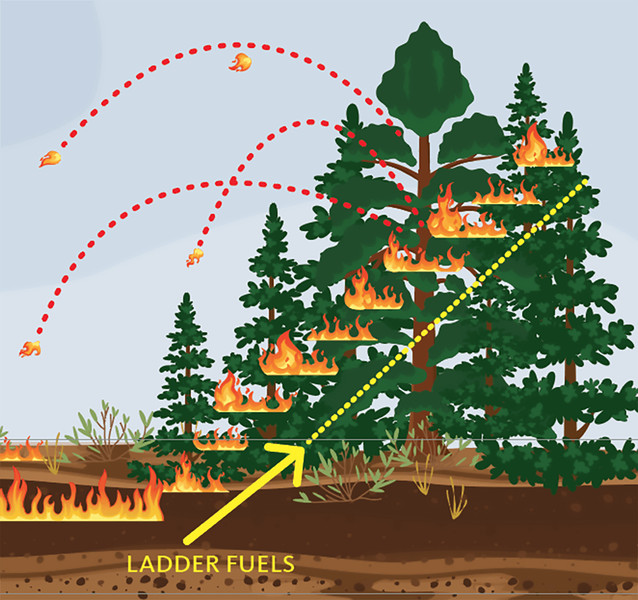
Ladder fuels and crown fire risk
This matters because fire suppression can let leaves, branches, shrubs, and small trees pile up. That dry fuel can make later wildfires hotter, faster, and harder to control.
How it works:
- Choose proper weather and fuel conditions.
- Establish firebreaks and burn boundaries.
- Use trained crews and planned ignition patterns.
- Monitor and contain the fire.
Benefits:
- lowers fuel loads
- reduces undergrowth that carries fire into the canopy
- recycles nutrients
- helps some fire-adapted species and habitats
- may reduce some pests, pathogens, and invasive plants
Risks and limits include smoke, air pollution, possible escape, organism death, erosion if too intense, and the fact that it is not appropriate in every forest.
Key Takeaways
Sustainable Forestry
Managing and using forests for products without exhausting their regenerative capacity or undermining long-term ecological functions
Sustainable Yield
The amount of a renewable resource that can be removed without reducing its long-term available supply; timber harvest should not exceed forest regeneration
Reforestation
Reestablishing trees on recently forested land after trees were lost through logging or another disturbance
Ecologically Sustainable Timber Harvest
Removing wood at a rate the forest can replace while retaining enough structure and regenerative capacity for the forest to persist
Selective Cutting
Harvesting individual mature trees or small groups rather than removing the entire stand, usually retaining more canopy, roots, habitat, and seed sources than clearcutting
Riparian Buffer
Vegetation retained beside a stream to stabilize banks, filter runoff, trap sediment and nutrients, and shade the water
Forest Certification
Standards and audits identifying wood from forests managed with specified environmental and social safeguards, such as FSC certification
Chain-of-Custody System
A system that tracks certified wood from the forest through processing and sale so uncertified material is not sold as certified
Wood Reuse
Keeping salvaged or existing wood in service so fewer new trees are harvested and less wood becomes waste
Integrated Pest Management (IPM)
Monitoring and identifying forest pests, intervening only when justified, and combining targeted biological, physical, cultural, and limited chemical controls
Sanitation Cutting (Removal of Affected Trees)
Targeted removal and safe handling of infected or infested trees to eliminate a localized source of pest or pathogen spread
Prescribed Burn (Controlled Burn)
A fire intentionally set and managed under planned conditions to consume accumulated fuel and reduce the severity of later wildfires
Notes
Sustainable Forestry
Managing and using forests for products without exhausting their regenerative capacity or undermining long-term ecological functions
Sustainable Yield
The amount of a renewable resource that can be removed without reducing its long-term available supply; timber harvest should not exceed forest regeneration
Reforestation
Reestablishing trees on recently forested land after trees were lost through logging or another disturbance
Ecologically Sustainable Timber Harvest
Removing wood at a rate the forest can replace while retaining enough structure and regenerative capacity for the forest to persist
Selective Cutting
Harvesting individual mature trees or small groups rather than removing the entire stand, usually retaining more canopy, roots, habitat, and seed sources than clearcutting
Riparian Buffer
Vegetation retained beside a stream to stabilize banks, filter runoff, trap sediment and nutrients, and shade the water
Forest Certification
Standards and audits identifying wood from forests managed with specified environmental and social safeguards, such as FSC certification
Chain-of-Custody System
A system that tracks certified wood from the forest through processing and sale so uncertified material is not sold as certified
Wood Reuse
Keeping salvaged or existing wood in service so fewer new trees are harvested and less wood becomes waste
Integrated Pest Management (IPM)
Monitoring and identifying forest pests, intervening only when justified, and combining targeted biological, physical, cultural, and limited chemical controls
Sanitation Cutting (Removal of Affected Trees)
Targeted removal and safe handling of infected or infested trees to eliminate a localized source of pest or pathogen spread
Prescribed Burn (Controlled Burn)
A fire intentionally set and managed under planned conditions to consume accumulated fuel and reduce the severity of later wildfires
