Topic 6.3 Notes – Fuel Types and Uses
What Fuels Are and How Their Uses Differ
A fuel is any material that stores chemical energy and releases usable energy when it is burned or otherwise converted.
Two useful categories show up right away:
- Direct fuels are burned with little processing.
- Firewood and peat fit here.
- Processed fuels are made from or separated out of raw resources.
- Charcoal is made from wood.
- Refined petroleum products are made from crude oil.
What makes one fuel better than another depends on a few things:
- Energy content
More energy per mass or volume means more useful power or heat. - Moisture content
Wet fuels waste energy evaporating water, so they usually burn less efficiently. - Carbon content and composition
This affects heat output and emissions. - Ignition, storage, and transport
A fuel might burn well but still be inconvenient to move or store. - Accessibility and cost
A fuel people can easily get often gets used even if it is lower quality. - Intended use
Cooking, home heating, electricity generation, transportation, and industry all need different fuel traits.
The main idea is simple. The “best” fuel depends on the job and the infrastructure available.
Major Fuel Types and Their Common Uses
Wood fuels
- Firewood is wood burned directly.
- Common for cooking and heating, especially in developing countries and rural areas.
- It is widely used because it is accessible and needs little technology.
- It often has lower efficiency because moisture and incomplete combustion reduce useful heat.
- Charcoal is a carbon-rich fuel made by heating wood in low oxygen.
- Burns hotter and with less smoke at the point of use than firewood.
- It is more compact and easier to store and transport.
- Used for cooking and for jobs needing concentrated heat.
- Important exam trap: charcoal is processed wood, not coal.
Peat
- Peat is partially decomposed organic material from waterlogged places such as bogs.
- It can be dried and burned for heating or cooking.
- It is a low-quality fuel because it has high moisture and lower energy content.
- Another common trap: peat is a precursor to coal, but it is not one of the three coal grades.
Coal types
Coal forms in a progression as burial, heat, and pressure increase. The diagram below traces that change from peat into lignite and then higher-grade coals.
- Peat
- Lignite
- Bituminous coal
- Anthracite
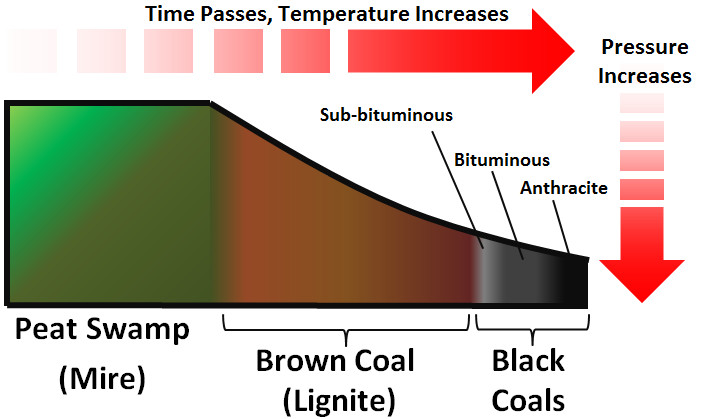
Coal formation and increasing coal rank
Across that sequence, carbon concentration and energy content increase, and moisture decreases.
- Lignite
- Lowest-grade coal
- High moisture, lower carbon, lower energy
- Often used near mining sites for electricity generation
- Bituminous coal
- Intermediate-to-high-grade coal
- More energy and less moisture than lignite
- Major fuel for electricity generation and industrial heating
- Anthracite
- Highest-grade coal
- Highest carbon concentration and heat content
- Burns hotter and relatively more cleanly than lower-grade coal
Natural gas
- Natural gas is mostly methane.
- It is the cleanest-burning fossil fuel.
- Used for cooking, space and water heating, industrial heat, electricity generation, and some transportation.
- Delivered by pipeline or stored as compressed or liquefied gas.
Petroleum fuels
- Crude oil is a raw mixture of hydrocarbons.
- It is refined into specialized fuels such as:
- gasoline
- diesel fuel
- jet fuel
- heating oil
- liquefied petroleum gases such as propane
- Petroleum works especially well for transportation because liquid fuels are energy-dense and easy to store in tanks.
Tar Sands and Specialized Petroleum Products
Tar sands are a mixture of clay, sand, water, and bitumen.
- Bitumen is a thick, viscous hydrocarbon material.
- It must be separated and processed before use.
- Tar sands are an unconventional petroleum resource.
- They are not pure crude oil and not a finished fuel.
Refined petroleum products have specialized uses:
- Gasoline for spark-ignition motor vehicles
- Diesel for trucks, buses, heavy equipment, ships, and generators
- Jet fuel for turbine aircraft
- Heating oil for furnaces and boilers
- Propane for cooking, heating, and some vehicles
Matching Fuels to Uses
Here’s the pattern APES wants you to recognize:
| Use | Common fuels |
|---|---|
| Household cooking and heating | firewood, charcoal, peat, natural gas, propane |
| Electricity generation | lignite, bituminous coal, natural gas |
| Industrial heat | coal, natural gas, charcoal, petroleum fuels |
| Transportation | gasoline, diesel, jet fuel |
Why these patterns happen:
- Solids like coal work well in large stationary facilities.
- Gases like natural gas work well where pipelines or storage systems exist.
- Liquids from petroleum dominate transportation because they are portable and energy dense.
How Cogeneration Increases Efficiency
Cogeneration, or combined heat and power, uses one fuel source to produce both electricity and useful heat.
The diagram below shows the basic idea. Instead of letting the exhaust heat leave the system, a CHP plant captures it and uses it.
- Fuel is burned.
- The system generates electricity.
- Waste heat is captured instead of released.
- That heat is used for steam, hot water, space heating, or industrial processes.
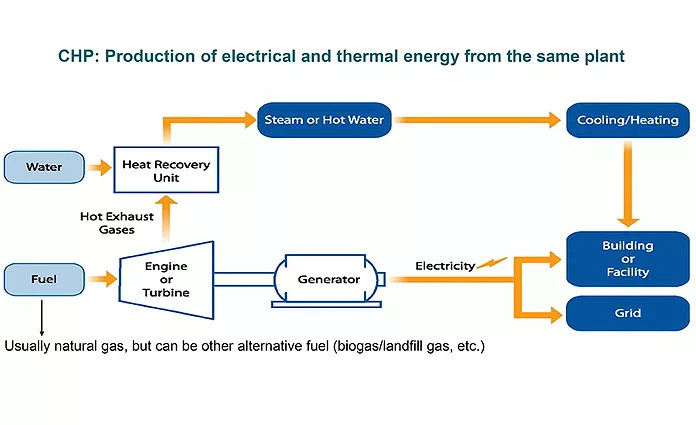
Combined heat and power system
Why it matters:
- It increases overall efficiency
- It reduces the need for separate fuel use for heat and electricity
- It can lower costs and emissions
Cogeneration can use natural gas, coal, petroleum products, or biomass. It works best where there is a steady nearby heat demand, like hospitals, factories, campuses, and district-heating systems.
Key Takeaways
Direct Fuels vs. Processed Fuels
Direct fuels are burned with little processing; processed fuels are manufactured or separated from raw resources for specialized uses
Wood Fuel
Recently living biomass used as firewood or charcoal, especially for cooking and heating where wood is locally accessible
Firewood
Wood burned directly for cooking or heating, especially where it can be collected locally
Charcoal
Carbon-rich fuel made by heating wood with little oxygen; it is compact and burns hotter with less smoke than wood
Peat
Partially decomposed organic material from waterlogged environments that can be dried and burned as a low-quality fuel
Coal
Carbon-rich fossil fuel formed when buried ancient plant material undergoes heat and pressure over millions of years
Coal Rank
The progression from peat, a coal precursor, through lignite and bituminous coal to anthracite; carbon and energy content increase while moisture decreases
Lignite
Lowest-grade coal; soft and brownish, with high moisture and relatively low carbon and energy content
Bituminous Coal
Intermediate-to-high-grade coal with less moisture and more carbon and energy than lignite, widely used for electricity and industrial heat
Anthracite
Highest-grade coal; hard, dense, and highest in carbon and energy content among the three coal types
Natural Gas
Fossil fuel composed mostly of methane; the cleanest-burning fossil fuel and used for heating, cooking, electricity, and industry
Crude Oil (Petroleum)
Raw liquid fossil fuel composed of mixed hydrocarbons and refined into specialized fuels such as gasoline, diesel, and jet fuel
Gasoline
Energy-dense liquid fuel refined from petroleum and used mainly in spark-ignition motor vehicles
Diesel Fuel
Petroleum fuel used in diesel automobiles, trucks, buses, heavy equipment, ships, and generators
Jet Fuel
Kerosene-range petroleum fuel used in aircraft turbine engines
Heating Oil
Liquid petroleum fuel used in boilers and furnaces for heating
Liquefied Petroleum Gas (LPG)
Liquefied petroleum fuels such as propane, used for cooking, heating, and some vehicles
Tar Sands (Oil Sands)
An unconventional petroleum resource consisting of clay, sand, water, and bitumen from which petroleum products can be produced
Bitumen
Heavy, viscous hydrocarbon mixture in tar sands that must be separated and processed or diluted
Cogeneration (Combined Heat and Power, CHP)
Using one fuel source to produce both electricity and useful heat by recovering thermal energy that would otherwise be wasted
Notes
Direct Fuels vs. Processed Fuels
Direct fuels are burned with little processing; processed fuels are manufactured or separated from raw resources for specialized uses
Wood Fuel
Recently living biomass used as firewood or charcoal, especially for cooking and heating where wood is locally accessible
Firewood
Wood burned directly for cooking or heating, especially where it can be collected locally
Charcoal
Carbon-rich fuel made by heating wood with little oxygen; it is compact and burns hotter with less smoke than wood
Peat
Partially decomposed organic material from waterlogged environments that can be dried and burned as a low-quality fuel
Coal
Carbon-rich fossil fuel formed when buried ancient plant material undergoes heat and pressure over millions of years
Coal Rank
The progression from peat, a coal precursor, through lignite and bituminous coal to anthracite; carbon and energy content increase while moisture decreases
Lignite
Lowest-grade coal; soft and brownish, with high moisture and relatively low carbon and energy content
Bituminous Coal
Intermediate-to-high-grade coal with less moisture and more carbon and energy than lignite, widely used for electricity and industrial heat
Anthracite
Highest-grade coal; hard, dense, and highest in carbon and energy content among the three coal types
Natural Gas
Fossil fuel composed mostly of methane; the cleanest-burning fossil fuel and used for heating, cooking, electricity, and industry
Crude Oil (Petroleum)
Raw liquid fossil fuel composed of mixed hydrocarbons and refined into specialized fuels such as gasoline, diesel, and jet fuel
Gasoline
Energy-dense liquid fuel refined from petroleum and used mainly in spark-ignition motor vehicles
Diesel Fuel
Petroleum fuel used in diesel automobiles, trucks, buses, heavy equipment, ships, and generators
Jet Fuel
Kerosene-range petroleum fuel used in aircraft turbine engines
Heating Oil
Liquid petroleum fuel used in boilers and furnaces for heating
Liquefied Petroleum Gas (LPG)
Liquefied petroleum fuels such as propane, used for cooking, heating, and some vehicles
Tar Sands (Oil Sands)
An unconventional petroleum resource consisting of clay, sand, water, and bitumen from which petroleum products can be produced
Bitumen
Heavy, viscous hydrocarbon mixture in tar sands that must be separated and processed or diluted
Cogeneration (Combined Heat and Power, CHP)
Using one fuel source to produce both electricity and useful heat by recovering thermal energy that would otherwise be wasted
