Topic 5.8 Notes – Impacts of Overfishing
What Overfishing Is
A fishery includes the fish being harvested, the place they’re caught, and the people and equipment involved. A fish stock is one population or management unit of a species in a certain area.
Overfishing means harvest is happening too fast for replacement. Fish are a renewable resource only when the harvest rate stays below the replacement rate.
The chain you need to picture is this:
- fish are removed, often breeding adults
- fewer adults produce offspring
- recruitment drops
(recruitment = young fish surviving into the harvestable population) - stock abundance declines
- future catches fall too
Three terms get mixed up a lot:
| Term | What it means |
|---|---|
| Overfishing | Excessive harvest is currently happening |
| Overfished stock | The population is already below a management threshold |
| Fishery collapse | Catch or stock falls so low the fishery is no longer ecologically or economically viable |
A collapse does not have to mean extinction. The species can still exist but be too rare to support a fishery.
This also connects to logistic growth. A population grows fastest at an intermediate size, not when it is tiny. The curve below marks that fastest-growth point about halfway to carrying capacity. So once a stock gets very small, recovery is usually slow.
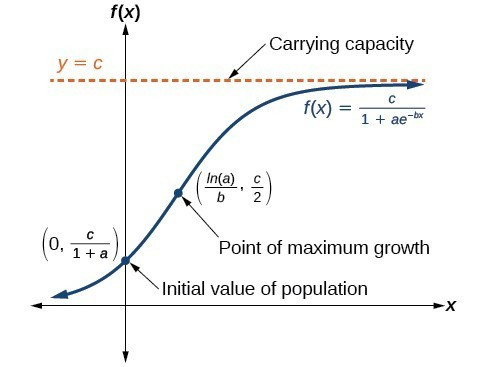
Logistic population growth
Why Fish Populations Become Overfished
Open access and the tragedy of the commons
Many fisheries are common-pool resources. No single fisher owns the whole stock, especially in oceans. Each person gets the short-term benefit of catching more fish, but the cost of depletion is shared by everyone. That is the tragedy of the commons.
Demand, technology, and fishing capacity
More people rely on seafood for protein, and global markets increase demand. Modern fleets also fish much more efficiently:
- sonar locates fish schools
- satellite navigation improves tracking
- large nets increase catch
- refrigerated vessels preserve fish longer
- factory ships process fish at sea
A big trap on tests is this. Catch can stay high even when the stock is declining because technology hides the decline for a while. Government subsidies can also keep too many boats operating.
Weak regulation and illegal fishing
Stocks decline faster when there are:
- no catch limits
- quotas set too high
- weak enforcement
- illegal, unreported, and unregulated fishing
Unreported catch makes stock estimates less accurate. Migratory fish are harder to manage because they cross borders.
Harvest of vulnerable fish
Some harvest hits the most important part of the population:
- immature fish are caught before reproducing
- large breeding adults are removed, lowering spawning-stock biomass
- fishing at spawning grounds or during spawning season does outsized damage
Species with late maturity, slow growth, long lifespans, or few offspring are most vulnerable, especially sharks and many large predatory fish.
Fishing Methods and Their Impacts
A method is not automatically overfishing, but efficient or nonselective methods raise the risk. The gear shown here highlights two methods in this list, bottom trawls and purse seines, and contrasts them with a midwater trawl that fishes higher in the water column.
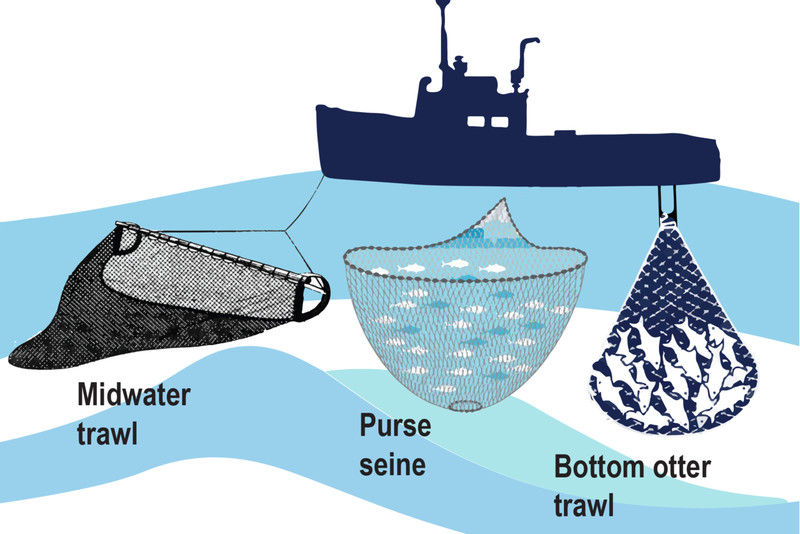
- Bottom trawling drags weighted nets across the seafloor. It catches a lot, but damages corals, sponges, and benthic communities.
- Purse seines surround schools like tuna, herring, and sardines. They can create bycatch in mixed groups.
- Longlines use many baited hooks. They often catch sea turtles, sharks, seabirds, and nontarget fish.
- Gill nets and drift nets entangle fish and also marine mammals, sea turtles, and seabirds. Lost nets cause ghost fishing.
- Traps and pots for crabs and lobsters are relatively selective, but lost gear keeps trapping and ropes can entangle mammals.
Bycatch
Bycatch is unintended capture of nontarget organisms or fish of the wrong size or sex. It can kill juvenile fish, sharks, turtles, seabirds, and marine mammals. Bycatch is different from overfishing, but severe bycatch can overfish a nontarget species.
Ecological and Human Consequences
Overfishing can cause:
- extreme scarcity of harvested species
- lower biodiversity
- possible genetic bottlenecks
- food-web disruption and trophic cascades
- more habitat degradation, which slows recovery
- populations shifting toward smaller, younger fish with lower reproductive output
Human effects matter just as much:
- lower future catch
- more time, fuel, and money needed to catch fish
- less secure jobs and income
- reduced food supply
- higher seafood prices
These effects hit coastal communities, subsistence fishers, and people who depend on fish for protein especially hard.
Northern Atlantic cod
The classic case is the northern Atlantic cod fishery off Newfoundland and Labrador. Industrial fleets, sonar, factory ships, and bottom trawling kept harvest high until the stock and catch collapsed. In the graph, cod landings stay high for decades, spike in the 1960s, and then crash by the early 1990s. Canada imposed a moratorium in 1992. This example shows delayed collapse, weak or late management, and slow recovery.
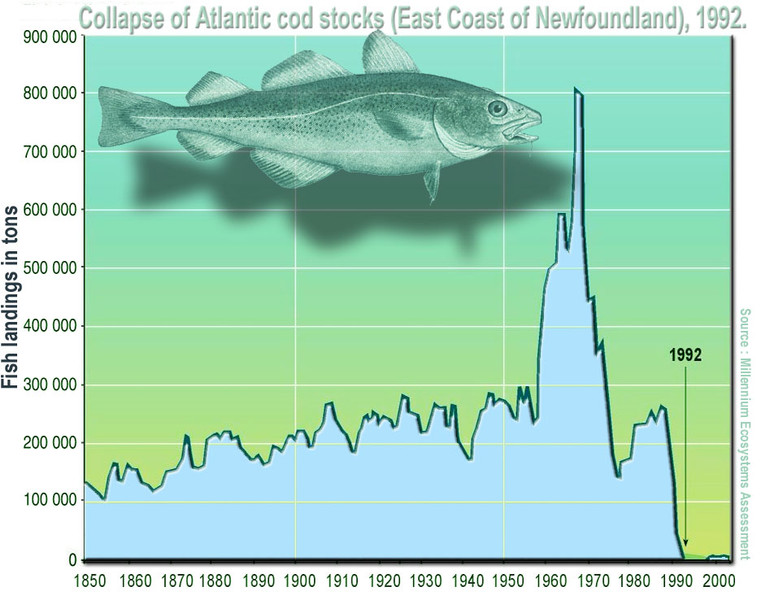
Collapse of Atlantic cod landings
How Overfishing Is Identified and Reduced
Evidence in data often includes declining abundance, smaller fish, younger fish, and rising effort.
If total catch stays the same but effort increases, the stock may still be declining. That is a very common AP-style graph interpretation.
Responses work best together, not one at a time:
- catch limits and quotas based on science
- catch shares or ITQs to reduce the race to fish
- minimum-size limits, maximum-size limits, slot limits, mesh-size rules
- seasonal closures and area closures to protect spawning and nursery habitat
- marine protected areas and no-take reserves
- gear restrictions and bycatch-reduction devices
- monitoring and enforcement with stock assessments, observers, vessel tracking, and inspections
- precautionary management when data are uncertain
- consumer choice, certification, and reduced seafood waste
Aquaculture often comes up in class, but its pros and cons are covered in a different topic, so don’t treat it here as the main solution.
Key Takeaways
Overfishing
Harvesting fish faster than the surviving population can replace them through reproduction and growth
Fishery
The harvested fish population, the place it is harvested, and the people and equipment involved in harvesting it
Fish Stock
A population or management unit of a harvested species in a particular area
Overfished Stock
A fish stock whose abundance has fallen below a management threshold, even if excessive harvesting has stopped
Fishery Collapse
A decline in abundance or catch so severe that a fishery is no longer ecologically or economically viable, without necessarily causing extinction
Recruitment
The addition of young fish to the harvestable population
Open-Access Fishery
A fishery in which users cannot effectively exclude one another, encouraging each fisher to harvest before others do
Illegal, Unreported, and Unregulated Fishing
Fishing that violates rules, goes unreported, or occurs without effective regulation, undermining enforcement and stock assessments
Spawning-Stock Biomass
The total mass of fish in a stock that are capable of reproduction
Bottom Trawling
Dragging a weighted net across the seafloor, capturing bottom-dwelling organisms and potentially damaging benthic habitat
Purse Seine
A large net placed around a school of fish and drawn closed at the bottom
Longline Fishing
Fishing with a main line carrying hundreds or thousands of baited hooks, which may also catch turtles, sharks, seabirds, and nontarget fish
Gill Net
A net suspended in the water that catches fish by their gills and may entangle nontarget wildlife
Drift Net
A net that moves with currents and can entangle marine mammals, turtles, seabirds, and unwanted fish
Traps and Pots
Gear used to capture organisms such as crabs and lobsters; lost gear may keep trapping animals and buoy ropes may entangle mammals
Ghost Fishing
Continued capture of organisms by lost or abandoned fishing gear
Bycatch
The unintended capture of nontarget organisms or individuals of the wrong size or sex; heavy bycatch can overfish nontarget populations
Catch per Unit Effort
Catch per unit effort = total catch ÷ fishing effort; a decline can indicate that more effort is needed because the stock is becoming scarce
Collapse of the Northern Atlantic Cod Fishery
The Newfoundland and Labrador cod collapse caused by excessive industrial harvest and weak management, leading Canada to impose a 1992 moratorium and causing major ecological and economic losses
Notes
Overfishing
Harvesting fish faster than the surviving population can replace them through reproduction and growth
Fishery
The harvested fish population, the place it is harvested, and the people and equipment involved in harvesting it
Fish Stock
A population or management unit of a harvested species in a particular area
Overfished Stock
A fish stock whose abundance has fallen below a management threshold, even if excessive harvesting has stopped
Fishery Collapse
A decline in abundance or catch so severe that a fishery is no longer ecologically or economically viable, without necessarily causing extinction
Recruitment
The addition of young fish to the harvestable population
Open-Access Fishery
A fishery in which users cannot effectively exclude one another, encouraging each fisher to harvest before others do
Illegal, Unreported, and Unregulated Fishing
Fishing that violates rules, goes unreported, or occurs without effective regulation, undermining enforcement and stock assessments
Spawning-Stock Biomass
The total mass of fish in a stock that are capable of reproduction
Bottom Trawling
Dragging a weighted net across the seafloor, capturing bottom-dwelling organisms and potentially damaging benthic habitat
Purse Seine
A large net placed around a school of fish and drawn closed at the bottom
Longline Fishing
Fishing with a main line carrying hundreds or thousands of baited hooks, which may also catch turtles, sharks, seabirds, and nontarget fish
Gill Net
A net suspended in the water that catches fish by their gills and may entangle nontarget wildlife
Drift Net
A net that moves with currents and can entangle marine mammals, turtles, seabirds, and unwanted fish
Traps and Pots
Gear used to capture organisms such as crabs and lobsters; lost gear may keep trapping animals and buoy ropes may entangle mammals
Ghost Fishing
Continued capture of organisms by lost or abandoned fishing gear
Bycatch
The unintended capture of nontarget organisms or individuals of the wrong size or sex; heavy bycatch can overfish nontarget populations
Catch per Unit Effort
Catch per unit effort = total catch ÷ fishing effort; a decline can indicate that more effort is needed because the stock is becoming scarce
Collapse of the Northern Atlantic Cod Fishery
The Newfoundland and Labrador cod collapse caused by excessive industrial harvest and weak management, leading Canada to impose a 1992 moratorium and causing major ecological and economic losses
