Topic 1.5 Notes – The Nitrogen Cycle
What the Nitrogen Cycle Is
Nitrogen is an essential macronutrient. Living things need it to build:
- amino acids and proteins
- nucleic acids like DNA and RNA
- chlorophyll
- other important biological compounds
The nitrogen cycle is the movement and chemical transformation of nitrogen among these reservoirs:
- atmospheric , the biggest reservoir, about 78% of air
- soil nitrogen compounds
- dissolved nitrogen in water and groundwater
- organic nitrogen in biomass, waste, and dead matter
- ocean water and sediments
Here’s the key idea that drives the whole topic. Nitrogen atoms are conserved, but their chemical form changes.
That matters because abundance is not the same as availability. Atmospheric nitrogen gas, , has a very strong triple bond, so most organisms cannot use it directly. Producers usually take up ammonium and nitrate instead. Most non-atmospheric reservoirs hold nitrogen only for short periods before it gets moved or transformed again.
This overview diagram pulls those reservoirs and transformations together before you learn the individual steps.
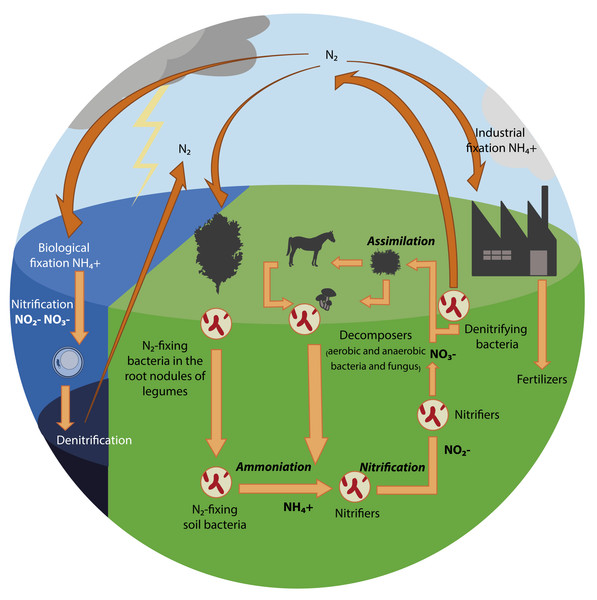
The Main Nitrogen Forms and Processes
Nitrogen forms
You need to recognize these together:
- = atmospheric nitrogen gas, mostly unusable to organisms
- = ammonia
- = ammonium, available to producers
- = nitrite, an intermediate
- = nitrate, available to producers and very mobile in water
- organic nitrogen = nitrogen in biomass, waste, detritus
- = nitrous oxide, a greenhouse gas and possible intermediate/product
Five core processes
- Nitrogen fixation
Done mainly by microorganisms. Examples you should know:- Rhizobium in legume root nodules
- cyanobacteria
- lightning
- Haber-Bosch industrial fixation
- Nitrification
This is a microbial process in oxygen-rich soil or water. - Assimilation
or \rightarrow organic nitrogen in producers
Consumers then get nitrogen by eating. - Ammonification
organic nitrogen
Decomposers break down waste and dead organisms. - Denitrification
This returns nitrogen to the atmosphere, usually in low-oxygen conditions.
How the Nitrogen Cycle Moves Through Ecosystems
It helps to picture the cycle as a path:
- Atmospheric enters ecosystems through fixation.
- In soil, ammonia becomes ammonium.
- Nitrification can turn ammonium into nitrite and then nitrate.
- Producers assimilate ammonium or nitrate.
- Consumers get organic nitrogen through feeding.
- Waste and dead matter enter the detritus pool.
- Ammonification returns organic nitrogen to ammonium.
- Denitrification can return nitrate to the atmosphere as gases.
Nitrogen also moves sideways between reservoirs through runoff, leaching, groundwater flow, and deposition.
A common diagram question tests whether you know the forms at each end of an arrow. Don’t identify a process by arrow direction alone. Identify it by starting form and ending form.
Microorganisms and Environmental Conditions
Most of the chemical conversions are done by microorganisms:
- nitrogen-fixing microbes do fixation
- nitrifying microbes do nitrification
- bacteria and fungi do ammonification
- denitrifying bacteria do denitrification
Plants are central to assimilation, but they usually do not perform the major chemical conversions themselves.
Environmental conditions shape which process happens:
- oxygen-rich conditions favor nitrification
- low-oxygen or waterlogged conditions favor denitrification
Mobility matters too:
- ammonium is less mobile because it can bind to soil particles
- nitrate is more mobile because it is soluble and easily leaches or runs off
Why the Nitrogen Cycle Matters
Nitrogen is often a limiting nutrient for primary production in many terrestrial and marine ecosystems. So even though the atmosphere is full of nitrogen, growth can still be limited if there isn’t enough usable nitrogen.
The rate of nitrogen fixation helps control how much usable nitrogen enters ecosystems. If available nitrogen is added, producer growth often increases until some other factor becomes limiting.
Humans increase reactive nitrogen through:
- synthetic fertilizer from Haber-Bosch fixation
- planting nitrogen-fixing crops
- fossil-fuel combustion that releases nitrogen oxides
Major effects of excess reactive nitrogen:
- increased crop production
- nitrate leaching into groundwater
- runoff into aquatic systems
- algal growth and eutrophication
- shifts in species composition and lower biodiversity
- increased emissions
Key Takeaways
Nitrogen Cycle
Movement and chemical transformation of nitrogen among the atmosphere, soil, water, and organisms; the atmosphere is its largest reservoir
Molecular Nitrogen (N₂)
Dominant atmospheric form of nitrogen; its strong triple bond makes it directly unusable by most organisms
Ammonia (NH₃)
Nitrogen compound produced during fixation and decomposition; in soil, it quickly converts to ammonium
Ammonium (NH₄⁺)
Biologically available inorganic nitrogen ion that producers can assimilate and nitrifying microorganisms can convert to nitrite
Nitrite (NO₂⁻)
Intermediate formed when ammonia or ammonium is oxidized to nitrate during nitrification
Nitrate (NO₃⁻)
Biologically available, highly soluble nitrogen ion produced by nitrification and commonly absorbed by producers
Organic Nitrogen
Nitrogen incorporated into compounds in living organisms, wastes, and dead organic matter
Nitrous Oxide (N₂O)
Gaseous nitrogen compound that may be released as an intermediate or final product of denitrification; it is also a greenhouse gas
Nitrogen Fixation
Conversion of atmospheric N₂ into reactive nitrogen compounds; biologically, certain bacteria and archaea produce NH₃, which becomes NH₄⁺.
Nitrification
Microbial oxidation of ammonia or ammonium to nitrite and then nitrate, usually under oxygenated conditions
Assimilation
Uptake of ammonium or nitrate by producers and incorporation of its nitrogen into organic molecules and biomass
Ammonification / Nitrogen Mineralization
Decomposer conversion of organic nitrogen in wastes and dead matter into ammonia or ammonium
Denitrification
Microbial conversion of nitrate to gaseous N₂, often through N₂O, generally under low-oxygen conditions
Haber-Bosch Process / Industrial Nitrogen Fixation
Industrial combination of atmospheric nitrogen and hydrogen to manufacture ammonia, chiefly for synthetic fertilizer
Limiting Nutrient
A nutrient whose low availability restricts biological growth; usable nitrogen often limits primary production
Notes
Nitrogen Cycle
Movement and chemical transformation of nitrogen among the atmosphere, soil, water, and organisms; the atmosphere is its largest reservoir
Molecular Nitrogen (N₂)
Dominant atmospheric form of nitrogen; its strong triple bond makes it directly unusable by most organisms
Ammonia (NH₃)
Nitrogen compound produced during fixation and decomposition; in soil, it quickly converts to ammonium
Ammonium (NH₄⁺)
Biologically available inorganic nitrogen ion that producers can assimilate and nitrifying microorganisms can convert to nitrite
Nitrite (NO₂⁻)
Intermediate formed when ammonia or ammonium is oxidized to nitrate during nitrification
Nitrate (NO₃⁻)
Biologically available, highly soluble nitrogen ion produced by nitrification and commonly absorbed by producers
Organic Nitrogen
Nitrogen incorporated into compounds in living organisms, wastes, and dead organic matter
Nitrous Oxide (N₂O)
Gaseous nitrogen compound that may be released as an intermediate or final product of denitrification; it is also a greenhouse gas
Nitrogen Fixation
Conversion of atmospheric N₂ into reactive nitrogen compounds; biologically, certain bacteria and archaea produce NH₃, which becomes NH₄⁺.
Nitrification
Microbial oxidation of ammonia or ammonium to nitrite and then nitrate, usually under oxygenated conditions
Assimilation
Uptake of ammonium or nitrate by producers and incorporation of its nitrogen into organic molecules and biomass
Ammonification / Nitrogen Mineralization
Decomposer conversion of organic nitrogen in wastes and dead matter into ammonia or ammonium
Denitrification
Microbial conversion of nitrate to gaseous N₂, often through N₂O, generally under low-oxygen conditions
Haber-Bosch Process / Industrial Nitrogen Fixation
Industrial combination of atmospheric nitrogen and hydrogen to manufacture ammonia, chiefly for synthetic fertilizer
Limiting Nutrient
A nutrient whose low availability restricts biological growth; usable nitrogen often limits primary production
