Topic 8.11 Notes – Sewage Treatment
What Sewage Treatment Is
Sewage treatment means using staged treatment to remove or inactivate contaminants in wastewater. Municipal wastewater can contain debris, suspended solids, biodegradable organic matter, nutrients, pathogens, and dissolved substances, so one process is never enough.
A few words you need solidly:
- Influent means the wastewater entering the treatment plant.
- Effluent means the treated water leaving the plant.
- Sludge means the solids removed during treatment.
- Biochemical oxygen demand (BOD) means the amount of oxygen microorganisms need to decompose organic matter. High BOD is dangerous because decomposers can use up dissolved oxygen in rivers, lakes, or estuaries.
Why treatment matters:
- Suspended solids increase turbidity and can settle over habitats.
- Organic matter raises BOD, which can cause low dissolved oxygen.
- Nitrogen and phosphorus can trigger eutrophication.
- Pathogens raise the risk of waterborne disease.
One limit students miss a lot: treated wastewater is not automatically drinking water.
The Four Treatment Stages
The standard order is primary → secondary → tertiary → disinfection. This plant diagram shows that flow, along with the sludge stream that branches off during treatment.
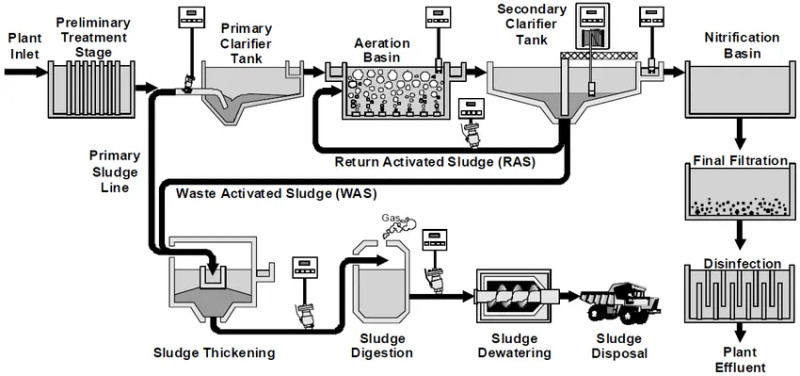
Wastewater treatment plant flow diagram
Primary treatment
This is physical removal.
- Screens and grates catch large debris such as rags, sticks, and plastics.
- In a primary clarifier or settling tank, heavy suspended solids sink and form primary sludge.
- Floating material can be skimmed off the top.
Primary treatment removes big and settleable stuff. It does not remove most dissolved pollutants, nutrients, or microorganisms.
Secondary treatment
This is biological treatment.
- Wastewater enters an aeration basin.
- Oxygen is added so aerobic bacteria can break down remaining organic matter faster.
- That organic matter is converted into carbon dioxide and inorganic sludge.
- In a secondary clarifier, microbial biomass and particles settle out as secondary sludge.
The big result is lower organic load and lower BOD.
Tertiary treatment
This is advanced ecological or chemical treatment for pollutants left behind.
In the diagram, this shows up as steps like nitrification and final filtration. More broadly, tertiary treatment often targets nitrogen, phosphorus, fine particles, or dissolved contaminants. The exact method depends on what is still in the water and what the discharge rules require.
Illustrative examples you should know:
- Chemical treatment that causes dissolved phosphorus to form solids
- Ecological or biological processes that remove nitrogen compounds
- Constructed wetlands
- Additional polishing processes
Disinfection before discharge
This stage kills or inactivates disease-causing microorganisms after earlier stages have cleared the water enough for disinfection to work well.
Illustrative examples:
- Chlorine
- Ozone
- UV light
What Each Stage Removes
Think of the stages as different tools for different pollutants:
| Stage | Best at removing | Main mechanism |
|---|---|---|
| Primary | large debris, floating material, settleable suspended solids | physical screening and settling |
| Secondary | biodegradable organic matter | bacterial decomposition with aeration |
| Tertiary | leftover pollutants, especially nitrogen and phosphorus | ecological or chemical removal |
| Disinfection | pathogens | chlorine, ozone, or UV exposure |
The exam loves this distinction. These are different mechanisms, not repeated versions of “cleaning.”
How to Read a Sewage Treatment Diagram
Follow the water flow from influent to effluent.
Look for these clues in order:
- Screens or grates
- Primary settling tank
- Aerated tank with bacteria
- Secondary settling tank
- Tertiary treatment unit
- Chlorine, ozone, or UV disinfection
Visual cues matter:
- Screens + settling = primary
- Bubbles/air + bacteria = secondary
- Chemical or ecological nutrient removal = tertiary
- Chlorine, ozone, or UV = disinfection
If you see separate sludge arrows, that shows solids leaving the main water pathway for separate management.
Best Practices and Common Mistakes
Best practice means matching the stage to the pollutant present. All four stages work together because sewage contains several different kinds of contaminants.
Common mistakes:
- Saying primary treatment is biological
- Calling secondary treatment just filtration
- Assuming disinfection replaces earlier treatment
- Assuming secondary treatment removes enough nutrients to stop eutrophication
- Saying treated effluent is automatically safe to drink
Practical limits also matter:
- Aeration uses a lot of energy
- Treatment creates sludge that still has to be managed
- Some pollutants need tertiary treatment for adequate removal
Key Takeaways
Sewage Treatment
Staged removal or inactivation of wastewater contaminants before the water is discharged or reused
Primary Treatment
Physical removal of large debris with screens or grates, followed by settling of solid waste in a tank
Secondary Treatment
Biological treatment in which bacteria break down organic matter into carbon dioxide and inorganic sludge, with aeration increasing the rate of decomposition
Aeration
Introducing air or oxygen into wastewater to support aerobic bacteria and accelerate organic-matter decomposition
Tertiary Treatment (Advanced Treatment)
Ecological or chemical removal of pollutants remaining after primary and secondary treatment, often including nitrogen and phosphorus
Disinfection
Final exposure of treated wastewater to chlorine, ozone, or UV light to kill or inactivate bacteria before discharge
Chlorine Disinfection
Chemical disinfection that kills microorganisms and leaves a residual that may need removal before discharge
Ozone Disinfection
Use of a strong oxidizing agent to disinfect wastewater without leaving the same persistent residual as chlorine
Ultraviolet (UV) Disinfection
Exposure to UV light that damages microbial genetic material and prevents reproduction without removing solids or nutrients
Biochemical Oxygen Demand (BOD)
The amount of oxygen microorganisms require to decompose organic material; abundant biodegradable waste produces high BOD.
Influent vs. Effluent
Influent is wastewater entering a treatment plant; effluent is treated wastewater leaving it
Septic System
On-site treatment in which solids settle in a septic tank and liquid flows to a drain field for treatment by soil and microorganisms
Notes
Sewage Treatment
Staged removal or inactivation of wastewater contaminants before the water is discharged or reused
Primary Treatment
Physical removal of large debris with screens or grates, followed by settling of solid waste in a tank
Secondary Treatment
Biological treatment in which bacteria break down organic matter into carbon dioxide and inorganic sludge, with aeration increasing the rate of decomposition
Aeration
Introducing air or oxygen into wastewater to support aerobic bacteria and accelerate organic-matter decomposition
Tertiary Treatment (Advanced Treatment)
Ecological or chemical removal of pollutants remaining after primary and secondary treatment, often including nitrogen and phosphorus
Disinfection
Final exposure of treated wastewater to chlorine, ozone, or UV light to kill or inactivate bacteria before discharge
Chlorine Disinfection
Chemical disinfection that kills microorganisms and leaves a residual that may need removal before discharge
Ozone Disinfection
Use of a strong oxidizing agent to disinfect wastewater without leaving the same persistent residual as chlorine
Ultraviolet (UV) Disinfection
Exposure to UV light that damages microbial genetic material and prevents reproduction without removing solids or nutrients
Biochemical Oxygen Demand (BOD)
The amount of oxygen microorganisms require to decompose organic material; abundant biodegradable waste produces high BOD.
Influent vs. Effluent
Influent is wastewater entering a treatment plant; effluent is treated wastewater leaving it
Septic System
On-site treatment in which solids settle in a septic tank and liquid flows to a drain field for treatment by soil and microorganisms
