Topic 9.5 Notes – Global Climate Change
What Global Climate Change Is
Climate is the long-term pattern of conditions in a region. Weather is what happens over short periods like a day or a week. A snowstorm or cold snap does not cancel climate change because climate is about trends over time.
Global climate change includes shifts in:
- Temperature
- Precipitation
- Winds
- Ocean circulation
- Ice cover
- Sea level
Earth’s climate has always changed over geologic time. Past warming and cooling happened because of things like:
- Orbital changes in Earth’s path and tilt
- Solar variation in energy from the sun
- Volcanism that can cool climate by adding reflective particles
- Tectonics that move continents and reshape oceans
- Atmospheric composition changes, especially greenhouse gases
Today’s climate change sits on top of that natural variability, but the current shift is strongly tied to rapid increases in greenhouse gases from human activity. One of the biggest tested ideas here is that global change does not mean uniform change. The atmosphere and oceans redistribute heat and moisture, so some regions get warmer faster, wetter, drier, or stormier than others.
Evidence of Climate Change Through Time
A lot of past climate evidence comes from proxy records, which are indirect clues about earlier conditions.
Ice cores
Ice cores drilled from Greenland and Antarctica preserve yearly layers of snowfall. Tiny trapped air bubbles act like samples of ancient atmosphere.
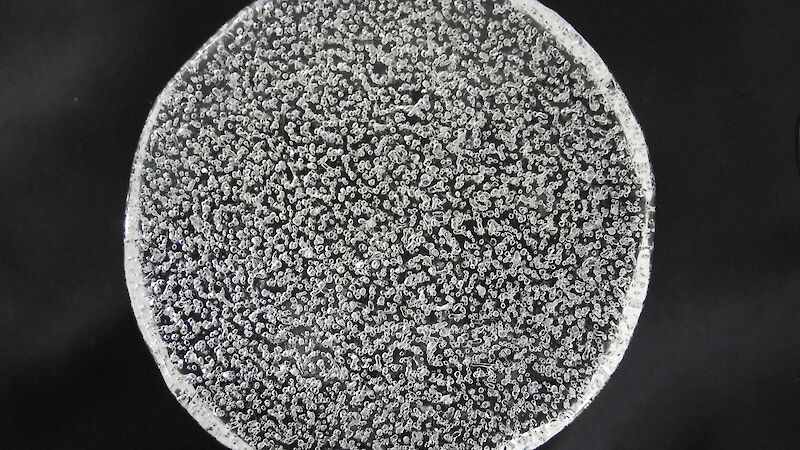
Air bubbles in an ice core
Ice cores let scientists measure:
- Past CO levels
- Past methane levels
- Past temperatures using isotopic and chemical data
These records show repeated glacial and interglacial cycles over hundreds of thousands of years. On graphs, CO and temperature usually rise and fall together.
What AP loves you to notice from a graph:
- Identify the pattern over time
Example: CO increases sharply near the present. - Connect it to a climate process
More greenhouse gases strengthen heat trapping. - Explain the consequence
Warmer temperatures melt ice, shift habitats, and raise sea level.
The major conclusion is not just “climate changed naturally before.” It is that recent CO increase is much more rapid than the older natural swings shown in long records.
If they ask for percent change, use
Major Physical Changes and Their Ecosystem Effects
Rising temperatures and cryosphere change
The cryosphere means Earth’s frozen water, including snow, glaciers, sea ice, and permafrost. As temperatures rise, more of it melts.
Important distinction:
- Melting land ice raises sea level
- Melting floating sea ice has little direct effect on sea level
Sea ice still matters a lot because it affects albedo and provides habitat.
Sea-level rise and marine habitats
Sea level rises because of:
- Melting land ice
- Thermal expansion of warmer seawater
Effects on coasts include:
- More flooding
- More erosion
- Saltwater intrusion into freshwater supplies
- Displacement of coastal populations
Marine ecosystems can be affected in two directions:
- Positive
Newly flooded continental shelves can create new shallow habitats. - Negative
Benthic communities may end up below the photic zone, the sunlit layer where photosynthesis can happen.
Soil impacts
Climate change also changes soil by altering temperature and rainfall.
- Higher temperatures can increase evaporation and dry soils.
- Vegetation loss removes roots that hold soil in place.
- Heavier rain can increase runoff and strip away topsoil even if yearly rainfall stays similar.
How Heat Redistribution Changes Regional Climate
Atmospheric and ocean circulation move heat around the planet. That is why a global shift changes regions differently.
Atmospheric circulation
Hadley cells are large tropical circulation patterns that help set up wet equatorial zones and dry subtropical zones. Climate change can shift their position, width, or strength, which shifts rainfall belts too.
The jet stream can also change as temperature gradients change. That can redirect storm tracks and change regional temperature and precipitation.
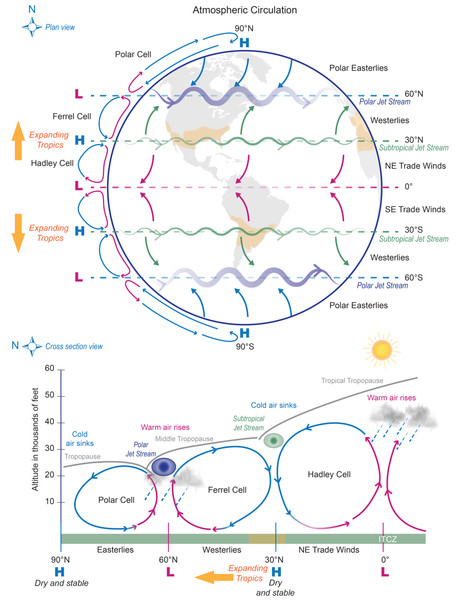
Global atmospheric circulation
Ocean conveyor belt
The ocean conveyor belt is global circulation driven by surface currents and deep thermohaline circulation, which depends on temperature and salinity.
If warming and freshwater from melting land ice reduce water density in the North Atlantic, sinking can weaken. That means less heat may be delivered to nearby coasts, including parts of Europe, even as global average temperature continues rising.
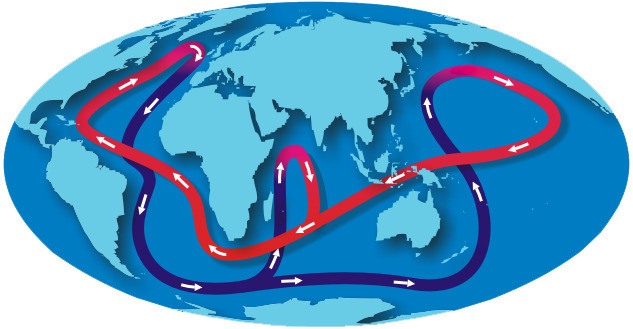
Global ocean conveyor belt
Why the Arctic Changes Faster
This is polar amplification. The Arctic warms faster than the global average because positive feedback loops strengthen the original warming.
Ice-albedo feedback
- Snow and ice reflect lots of sunlight because they have high albedo.
- Warming melts ice.
- Darker land or ocean is exposed.
- Darker surfaces absorb more solar energy.
- More absorption causes more warming and more melting.
The diagram below shows that self-reinforcing cycle.
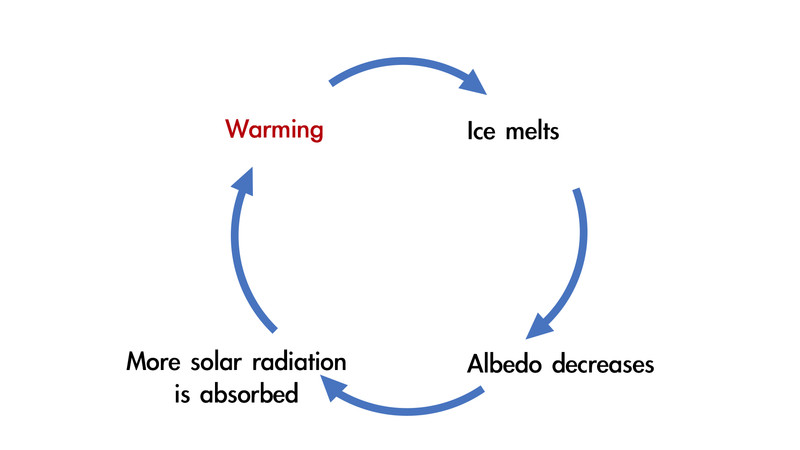
Ice-albedo positive feedback loop
Permafrost feedback
Permafrost is ground frozen for at least two consecutive years.
- Rising temperature thaws permafrost.
- Frozen organic matter starts decomposing.
- Decomposition releases CO and methane.
- Those greenhouse gases increase warming.
- More warming causes more thawing.
Polar ecosystem effects
Species that rely on ice lose habitat and food access. The course specifically expects polar bears, seals, and walruses.
Sea-ice loss can disrupt:
- Hunting
- Breeding
- Resting
- Migration
- Food-web timing
Key Takeaways
Global Climate Change vs. Global Warming
Global climate change is a persistent shift in Earth’s climatic conditions and circulation patterns; global warming is specifically the long-term increase in average surface temperature
Climate vs. Weather
Climate is the long-term pattern of conditions across many observations; weather is the atmospheric condition at a particular place and time
Glacial–Interglacial Cycles
Repeated alternation between colder glacial periods and warmer interglacial periods over geologic time
Climate Proxy
A preserved physical or chemical feature that provides indirect evidence of past climate conditions
Ice Core
A cylinder of layered glacial ice whose trapped air bubbles reveal past greenhouse gas concentrations and whose chemistry can indicate past temperatures
Sea-Level Rise
An increase in average ocean level caused mainly by thermal expansion and melting land ice, leading to coastal flooding, erosion, and population displacement
Thermal Expansion
The increase in seawater volume as it warms, contributing to sea-level rise
Land-Ice Loss vs. Sea-Ice Loss
Melting land ice adds water to the ocean and raises sea level; melting floating sea ice causes little direct sea-level rise but lowers albedo and removes habitat
Photic Zone
The sunlit upper layer of water in which enough light penetrates for photosynthesis
Hadley Cell
A tropical circulation cell in which air rises near the equator, moves poleward aloft, descends in the subtropics, and returns equatorward at the surface
Jet Stream
A relatively narrow band of fast-moving, high-altitude wind whose path is influenced by temperature and pressure differences between air masses
Global Ocean Conveyor Belt (Thermohaline Circulation)
The connected system of surface and deep-ocean currents driven partly by temperature- and salinity-related density differences that redistributes heat worldwide
Soil Viability
A soil’s ability to support plant growth and ecological or agricultural functions
Polar Amplification
The disproportionately rapid warming of polar regions, especially the Arctic, relative to the global average
Albedo
The fraction of incoming solar radiation reflected by a surface; snow and ice have higher albedo than dark ocean or land
Positive Feedback Loop
A process in which an initial change causes effects that reinforce and amplify that change
Ice–Albedo Feedback
Warming melts reflective snow and ice, exposing darker surfaces that absorb more solar energy and cause additional warming and melting
Permafrost
Ground that remains frozen for at least two consecutive years and may contain large stores of frozen organic matter
Permafrost Greenhouse Gas Feedback
Warming thaws permafrost, decomposition releases carbon dioxide and methane, and the added greenhouse gases cause further warming and thawing
Notes
Global Climate Change vs. Global Warming
Global climate change is a persistent shift in Earth’s climatic conditions and circulation patterns; global warming is specifically the long-term increase in average surface temperature
Climate vs. Weather
Climate is the long-term pattern of conditions across many observations; weather is the atmospheric condition at a particular place and time
Glacial–Interglacial Cycles
Repeated alternation between colder glacial periods and warmer interglacial periods over geologic time
Climate Proxy
A preserved physical or chemical feature that provides indirect evidence of past climate conditions
Ice Core
A cylinder of layered glacial ice whose trapped air bubbles reveal past greenhouse gas concentrations and whose chemistry can indicate past temperatures
Sea-Level Rise
An increase in average ocean level caused mainly by thermal expansion and melting land ice, leading to coastal flooding, erosion, and population displacement
Thermal Expansion
The increase in seawater volume as it warms, contributing to sea-level rise
Land-Ice Loss vs. Sea-Ice Loss
Melting land ice adds water to the ocean and raises sea level; melting floating sea ice causes little direct sea-level rise but lowers albedo and removes habitat
Photic Zone
The sunlit upper layer of water in which enough light penetrates for photosynthesis
Hadley Cell
A tropical circulation cell in which air rises near the equator, moves poleward aloft, descends in the subtropics, and returns equatorward at the surface
Jet Stream
A relatively narrow band of fast-moving, high-altitude wind whose path is influenced by temperature and pressure differences between air masses
Global Ocean Conveyor Belt (Thermohaline Circulation)
The connected system of surface and deep-ocean currents driven partly by temperature- and salinity-related density differences that redistributes heat worldwide
Soil Viability
A soil’s ability to support plant growth and ecological or agricultural functions
Polar Amplification
The disproportionately rapid warming of polar regions, especially the Arctic, relative to the global average
Albedo
The fraction of incoming solar radiation reflected by a surface; snow and ice have higher albedo than dark ocean or land
Positive Feedback Loop
A process in which an initial change causes effects that reinforce and amplify that change
Ice–Albedo Feedback
Warming melts reflective snow and ice, exposing darker surfaces that absorb more solar energy and cause additional warming and melting
Permafrost
Ground that remains frozen for at least two consecutive years and may contain large stores of frozen organic matter
Permafrost Greenhouse Gas Feedback
Warming thaws permafrost, decomposition releases carbon dioxide and methane, and the added greenhouse gases cause further warming and thawing
