Topic 4.2 Notes – Soil Formation and Erosion
What Soil Is and How It Forms
Soil is a living, active mixture of:
- weathered mineral material from rock
- organic matter
- water
- air
- living organisms
This is why soil sits at the meeting point of the geosphere, atmosphere, hydrosphere, and biosphere.
Parent material is the mineral source of soil. It can be bedrock underneath the soil, or sediment that was moved in from somewhere else. Soil formation begins when that parent material is weathered, and sometimes the material is then transported and deposited before a full soil profile develops.
A common APES mix-up is weathering vs. erosion:
- Weathering breaks rock down.
- Erosion removes and transports that material.
Weathering types
- Physical weathering breaks rock into smaller pieces without changing its chemistry.
- freeze-thaw
- abrasion
- heating and cooling
- pressure release or exfoliation
- root wedging
- Chemical weathering changes minerals through reactions.
- dissolution
- oxidation
- carbonic acid
- organic acids
- Biological weathering comes from living things.
- roots crack rock
- burrowing animals mix soil
- lichens, fungi, and microorganisms release chemicals
Humus is partly decomposed, stable organic matter. It helps make soil dark and fertile.
Over time, these processes turn parent material into a more developed soil profile with distinct horizons.
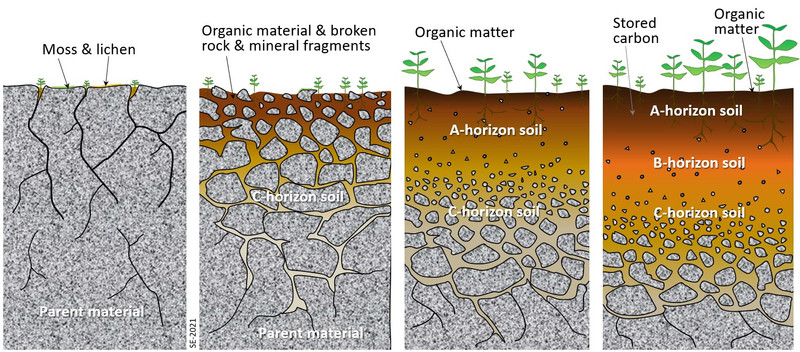
Stages of soil profile development
Weathered material can be moved by:
- water
- wind
- ice
- gravity
Transported parent materials you should know:
- alluvium = water-deposited sediment
- loess = wind-deposited silt
- glacial deposits = material left by glaciers
- colluvium = gravity-moved downslope material
What Controls Soil Development
Five factors work together to shape soil:
| Factor | What it affects |
|---|---|
| Parent material | starting minerals and chemistry |
| Climate | weathering, decomposition, leaching |
| Organisms | organic matter, mixing, erosion reduction |
| Topography | drainage, erosion, deposition |
| Time | horizon development |
Time matters, but older soil does not always mean more fertile soil. Long weathering can also leach nutrients away.
Four soil-forming processes
Additions
Material enters, like litter, dust, or sediment.
Losses
Material leaves, like through erosion or leaching.
Transformations
Material changes, like rock weathering or decomposition into humus.
Translocations
Material moves within the soil, often downward with water.
Soils form slowly. Because topsoil can be lost much faster than it forms, APES treats it as nonrenewable or very slowly renewable on a human time scale.
Soil Horizons and the Soil Profile
A soil profile is a vertical section of soil layers, called horizons. The ideal order is:
O → A → E → B → C → R
Not every soil has every horizon. This kind of labeled profile is what that sequence looks like in cross-section.
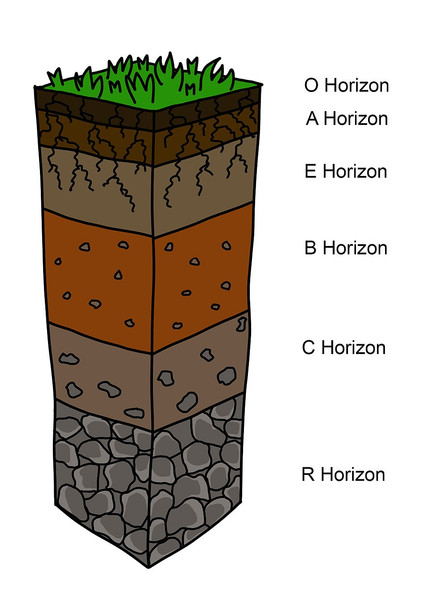
Soil profile with major horizons
Horizon meanings
O horizon
Surface organic layer with litter, dead organisms, decomposing material, and humus
A horizon
Topsoil. Minerals mixed with organic matter. High biological activity and major plant-growth zone
E horizon
Eluviation zone. Pale, leached layer that loses clay, iron, aluminum, and organics
B horizon
Subsoil. Illuviation zone where clay and minerals from above accumulate
C horizon
Partly weathered parent material with little organic matter
R horizon
Bedrock
When reading a profile, use position plus composition, not just color. A classic sequence is dark O, dark A, pale E, reddish-brown B, broken-rock C, then R.
Soil Erosion and Its Effects
Erosion is the detachment, transport, and deposition of soil by wind or water. It becomes a problem when soil is lost faster than it forms.
Vegetation protects soil because it:
- intercepts rainfall
- slows runoff and wind
- binds soil with roots
Erosion gets worse with:
- intense precipitation
- strong wind
- steep slopes
- bare or disturbed soil
- compaction
- very dry, loose, or saturated soil
Water erosion
- Splash = raindrops knock particles loose
- Sheet = thin layer removed across surface
- Rill = small channels form
- Gully = large channels form
Wind erosion
This is worst in dry, loose, sparsely vegetated soil. The Dust Bowl is the key example. Drought + plowing + removal of grass cover led to massive soil loss.
Consequences include:
- loss of nutrient-rich O and A horizons
- lower fertility and less organic matter
- shallower root zone
- sediment buildup elsewhere
- turbidity, habitat burial, filled reservoirs/channels
- transport of nutrients, pesticides, metals, and other pollutants
Soil Protection and Water Quality
Healthy soil protects water because water moving through soil gets slowed and filtered. Soil:
- traps particles
- adsorbs some dissolved substances
- allows root uptake
- supports microbial breakdown
- reduces runoff into streams
When erosion removes soil, that filtering service gets weaker, and the sediment itself becomes a pollutant.
Erosion-control methods
- vegetation and cover crops
- reduced tillage and leaving crop residue
- contour plowing
- terracing
- windbreaks
- riparian buffers
- avoiding overgrazing and deforestation
Erosion investigation
A common APES experiment compares bare vs. vegetated plots under equal rainfall, slope, soil, and area.
- Independent variable = vegetation cover
- Dependent variable = dry sediment mass, turbidity, runoff volume, or erosion rate
- Constants = rainfall intensity and duration, slope, soil amount, plot area, preparation
- Use replicates
Bare plots should usually show more runoff and sediment loss.
Key Takeaways
Soil
The biologically active layer of weathered mineral material and organic matter covering much of Earth’s land surface
Soil Formation
The slow development of soil as parent material is weathered, may be transported and deposited, and is altered and organized into horizons
Parent Material
The underlying rock or transported sediment from which a soil’s mineral material develops
Weathering
The physical breakdown or chemical alteration of rock and minerals without their removal and transport
Physical Weathering (Mechanical Weathering)
The breakdown of rock into smaller pieces without changing its chemical composition
Freeze-Thaw Action
Physical weathering in which water repeatedly freezes, expands, and widens cracks in rock
Abrasion
Physical weathering in which particles carried by wind, water, or ice scrape and grind rock
Pressure Release and Exfoliation
Physical weathering in which reduced pressure causes exposed rock’s outer layers to separate or peel away
Root Wedging
Physical weathering in which growing plant roots force open cracks in rock
Chemical Weathering
The alteration of rock’s mineral composition through chemical reactions, especially reactions involving water
Dissolution
Chemical weathering in which water or weak acids dissolve susceptible minerals
Oxidation
Chemical weathering in which oxygen reacts with minerals, especially iron-bearing minerals, to form oxides
Biological Weathering
Physical or chemical weathering caused by organisms, such as roots, burrowing animals, lichens, fungi, and microbes
Humus
Dark, relatively stable, partly decomposed and chemically altered organic matter in soil
Alluvium
Sediment transported and deposited by flowing water, especially along rivers and floodplains
Loess
Fine wind-deposited sediment composed mainly of silt-sized particles
Colluvium
Soil and rock material moved downslope primarily by gravity
Factors Controlling Soil Development
Parent material, climate, organisms, topography or relief, and time
Additions
Soil-forming processes that introduce material, such as litter, dust, sediment, or dissolved substances
Losses
Soil-forming processes that remove material through erosion, leaching, harvest, or gas release
Transformations
Soil-forming processes that alter materials, such as mineral weathering or decomposition into humus
Translocations
Soil-forming processes that move material from one horizon to another, usually by water or organisms
Soil Profile
A vertical section showing soil horizons from the surface to parent material or bedrock, ideally O-A-E-B-C-R.
Soil Horizon
A soil layer distinguished from adjacent layers by composition, organic content, color, structure, or weathering
Leaching
The downward removal and transport of dissolved or suspended materials by water moving through soil
O Horizon
The surface organic horizon containing litter, dead organisms, decomposing material, and humus
A Horizon (Topsoil)
The upper mineral horizon mixed with organic matter and rich in roots and biological activity
E Horizon
A pale, depleted horizon from which clay, iron, aluminum, and organic compounds have been removed by eluviation
Eluviation
The removal of fine particles and dissolved materials from an upper soil horizon by downward-moving water
B Horizon (Subsoil)
A mineral horizon where clay and iron- or aluminum-bearing compounds transported from above often accumulate
Illuviation
The deposition and accumulation in a lower horizon of materials transported from horizons above
C Horizon
Partly weathered parent material with little organic matter or biological alteration
R Horizon (Bedrock)
Consolidated, relatively unweathered bedrock beneath the soil and parent material
Soil Erosion
The detachment, transport, and eventual deposition of soil particles by agents such as water or wind
Water Erosion
The detachment of soil by raindrops and its transport downslope by surface runoff
Splash Erosion
The dislodging of soil particles by the impact of falling raindrops
Sheet Erosion
The relatively even removal of a thin layer of soil by broad surface runoff
Rill Erosion
Water erosion in which runoff cuts many small channels into the soil surface
Gully Erosion
Water erosion in which concentrated runoff forms channels too deep to remove by ordinary cultivation
Wind Erosion (Aeolian Erosion)
The detachment and transport of dry, loose soil by wind
Dust Bowl
A 1930s Great Plains disaster in which cultivation, loss of native grasses, drought, and wind caused severe dust storms and soil loss
Cover Crops
Crops planted to keep soil covered so roots anchor it and foliage protects it from rain and wind
Reduced Tillage
Limiting soil disturbance and leaving crop residue on the surface to maintain cover and reduce erosion
Contour Plowing
Plowing across a slope’s contours rather than downhill so furrows slow runoff and erosion
Terracing
Converting a long, steep slope into shorter, flatter steps to slow runoff and reduce erosion
Windbreaks
Rows of trees or shrubs planted to reduce wind speed and protect exposed soil
Riparian Buffers
Vegetated areas beside streams that stabilize banks, slow runoff, and trap sediment before it reaches the water
Notes
Soil
The biologically active layer of weathered mineral material and organic matter covering much of Earth’s land surface
Soil Formation
The slow development of soil as parent material is weathered, may be transported and deposited, and is altered and organized into horizons
Parent Material
The underlying rock or transported sediment from which a soil’s mineral material develops
Weathering
The physical breakdown or chemical alteration of rock and minerals without their removal and transport
Physical Weathering (Mechanical Weathering)
The breakdown of rock into smaller pieces without changing its chemical composition
Freeze-Thaw Action
Physical weathering in which water repeatedly freezes, expands, and widens cracks in rock
Abrasion
Physical weathering in which particles carried by wind, water, or ice scrape and grind rock
Pressure Release and Exfoliation
Physical weathering in which reduced pressure causes exposed rock’s outer layers to separate or peel away
Root Wedging
Physical weathering in which growing plant roots force open cracks in rock
Chemical Weathering
The alteration of rock’s mineral composition through chemical reactions, especially reactions involving water
Dissolution
Chemical weathering in which water or weak acids dissolve susceptible minerals
Oxidation
Chemical weathering in which oxygen reacts with minerals, especially iron-bearing minerals, to form oxides
Biological Weathering
Physical or chemical weathering caused by organisms, such as roots, burrowing animals, lichens, fungi, and microbes
Humus
Dark, relatively stable, partly decomposed and chemically altered organic matter in soil
Alluvium
Sediment transported and deposited by flowing water, especially along rivers and floodplains
Loess
Fine wind-deposited sediment composed mainly of silt-sized particles
Colluvium
Soil and rock material moved downslope primarily by gravity
Factors Controlling Soil Development
Parent material, climate, organisms, topography or relief, and time
Additions
Soil-forming processes that introduce material, such as litter, dust, sediment, or dissolved substances
Losses
Soil-forming processes that remove material through erosion, leaching, harvest, or gas release
Transformations
Soil-forming processes that alter materials, such as mineral weathering or decomposition into humus
Translocations
Soil-forming processes that move material from one horizon to another, usually by water or organisms
Soil Profile
A vertical section showing soil horizons from the surface to parent material or bedrock, ideally O-A-E-B-C-R.
Soil Horizon
A soil layer distinguished from adjacent layers by composition, organic content, color, structure, or weathering
Leaching
The downward removal and transport of dissolved or suspended materials by water moving through soil
O Horizon
The surface organic horizon containing litter, dead organisms, decomposing material, and humus
A Horizon (Topsoil)
The upper mineral horizon mixed with organic matter and rich in roots and biological activity
E Horizon
A pale, depleted horizon from which clay, iron, aluminum, and organic compounds have been removed by eluviation
Eluviation
The removal of fine particles and dissolved materials from an upper soil horizon by downward-moving water
B Horizon (Subsoil)
A mineral horizon where clay and iron- or aluminum-bearing compounds transported from above often accumulate
Illuviation
The deposition and accumulation in a lower horizon of materials transported from horizons above
C Horizon
Partly weathered parent material with little organic matter or biological alteration
R Horizon (Bedrock)
Consolidated, relatively unweathered bedrock beneath the soil and parent material
Soil Erosion
The detachment, transport, and eventual deposition of soil particles by agents such as water or wind
Water Erosion
The detachment of soil by raindrops and its transport downslope by surface runoff
Splash Erosion
The dislodging of soil particles by the impact of falling raindrops
Sheet Erosion
The relatively even removal of a thin layer of soil by broad surface runoff
Rill Erosion
Water erosion in which runoff cuts many small channels into the soil surface
Gully Erosion
Water erosion in which concentrated runoff forms channels too deep to remove by ordinary cultivation
Wind Erosion (Aeolian Erosion)
The detachment and transport of dry, loose soil by wind
Dust Bowl
A 1930s Great Plains disaster in which cultivation, loss of native grasses, drought, and wind caused severe dust storms and soil loss
Cover Crops
Crops planted to keep soil covered so roots anchor it and foliage protects it from rain and wind
Reduced Tillage
Limiting soil disturbance and leaving crop residue on the surface to maintain cover and reduce erosion
Contour Plowing
Plowing across a slope’s contours rather than downhill so furrows slow runoff and erosion
Terracing
Converting a long, steep slope into shorter, flatter steps to slow runoff and reduce erosion
Windbreaks
Rows of trees or shrubs planted to reduce wind speed and protect exposed soil
Riparian Buffers
Vegetated areas beside streams that stabilize banks, slow runoff, and trap sediment before it reaches the water
