Topic 8.5 Notes – Eutrophication
What Eutrophication Is
Eutrophication means nutrient enrichment of a lake, river, estuary, or coastal water. The two nutrients that matter most are nitrogen and phosphorus because they can be limiting nutrients, meaning primary producers cannot keep growing unless that nutrient is available.
When the limiting nutrient is added, primary productivity can jump fast. In water, that usually means a lot more algae or cyanobacteria. The diagram below shows the chain reaction APES is really talking about, from nutrient runoff to algal growth to oxygen depletion and fish kills.
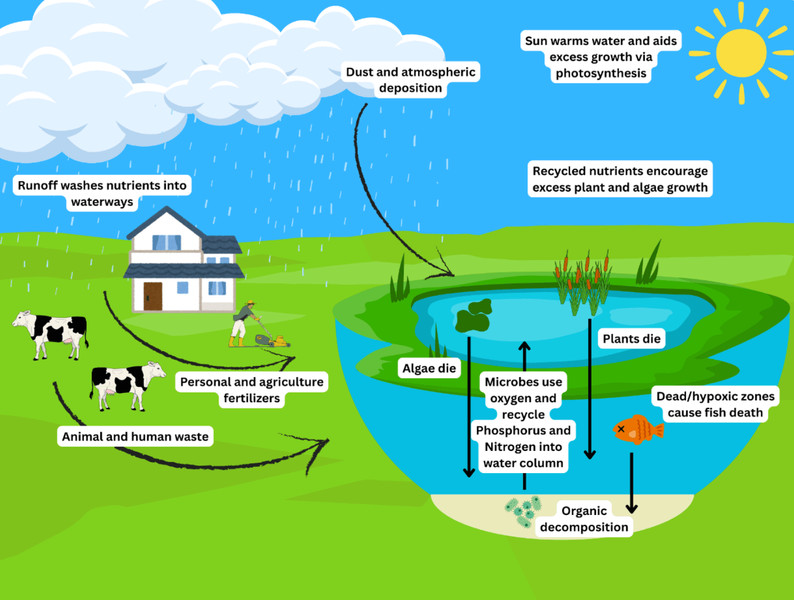
Eutrophication cycle
A few APES details matter here:
- APES usually means human-accelerated eutrophication, not the slow natural aging of a lake over long time periods.
- Freshwater is often phosphorus-limited.
- Estuaries and coastal waters are often nitrogen-limited.
- Eutrophication is about excess nutrients specifically, not just any water pollution.
Sources of Excess Nutrients
The two big human causes are agricultural runoff and wastewater release.
Fertilizers
Fertilizers from farms, lawns, golf courses, and landscaped areas often contain nitrogen and phosphorus. After rain or irrigation, runoff carries those nutrients into streams, lakes, estuaries, and coastal waters.
- Nitrogen often dissolves and moves with water.
- Phosphorus can also travel attached to eroded sediment.
Wastewater and sewage
Human waste and food waste contain nitrogen and phosphorus. If wastewater is untreated or not treated well enough to remove nutrients, it can feed algal growth.
One common test trap is this idea that treatment alone solves the problem. It doesn’t if the plant still releases nutrients.
Detergents
Some detergents contain phosphates, which add phosphorus to water. This is especially important in freshwater lakes, where phosphorus is often the limiting nutrient.
Point source and nonpoint source
- Agricultural runoff is usually nonpoint source pollution because it comes from many spread-out places.
- Wastewater discharge from a pipe or treatment plant is usually point source pollution because it comes from one identifiable source.
How Eutrophication Causes Hypoxia and Fish Kills
This sequence is the heart of the topic.
- Excess nitrogen or phosphorus enters the water.
- Algae or cyanobacteria grow rapidly and form an algal bloom.
- The bloom dies.
- Microbes decompose the dead organic matter.
- Microbial respiration uses up dissolved oxygen.
- Dissolved oxygen drops.
- Fish and other organisms are stressed, leave, or die.
Dissolved oxygen means oxygen available in water for aquatic life. A hypoxic waterway has low dissolved oxygen. Anoxic means there is essentially none. A dead zone is an area with oxygen too low for most aquatic animal life.
The most missed idea is the mechanism. Nutrients do not directly remove oxygen. The major oxygen loss happens when decomposers break down dead algae.
A few things can make oxygen loss worse:
- Dense blooms block sunlight, killing submerged plants.
- Algae and microbes respire, especially at night.
- Warm, stratified water limits mixing, so deep water is not re-oxygenated.
Eutrophic and Oligotrophic Waterways
Here’s the comparison you need to picture clearly:
| Waterway | Nutrients | Algae | Water clarity | Dissolved oxygen |
|---|---|---|---|---|
| Eutrophic | high | dense | turbid/cloudy | big swings, risk of low DO |
| Oligotrophic | very low | low and stable | clear | high |
Eutrophic does not just mean “more life.” It often means high productivity at first, followed by instability, hypoxia, and lower biodiversity.
Environmental Effects and Key Example
Eutrophication can cause:
- algal blooms
- reduced light penetration
- loss of submerged vegetation
- hypoxia
- fish kills and die-offs of shellfish, aquatic insects, and other organisms
- reduced biodiversity and altered food webs
- harmful algal blooms with toxins, though toxicity is not required for eutrophication
The classic example is the Gulf of Mexico dead zone. Nutrients carried by the Mississippi River come from farms, livestock operations, cities, and wastewater sources upstream. Those nutrients fuel algal growth, and decomposition later strips oxygen from coastal bottom waters, especially during warm stratified months.
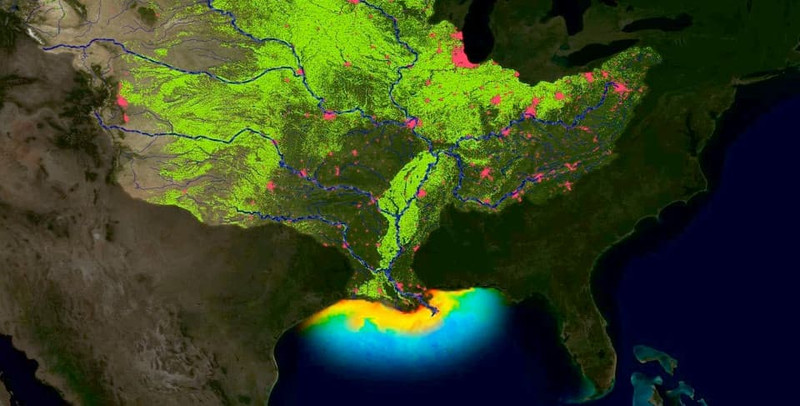
Mississippi River watershed and Gulf of Mexico dead zone
The map helps connect the cause and effect. A huge inland watershed drains through the Mississippi River system into the Gulf, so many upstream nonpoint sources can create a major environmental effect far downstream.
Key Takeaways
Eutrophication
Enrichment of a body of water with nutrients, often causing an algal bloom followed by decomposition, oxygen depletion, and aquatic die-offs
Cultural Eutrophication; Anthropogenic Eutrophication
Human-accelerated eutrophication caused mainly by nutrient-rich agricultural runoff and wastewater releases
Algal Bloom
A rapid increase in algae or cyanobacteria, commonly triggered by excess nutrients in water
Dissolved Oxygen (DO)
Molecular oxygen dissolved in water and available to aquatic organisms for aerobic respiration
Hypoxic Waterway
A body of water with a low concentration of dissolved oxygen
Anoxic Water
Water containing essentially no dissolved oxygen
Dead Zone
An area where dissolved oxygen is too low to support most oxygen-dependent aquatic animal life
Eutrophic Waterway
A nutrient-rich, highly productive waterway that may have dense algae, abundant organic matter, and large dissolved-oxygen fluctuations
Oligotrophic Waterway
A waterway with very low nutrient levels, low and stable algal populations, clear water, and high dissolved oxygen
Harmful Algal Bloom
An algal or cyanobacterial bloom that produces toxins harmful to wildlife, livestock, pets, or humans
Notes
Eutrophication
Enrichment of a body of water with nutrients, often causing an algal bloom followed by decomposition, oxygen depletion, and aquatic die-offs
Cultural Eutrophication; Anthropogenic Eutrophication
Human-accelerated eutrophication caused mainly by nutrient-rich agricultural runoff and wastewater releases
Algal Bloom
A rapid increase in algae or cyanobacteria, commonly triggered by excess nutrients in water
Dissolved Oxygen (DO)
Molecular oxygen dissolved in water and available to aquatic organisms for aerobic respiration
Hypoxic Waterway
A body of water with a low concentration of dissolved oxygen
Anoxic Water
Water containing essentially no dissolved oxygen
Dead Zone
An area where dissolved oxygen is too low to support most oxygen-dependent aquatic animal life
Eutrophic Waterway
A nutrient-rich, highly productive waterway that may have dense algae, abundant organic matter, and large dissolved-oxygen fluctuations
Oligotrophic Waterway
A waterway with very low nutrient levels, low and stable algal populations, clear water, and high dissolved oxygen
Harmful Algal Bloom
An algal or cyanobacterial bloom that produces toxins harmful to wildlife, livestock, pets, or humans
