Topic 9.2 Notes – Reducing Ozone Depletion
Why Replacing CFCs Reduces Ozone Depletion
Stratospheric ozone sits high in the atmosphere and absorbs harmful ultraviolet radiation. When ozone is thinned, more UV reaches Earth’s surface, which raises risks like skin cancer and cataracts.
CFCs are chlorofluorocarbons, compounds made of carbon, chlorine, and fluorine. They were widely used in:
- refrigerants in fridges and air conditioners
- aerosols as propellants
- foam-blowing agents for making foams
- cleaning solvents for electronics and industry
The key reason CFCs are so damaging is their stability. In the lower atmosphere, they do not break down easily, so they last long enough to drift up into the stratosphere. There, UV radiation breaks them apart and releases chlorine radicals.
That chlorine destroys ozone catalytically, which means the chlorine is reused and can destroy many ozone molecules, not just one. This reaction cycle is what the diagram traces.
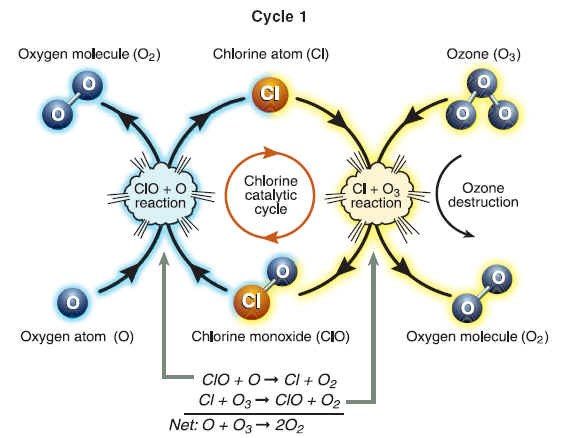
Chlorine catalytic cycle in ozone destruction
The direct fix is source reduction. Stop making and releasing ozone-depleting substances, and replace them with chemicals that do not release chlorine or bromine in the stratosphere.
A term you should know is ozone-depletion potential or ODP. This measures how strongly a substance depletes stratospheric ozone. An ODP of zero means it does not directly deplete ozone.
CFC Substitutes and Their Trade-Offs
The three groups to compare are CFCs, HCFCs, and HFCs.
| Chemical group | Contains chlorine | ODP | Main idea |
|---|---|---|---|
| CFCs | Yes | High | Long-lived, major ozone destroyers, phased out |
| HCFCs | Yes | Lower than CFCs, but not zero | Transitional substitutes, also being phased out |
| HFCs | No | About zero | Protect ozone layer, but some worsen climate change |
CFCs
CFCs contain chlorine, have a high ozone-depleting effect, and stay in the atmosphere a long time. That is why they became the main target of phaseouts.
HCFCs
HCFCs contain hydrogen, chlorine, fluorine, and carbon. Because they include hydrogen, more of them break down in the lower atmosphere before reaching the stratosphere. That gives them a lower ODP than CFCs, but since they still contain chlorine, their ODP is still not zero.
HFCs
HFCs are hydrofluorocarbons. They contain hydrogen, fluorine, and carbon, but no chlorine. That is the key fact. No chlorine means essentially zero ODP. They became important substitutes, especially as refrigerants in redesigned systems.
The environmental trade-off
Here’s the catch. Some HFCs are strong greenhouse gases.
- Benefit: they reduce ozone depletion
- Cost: some have high global warming potential or GWP
GWP compares how much heat a gas traps relative to carbon dioxide, where CO has GWP = 1.
This is a classic APES distinction. Ozone depletion and climate change are different problems. A chemical can be safe for ozone and still be bad for warming.
How Mitigation Works in Practice
The chain looks like this:
- Replace CFCs with chemicals that have zero or near-zero ODP.
- Reduce use and leakage of chlorine-containing chemicals.
- Less chlorine reaches the stratosphere.
- Less catalytic ozone destruction happens.
- Natural ozone formation slowly rebuilds ozone levels.
Recovery is slow because CFCs already in the atmosphere can last for decades. Old equipment still stores these chemicals, so management matters.
Key practices:
- leak detection and repair
- refrigerant recovery before servicing or disposal
- recycling or reclamation of usable refrigerant
- destruction of unusable chemicals
- replacing aging equipment
- preventing venting during maintenance and disposal
The Montreal Protocol and Why It Matters
The major real-world success story is the Montreal Protocol. It was adopted in 1987 and entered into force in 1989.
It is an international agreement to phase out CFCs and other ozone-depleting substances through:
- source reduction
- trade restrictions
- reporting requirements
- substitute chemicals
This had to be global because ozone depletion is a global atmospheric problem. Long-lived gases mix throughout the atmosphere, so emissions in one place affect everyone.
The later Kigali Amendment matters too. It created a global phase-down of HFCs because of their climate impacts.
Progression to remember:
- CFCs restricted because they deplete ozone
- HFCs adopted because they do not deplete ozone
- some HFCs later limited because they are potent greenhouse gases
What Evidence of Success Looks Like
On graphs, CFC production drops first after regulation. Atmospheric CFC concentration or stratospheric chlorine falls more slowly. Ozone recovery is slowest of all and can vary by region and year.
This timeline figure shows that sequence clearly. Focus on the top panels first, where emissions fall before equivalent effective chlorine declines, then the lower panels, where ozone recovers gradually over decades.
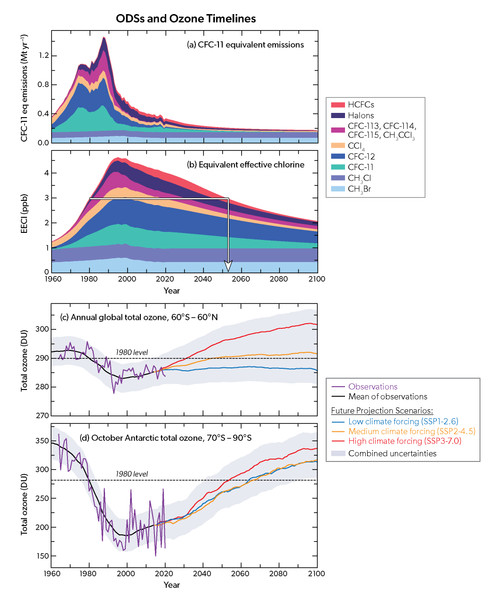
ODSs and ozone timelines
That lag does not mean the policy failed. It reflects long atmospheric lifetimes and slow atmospheric response. On AP-style questions, pay attention to long-term trends, not one unusual year.
Also, effective ozone solutions must directly target ozone-depleting chemicals. Actions like tree planting or reducing CO may help climate change, but they do not directly fix stratospheric ozone depletion.
Key Takeaways
Hydrofluorocarbons (HFCs)
CFC substitutes containing hydrogen, fluorine, and carbon but no chlorine; they have essentially zero ozone-depletion potential, although some are powerful greenhouse gases
Hydrochlorofluorocarbons (HCFCs)
Transitional CFC substitutes that contain chlorine but break down more readily in the lower atmosphere, giving them lower but nonzero ozone-depletion potential
Ozone-Depletion Potential (ODP)
A measure of a substance’s ability to destroy stratospheric ozone relative to a reference substance; an ODP of zero indicates no direct chlorine- or bromine-catalyzed depletion
Global Warming Potential (GWP)
A measure comparing a greenhouse gas’s heat-trapping effect with that of carbon dioxide over a specified period; CO₂ has a GWP of 1
Notes
Hydrofluorocarbons (HFCs)
CFC substitutes containing hydrogen, fluorine, and carbon but no chlorine; they have essentially zero ozone-depletion potential, although some are powerful greenhouse gases
Hydrochlorofluorocarbons (HCFCs)
Transitional CFC substitutes that contain chlorine but break down more readily in the lower atmosphere, giving them lower but nonzero ozone-depletion potential
Ozone-Depletion Potential (ODP)
A measure of a substance’s ability to destroy stratospheric ozone relative to a reference substance; an ODP of zero indicates no direct chlorine- or bromine-catalyzed depletion
Global Warming Potential (GWP)
A measure comparing a greenhouse gas’s heat-trapping effect with that of carbon dioxide over a specified period; CO₂ has a GWP of 1
