Topic 1.3 Notes – Aquatic Biomes
What Aquatic Biomes Are
An aquatic biome is an ecosystem in water. The big divide is between freshwater and marine systems.
- Freshwater biomes have low salinity and include streams, rivers, ponds, and lakes.
- They matter a lot because they are a major source of drinking water.
- Marine biomes have high salinity and include oceans, coral reefs, marshland, and estuaries.
- Marine algae, especially phytoplankton, produce a large share of Earth’s oxygen and also remove carbon dioxide from the atmosphere during photosynthesis.
- Estuaries are brackish systems, which means freshwater and seawater mix there.
Aquatic organisms do not just live anywhere in water. Their distribution depends on whether they can tolerate the conditions there, whether food is available, whether the habitat fits their needs, and whether they can reproduce there.
The Main Types of Aquatic Biomes
Freshwater biomes
Streams and rivers are flowing freshwater systems.
- Headwaters are usually cold, clear, fast-moving, and oxygen-rich.
- Farther downstream, water is often warmer, wider, slower, and more turbid.
Ponds and lakes are standing freshwater systems.
- A pond is usually shallower.
- A lake is usually larger and deeper.
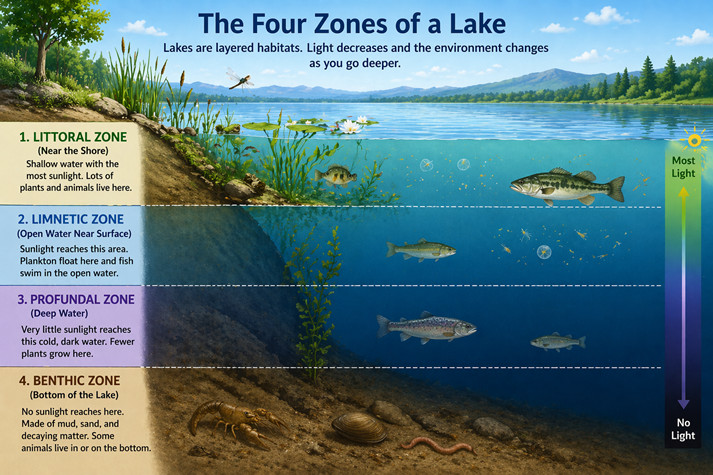
Lake zones
Lake zones work as a set:
- Littoral zone is the shallow near-shore area with rooted plants.
- Limnetic zone is sunlit open water where phytoplankton are important producers.
- Profundal zone is deeper, darker water.
- Benthic zone is the bottom, where decomposers and detritivores live.
Freshwater wetlands are water-saturated areas with water-tolerant plants.
- Marshes have nonwoody plants
- Swamps have woody plants
- Bogs are acidic, nutrient-poor, and rich in organic matter
Marine biomes
- Oceans are the largest aquatic biome and include photic and aphotic regions.
- Coral reefs occur in warm, shallow, clear, sunlit salt water. Corals depend on symbiotic photosynthetic algae.
- Marshland here means salt marshes, with salt-tolerant nonwoody plants in coastal or estuarine areas.
- Estuaries are partially enclosed coastal waters where rivers meet the sea. They are brackish, very productive, and important nursery habitats.
Marine zones and regions
For the ocean, focus on the major horizontal and vertical divisions shown here.
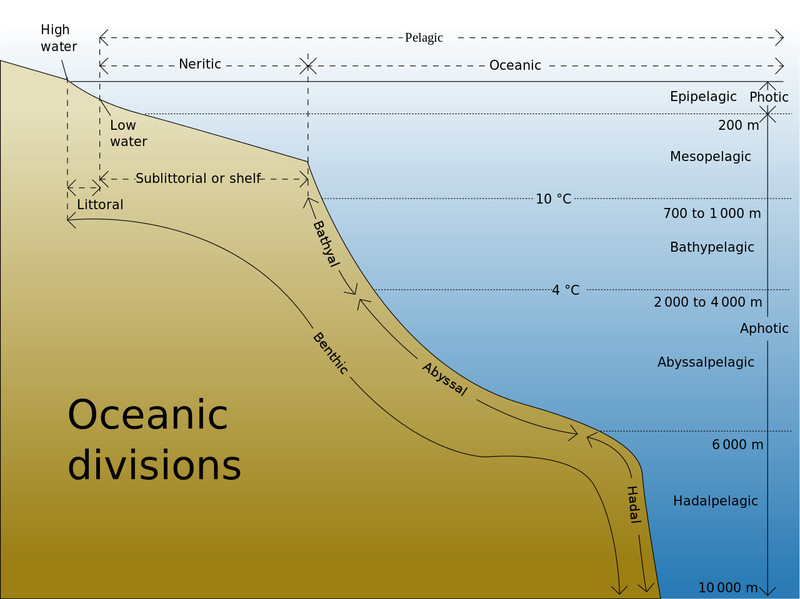
Ocean zones and regions
- Intertidal zone sits between high and low tide.
- Neritic zone is shallow water over the continental shelf and is highly productive.
- Oceanic zone is the open ocean beyond the shelf.
- Pelagic zone means the open water column.
- Benthic zone means the seafloor.
The Abiotic Factors That Control Distribution
This is the heart of the topic. Biome names matter less than the conditions inside them.
- Salinity means dissolved salt concentration.
- It separates freshwater, brackish, and marine habitats.
- It is a major reason species usually cannot move easily between freshwater and seawater.
- Depth and light
- Light decreases with depth.
- The photic zone gets enough light for photosynthesis.
- The aphotic zone does not.
- Turbidity means cloudiness from suspended particles.
- More turbidity means less light penetration and often less photosynthesis.
- Nutrient availability
- Nitrogen and phosphorus often limit producer growth.
- More nutrients often mean higher productivity.
- Temperature
- Affects metabolism, reproduction, and species range.
- Cold water holds more dissolved oxygen than warm water.
- Dissolved oxygen, flow, and substrate
- Oxygen is needed for respiration.
- Moving water usually gains more oxygen from the atmosphere.
- Current speed and bottom type help determine which organisms can live there.
How Aquatic Conditions Shape Productivity and Resources
Productivity depends on how abiotic factors work together.
- Highly productive waters usually have both light and nutrients.
- The open ocean often has plenty of light at the surface but few nutrients, so productivity per unit area is often low.
- Coastal waters, estuaries, and upwelling zones are often very productive because nutrients are available.
- Upwelling brings cold, nutrient-rich deep water to the surface and supports major fisheries.
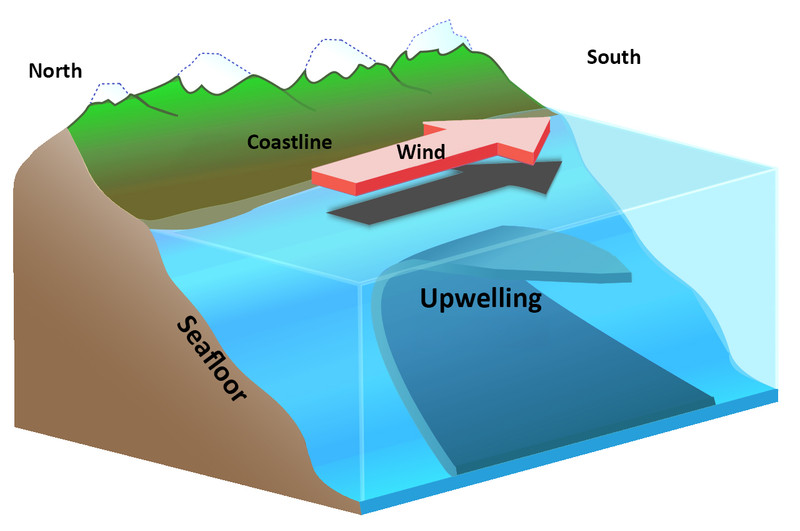
Coastal upwelling
Examples that tie the whole topic together:
- Anchoveta fishery off Peru and Chile grows well because upwelling brings nutrients into sunlit surface water.
- Coral reefs need warm, shallow, clear, saline water so their algae can photosynthesize.
- Cold-water stream fish do well in low-temperature, fast-flowing, oxygen-rich water.
- Chesapeake Bay estuary has a salinity gradient, so different communities live in different parts of the bay.
Key Takeaways
Aquatic Biome
A water-based ecological system classified chiefly by salinity, movement, depth, light, temperature, turbidity, nutrients, dissolved oxygen, and substrate
Freshwater Biome
A low-salinity aquatic system, including streams, rivers, ponds, lakes, and freshwater wetlands, that provides vital drinking water
Marine Biome
A saline aquatic system—including oceans, coral reefs, salt marshes, and estuaries—where algae take up atmospheric CO₂ and generate roughly half the oxygen produced by global photosynthesis
Salinity
The concentration of dissolved salts in water, commonly measured in parts per thousand (ppt)
Brackish Water
Water with intermediate, often variable salinity produced where freshwater and seawater mix
Photic Zone
The portion of a body of water receiving enough sunlight for photosynthesis
Aphotic Zone
Water below the photic zone that does not receive enough light to support photosynthesis
Phytoplankton
Microscopic algae and photosynthetic bacteria that drift in sunlit water and form the producer base of many aquatic food webs
Turbidity
The cloudiness of water caused by suspended particles, which reduces light penetration and may harm aquatic organisms
Nutrient Availability
The supply of nutrients such as nitrogen and phosphorus that limits aquatic producer growth and ecosystem productivity
Dissolved Oxygen
Oxygen gas present in water and available for aquatic respiration; cold, turbulent water generally holds more than warm, still water
Lotic vs. Lentic
Lotic systems contain flowing freshwater; lentic systems contain standing freshwater
Streams and Rivers
Bodies of flowing freshwater; streams generally carry less water than rivers, but no universal size boundary separates them
Headwaters
The upper beginnings of a river system, typically narrow, cold, clear, fast-moving, and rich in dissolved oxygen
Ponds and Lakes
Bodies of standing freshwater; ponds are generally shallower, while lakes are generally larger and deeper
Littoral Zone
The shallow nearshore lake zone where sunlight reaches the bottom and rooted plants are abundant
Limnetic Zone
The sunlit open-water lake zone away from shore, where phytoplankton are major producers
Profundal Zone
Deep lake water below the depth at which enough light is available for photosynthesis
Benthic Zone
The bottom surface and sediments of a body of water, inhabited by bottom-dwelling organisms
Oligotrophic Lake
A nutrient-poor, low-productivity lake with clear water and usually relatively high deep-water dissolved oxygen
Mesotrophic Lake
A lake with intermediate nutrient concentrations and biological productivity
Eutrophic Lake
A nutrient-rich, highly productive lake with abundant algal or plant growth, often turbid water, and decomposition that can reduce deep-water oxygen
Thermal Stratification
The formation of temperature and density layers in water that resist mixing of heat, oxygen, and nutrients
Epilimnion
The warm, less-dense surface layer of a thermally stratified lake
Thermocline
The layer of rapid temperature change separating a lake’s warm epilimnion from its cold hypolimnion
Hypolimnion
The cold, dense deep-water layer below the thermocline in a stratified lake
Lake Turnover
Seasonal mixing that occurs when surface and deep water reach similar temperatures and densities, redistributing oxygen and nutrients
Freshwater Wetland
An inland area whose soil is covered or saturated by water for part of the year and supports water-tolerant vegetation
Freshwater Marsh
A freshwater wetland dominated by nonwoody emergent plants such as grasses, reeds, and sedges
Swamp
A freshwater wetland dominated by woody vegetation such as trees or shrubs
Bog
An acidic, nutrient-poor freshwater wetland that accumulates partially decomposed organic material
Intertidal Zone
The shoreline between average high and low tides, alternately submerged and exposed
Neritic Zone
The shallow marine water above the continental shelf, often productive because of sunlight, mixing, and nutrient input
Oceanic Zone (Open Ocean)
The vast marine region beyond the continental shelf, whose sunlit surface often has low productivity because nutrients are scarce
Pelagic Zone
The water column of a marine system rather than its bottom
Estuary
A partially enclosed coastal body of water where river freshwater mixes with seawater, creating productive brackish habitat
Salt Marsh
A tidal coastal wetland dominated by salt-tolerant grasses and other nonwoody emergent plants
Mangrove Wetland
A tropical or subtropical coastal wetland dominated by salt-tolerant trees and shrubs with dense root systems
Coral Reef
A diverse marine ecosystem built by coral polyps in warm, shallow, clear, sunlit, saline water
Upwelling
The movement of nutrient-rich deep water toward the surface, supporting high phytoplankton productivity and fisheries
Notes
Aquatic Biome
A water-based ecological system classified chiefly by salinity, movement, depth, light, temperature, turbidity, nutrients, dissolved oxygen, and substrate
Freshwater Biome
A low-salinity aquatic system, including streams, rivers, ponds, lakes, and freshwater wetlands, that provides vital drinking water
Marine Biome
A saline aquatic system—including oceans, coral reefs, salt marshes, and estuaries—where algae take up atmospheric CO₂ and generate roughly half the oxygen produced by global photosynthesis
Salinity
The concentration of dissolved salts in water, commonly measured in parts per thousand (ppt)
Brackish Water
Water with intermediate, often variable salinity produced where freshwater and seawater mix
Photic Zone
The portion of a body of water receiving enough sunlight for photosynthesis
Aphotic Zone
Water below the photic zone that does not receive enough light to support photosynthesis
Phytoplankton
Microscopic algae and photosynthetic bacteria that drift in sunlit water and form the producer base of many aquatic food webs
Turbidity
The cloudiness of water caused by suspended particles, which reduces light penetration and may harm aquatic organisms
Nutrient Availability
The supply of nutrients such as nitrogen and phosphorus that limits aquatic producer growth and ecosystem productivity
Dissolved Oxygen
Oxygen gas present in water and available for aquatic respiration; cold, turbulent water generally holds more than warm, still water
Lotic vs. Lentic
Lotic systems contain flowing freshwater; lentic systems contain standing freshwater
Streams and Rivers
Bodies of flowing freshwater; streams generally carry less water than rivers, but no universal size boundary separates them
Headwaters
The upper beginnings of a river system, typically narrow, cold, clear, fast-moving, and rich in dissolved oxygen
Ponds and Lakes
Bodies of standing freshwater; ponds are generally shallower, while lakes are generally larger and deeper
Littoral Zone
The shallow nearshore lake zone where sunlight reaches the bottom and rooted plants are abundant
Limnetic Zone
The sunlit open-water lake zone away from shore, where phytoplankton are major producers
Profundal Zone
Deep lake water below the depth at which enough light is available for photosynthesis
Benthic Zone
The bottom surface and sediments of a body of water, inhabited by bottom-dwelling organisms
Oligotrophic Lake
A nutrient-poor, low-productivity lake with clear water and usually relatively high deep-water dissolved oxygen
Mesotrophic Lake
A lake with intermediate nutrient concentrations and biological productivity
Eutrophic Lake
A nutrient-rich, highly productive lake with abundant algal or plant growth, often turbid water, and decomposition that can reduce deep-water oxygen
Thermal Stratification
The formation of temperature and density layers in water that resist mixing of heat, oxygen, and nutrients
Epilimnion
The warm, less-dense surface layer of a thermally stratified lake
Thermocline
The layer of rapid temperature change separating a lake’s warm epilimnion from its cold hypolimnion
Hypolimnion
The cold, dense deep-water layer below the thermocline in a stratified lake
Lake Turnover
Seasonal mixing that occurs when surface and deep water reach similar temperatures and densities, redistributing oxygen and nutrients
Freshwater Wetland
An inland area whose soil is covered or saturated by water for part of the year and supports water-tolerant vegetation
Freshwater Marsh
A freshwater wetland dominated by nonwoody emergent plants such as grasses, reeds, and sedges
Swamp
A freshwater wetland dominated by woody vegetation such as trees or shrubs
Bog
An acidic, nutrient-poor freshwater wetland that accumulates partially decomposed organic material
Intertidal Zone
The shoreline between average high and low tides, alternately submerged and exposed
Neritic Zone
The shallow marine water above the continental shelf, often productive because of sunlight, mixing, and nutrient input
Oceanic Zone (Open Ocean)
The vast marine region beyond the continental shelf, whose sunlit surface often has low productivity because nutrients are scarce
Pelagic Zone
The water column of a marine system rather than its bottom
Estuary
A partially enclosed coastal body of water where river freshwater mixes with seawater, creating productive brackish habitat
Salt Marsh
A tidal coastal wetland dominated by salt-tolerant grasses and other nonwoody emergent plants
Mangrove Wetland
A tropical or subtropical coastal wetland dominated by salt-tolerant trees and shrubs with dense root systems
Coral Reef
A diverse marine ecosystem built by coral polyps in warm, shallow, clear, sunlit, saline water
Upwelling
The movement of nutrient-rich deep water toward the surface, supporting high phytoplankton productivity and fisheries
