Topic 2.1 Notes – Introduction to Biodiversity
What Biodiversity Is
Biodiversity is the variety of life in a defined area. That area could be a pond, forest, coastline, or larger region. The key thing is that biodiversity is more than a species count.
The three levels are shown below, then explained one at a time.
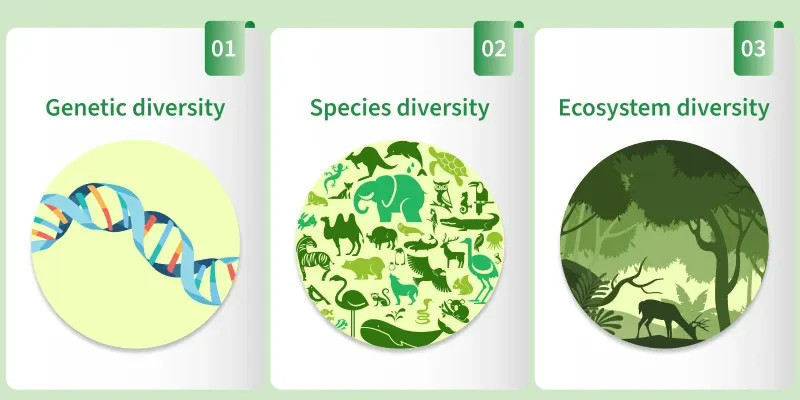
Three levels of biodiversity
Genetic diversity
Variation in genes and inherited traits within a population or species.
- Individuals of the same species are not identical.
- Those differences can affect disease resistance, drought tolerance, temperature or salinity tolerance, and reproductive timing.
Species diversity
The variety of species in a community.
- This includes how many species are present and how evenly individuals are spread among them.
- So two ecosystems can have the same number of species but different overall diversity.
Habitat diversity
The variety of habitats in a region.
- More habitat types means more combinations of conditions and resources.
- Different habitats can offer different moisture, sunlight, soil, salinity, food, shelter, and breeding sites.
These three levels are connected, but they are not interchangeable. A place can have many species but low genetic diversity within one species. It can also have several habitat types but still be biologically degraded. Overall, more biodiversity usually makes it more likely that populations and ecosystems keep functioning when conditions change.
Species Diversity, Species Richness, and Evenness
The term the course especially wants you to know is species richness. It means the number of different species in an ecosystem.
Species evenness means how equally individuals are distributed among those species.
Here’s the full set of patterns you could see:
- High richness, high evenness
Many species, with similar population sizes. This is usually the highest diversity. - High richness, low evenness
Many species, but one or two dominate. - Low richness, high evenness
Few species, but their numbers are similar. - Low richness, low evenness
Few species, and one dominates.
A common mistake is mixing up abundance with biodiversity. If an area has thousands of organisms but almost all are the same species, richness is low.
A diversity index combines richness and evenness into one number. You might be given Simpson’s Index of Diversity:
If the formula is , values closer to 1 mean greater diversity. The APES trap here is that different versions of Simpson’s index are reported differently, so always check the formula or key.
Quick reading skill:
- Same richness + higher evenness = higher species diversity
- On a bar graph, more equal bar heights = greater evenness
Genetic Diversity and Population Bottlenecks
Genetic diversity increases the chance that some individuals survive a stressor. It does not guarantee survival, but it gives the population more possible responses.
Low genetic diversity raises the risk of inbreeding.
- Harmful recessive alleles are more likely to be expressed.
- That can lower survival, fertility, and disease resistance.
A population bottleneck is a sharp reduction in population size.
- The survivors are only a small sample of the original gene pool.
- Rare alleles are especially likely to be lost.
- Even if population size later grows again, genetic diversity can stay low.
Illustrative example:
- Northern elephant seals were hunted down to a very small remnant population. Their numbers later rebounded, but they still have low genetic variation.
That leads to one of the most tested distinctions in this topic. A large population size does not automatically mean high genetic diversity.
Habitat Diversity and What Habitat Loss Does
Habitat diversity means a variety of habitats in one geographic area. Different habitats support different species because they provide different conditions and resources.
When habitat is lost, biodiversity usually declines in a predictable pattern:
- Specialist species decline first
They need a narrow set of conditions or resources, so they have less flexibility. - Generalist species decline later
They can use a wider range of resources, so they last longer, but continued habitat loss still reduces them. - Species with large territorial requirements are reduced
They need large hunting areas, breeding grounds, or multiple habitats.
If a species disappears from one area, that is local extinction, also called extirpation. The species may still exist somewhere else.
Why Biodiversity Makes Ecosystems More Stable
A disruption could be drought, fire, flood, storm, disease, pollution, or habitat loss.
Two responses matter here:
- Resistance means the ecosystem stays relatively unchanged during the disruption.
- Resilience means the ecosystem recovers after it has been changed.
Biodiversity helps because:
- some individuals can tolerate the stressor
- some species can keep ecosystem processes going
- species with overlapping roles can partly compensate for losses
- different habitats can serve as refuges or recolonization sources
The APES claim is careful here. Biodiversity increases the probability of resistance and resilience. It does not protect every ecosystem from every disturbance.
Key Takeaways
Biodiversity
The variety of life in a defined area, including genetic, species, and habitat diversity
Genetic Diversity
Variation in genes, alleles, and inherited traits within a population or species; greater variation increases the likelihood that some individuals can tolerate environmental stress
Population Bottleneck
A sharp population decline that leaves a limited sample of the original alleles, reducing genetic diversity even if abundance later recovers
Species Diversity
Variation among species in a community, determined by both species richness and species evenness
Species Richness
The number of different species found in a defined area, regardless of each species’ abundance
Species Evenness
How equally individuals are distributed among the species present in a community
Simpson’s Index of Diversity (1 − D)
1 − D = 1 − [Σ nᵢ(nᵢ − 1)]/[N(N − 1)]; it is the probability that two individuals selected without replacement belong to different species, with values nearer 1 indicating greater diversity
Habitat Diversity
The variety of habitats within a geographic area; more habitat types generally support species with a wider range of ecological requirements
Habitat Loss
A change that makes an area unable to provide organisms’ required conditions or resources, tending to eliminate specialists first, then generalists, and to reduce species needing large territories
Specialist Species
A species that uses a narrow range of resources or environmental conditions and is therefore especially vulnerable to habitat loss
Generalist Species
A species that can use a broad range of resources or conditions, allowing it to persist longer than specialists as habitat is lost
Local Extinction (Extirpation)
The disappearance of a species from one area while it continues to survive elsewhere
Ecosystem Resistance
An ecosystem’s ability to remain relatively unchanged when a disruption occurs; greater biodiversity generally increases this ability
Ecosystem Resilience
An ecosystem’s ability to recover toward its prior structure and function after a disruption; greater species diversity generally increases this ability
Diversity Index
A numerical measure that combines species richness and relative abundance to compare community diversity
Notes
Biodiversity
The variety of life in a defined area, including genetic, species, and habitat diversity
Genetic Diversity
Variation in genes, alleles, and inherited traits within a population or species; greater variation increases the likelihood that some individuals can tolerate environmental stress
Population Bottleneck
A sharp population decline that leaves a limited sample of the original alleles, reducing genetic diversity even if abundance later recovers
Species Diversity
Variation among species in a community, determined by both species richness and species evenness
Species Richness
The number of different species found in a defined area, regardless of each species’ abundance
Species Evenness
How equally individuals are distributed among the species present in a community
Simpson’s Index of Diversity (1 − D)
1 − D = 1 − [Σ nᵢ(nᵢ − 1)]/[N(N − 1)]; it is the probability that two individuals selected without replacement belong to different species, with values nearer 1 indicating greater diversity
Habitat Diversity
The variety of habitats within a geographic area; more habitat types generally support species with a wider range of ecological requirements
Habitat Loss
A change that makes an area unable to provide organisms’ required conditions or resources, tending to eliminate specialists first, then generalists, and to reduce species needing large territories
Specialist Species
A species that uses a narrow range of resources or environmental conditions and is therefore especially vulnerable to habitat loss
Generalist Species
A species that can use a broad range of resources or conditions, allowing it to persist longer than specialists as habitat is lost
Local Extinction (Extirpation)
The disappearance of a species from one area while it continues to survive elsewhere
Ecosystem Resistance
An ecosystem’s ability to remain relatively unchanged when a disruption occurs; greater biodiversity generally increases this ability
Ecosystem Resilience
An ecosystem’s ability to recover toward its prior structure and function after a disruption; greater species diversity generally increases this ability
Diversity Index
A numerical measure that combines species richness and relative abundance to compare community diversity
