Topic 5.5 Notes – Irrigation Methods
What Irrigation Is
Irrigation means humans apply water to farmland to help crops grow when precipitation is too low, seasonal, or unpredictable. That makes farming possible in drier places and helps crops survive dry periods.
The big idea is a trade-off you’ll see all through this topic:
- More irrigation can increase crop productivity and reliability.
- More irrigation also increases human demand on freshwater.
A number you should know is that about 70% of human freshwater consumption is used for agriculture. So when APES talks about water use, farming is a huge part of the story.
The four methods you need are furrow, flood, spray, and drip. They mainly differ in:
- how water reaches the roots
- how much water is lost
- how much the system costs
- how much energy it needs
This comparison helps you preview one of the biggest differences among irrigation methods, which is how much water is lost before plants can use it.
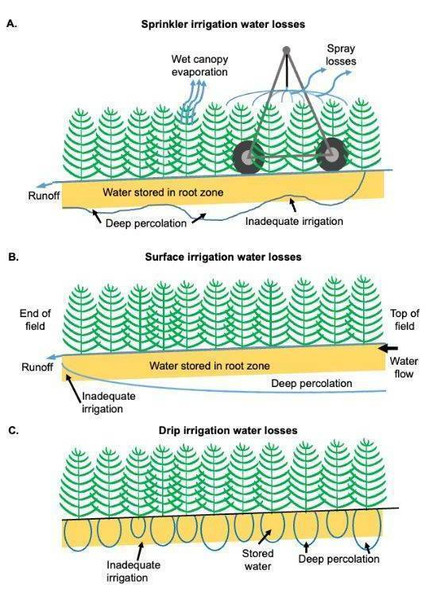
Irrigation water losses by method. The figure groups furrow and flood together as surface irrigation; spray appears as sprinkler irrigation.
Irrigation Methods and Their Trade-Offs
These methods are easiest to remember by comparing them side by side.
| Method | How it works | Advantage | Drawback | Water loss |
|---|---|---|---|---|
| Furrow | Shallow trenches between crop rows carry water by gravity into the root zone | Cheap and simple | A lot of water is lost to evaporation and runoff | About 1/3 lost |
| Flood | Water spreads over the whole field in a shallow layer | Simple and inexpensive | Can cause waterlogging | About 20% lost |
| Spray | Water is pumped through pipes and nozzles and falls like rain | More efficient than flood and furrow | More expensive and needs energy | 25% or less lost |
| Drip | Perforated tubes release small amounts of water right at the roots | Most efficient and most precise | Expensive, so less common | About 5% lost |
Spray irrigation
Center-pivot irrigation is the classic spray system. It is the one that creates circular fields when viewed from above.
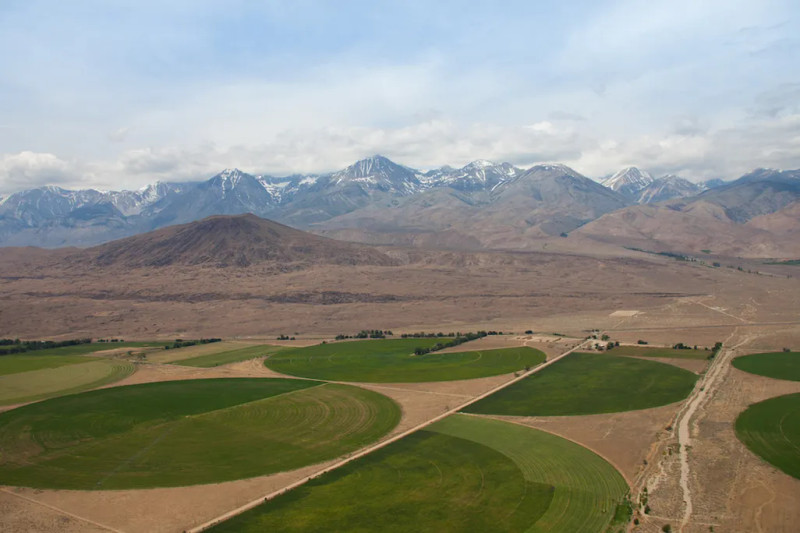
Center-pivot irrigation
One thing students miss is that spray can lose more water in hot, dry, windy conditions because droplets evaporate before reaching the soil.
Comparing Efficiency and Choosing a Method
Water-use efficiency means how much of the applied water actually stays available for crops instead of being lost to evaporation or runoff.
The ranking to memorize is:
- Drip most efficient
- Spray intermediate
- Flood less efficient
- Furrow least efficient
There’s one APES nuance here. Spray is taught as more efficient overall than flood and furrow, even though spray and flood percentages can sometimes look close. If a question gives you actual numbers, use those numbers.
The calculation is:
So if 1000 L is applied by drip, water remaining is L.
Choice usually follows the goal:
- Lowest cost often points to flood or furrow
- Saving water points to spray, especially drip
- Lower energy use points away from spray, because pumping and pressurizing take energy
Soil Problems Caused by Irrigation
Waterlogging
Waterlogging happens when too much water stays in the soil. The water table rises toward the roots, and soil pores fill with water instead of air. Roots need oxygen for cellular respiration, so plant growth drops and plants may die.
It is strongly linked to flood irrigation, but any method can cause it if too much water is applied.
Salinization
Salinization is salt buildup in soil. Here’s the sequence:
- Irrigation water enters soil carrying dissolved salts
- Water evaporates or is taken up by plants
- Salts stay behind
- More irrigation adds more salts
- Salt concentration builds up over time
This is most common in dry climates and poorly drained soils. High salt levels can become toxic to plants and lower crop yields.
Waterlogging vs. salinization
- Waterlogging = too much water, too little oxygen
- Salinization = too much salt left after evaporation
They are different problems, but they can happen together.
Aquifer Depletion and the Big Environmental Consequence
A lot of irrigation water comes from aquifers, which are underground layers that store groundwater. Aquifer depletion happens when water is pumped out faster than natural recharge replaces it.
Effects include:
- falling water table
- deeper wells
- more energy needed for pumping
- less water available later
The Ogallala Aquifer in the central United States shows all of these. This map shows water-level change across the aquifer, with many areas showing substantial declines.
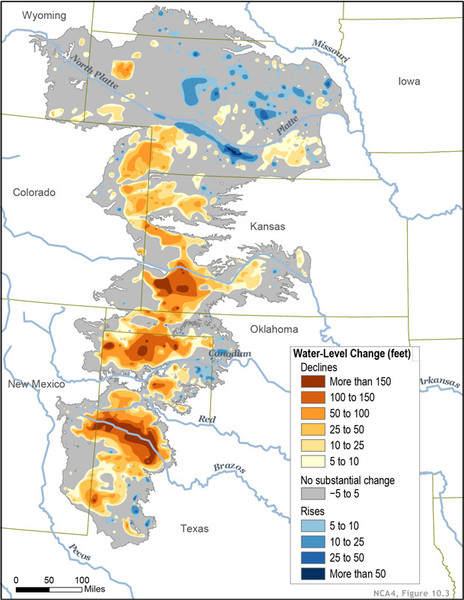
Water-level change in the Ogallala Aquifer
More efficient irrigation can reduce stress on aquifers, but it does not automatically solve depletion. If total pumping still exceeds recharge, or farmers use the saved water to irrigate more land, the aquifer can still decline.
Key Takeaways
Irrigation
Artificially applying water to agricultural land to support crops; agriculture accounts for about 70% of human freshwater consumption globally
Water-Use Efficiency
The proportion of applied irrigation water that remains available to crops rather than being lost through evaporation or runoff
Furrow Irrigation
Water flows by gravity through trenches between crop rows; it is inexpensive but loses about one-third of its water to evaporation and runoff
Flood Irrigation
A field is temporarily covered with water; it is simple and inexpensive but loses about 20% to evaporation and runoff and can cause waterlogging
Spray Irrigation
Groundwater is pumped through spray nozzles across a field; 25% or less is lost to evaporation and runoff, but the system is more expensive than flood or furrow irrigation and requires energy
Center-Pivot Irrigation
A form of spray irrigation in which a long sprinkler arm rotates around a central pumping point, producing circular irrigated fields
Drip Irrigation
Perforated hoses release small amounts of water directly near plant roots; it loses only about 5% but is expensive to install
Waterlogging
Excess irrigation water saturates soil and raises the water table into the root zone, depriving roots of oxygen
Salinization
The buildup of salts left in soil when irrigation water evaporates, eventually reducing plant water uptake and becoming toxic to crops
Aquifer Depletion
Groundwater is withdrawn faster than recharge replaces it, lowering the water table and reducing future water availability
Ogallala Aquifer
An aquifer beneath the central United States that has been heavily pumped for irrigation, with withdrawals exceeding recharge and substantially lowering groundwater levels
Notes
Irrigation
Artificially applying water to agricultural land to support crops; agriculture accounts for about 70% of human freshwater consumption globally
Water-Use Efficiency
The proportion of applied irrigation water that remains available to crops rather than being lost through evaporation or runoff
Furrow Irrigation
Water flows by gravity through trenches between crop rows; it is inexpensive but loses about one-third of its water to evaporation and runoff
Flood Irrigation
A field is temporarily covered with water; it is simple and inexpensive but loses about 20% to evaporation and runoff and can cause waterlogging
Spray Irrigation
Groundwater is pumped through spray nozzles across a field; 25% or less is lost to evaporation and runoff, but the system is more expensive than flood or furrow irrigation and requires energy
Center-Pivot Irrigation
A form of spray irrigation in which a long sprinkler arm rotates around a central pumping point, producing circular irrigated fields
Drip Irrigation
Perforated hoses release small amounts of water directly near plant roots; it loses only about 5% but is expensive to install
Waterlogging
Excess irrigation water saturates soil and raises the water table into the root zone, depriving roots of oxygen
Salinization
The buildup of salts left in soil when irrigation water evaporates, eventually reducing plant water uptake and becoming toxic to crops
Aquifer Depletion
Groundwater is withdrawn faster than recharge replaces it, lowering the water table and reducing future water availability
Ogallala Aquifer
An aquifer beneath the central United States that has been heavily pumped for irrigation, with withdrawals exceeding recharge and substantially lowering groundwater levels
