Topic 2.5 Notes – Natural Disruptions to Ecosystems
What Natural Disruptions Are
A natural disruption is a nonhuman event or process that changes abiotic conditions, habitat, population size, species composition, or community structure. That can mean a sudden event like a hurricane or a long-term shift like climate change.
The core idea is that disturbance is normal in ecosystems. It does not automatically mean permanent destruction. Many ecosystems developed with recurring disturbance, so some species are adapted to survive it or even benefit from it.
The main chain to remember is:
natural process → habitat and environmental change → population and community response
A single natural event can be as damaging as, or more damaging than, many human disruptions. What matters is the event’s characteristics:
- Intensity means severity at one location.
- Extent means how much area is affected.
- Duration means how long the disturbance lasts.
- Frequency means how often it happens.
- Timing means the season or life stage when it hits.
- Rate of change means how fast conditions shift.
- Disturbance history means whether the ecosystem is adapted to that kind of event.
These together make the disturbance regime, the usual pattern of disturbance type, frequency, intensity, extent, and season in an ecosystem. Damage is often worse when an event falls outside that historical regime.
Major Types of Natural Disruptions
These are the common ones you need to know. Wildfire is one of the clearest examples because it can rapidly change vegetation, soil conditions, and habitat structure.
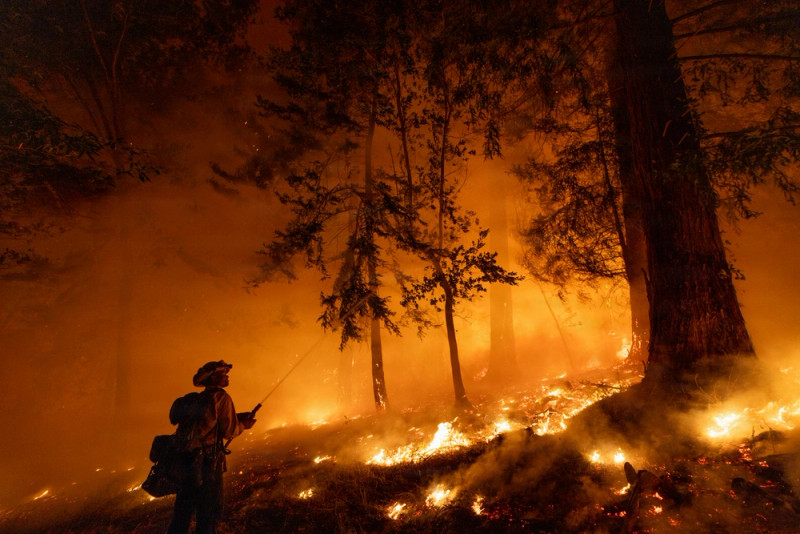
Wildfire in a forest ecosystem
- Wildfire
- Removes vegetation and organic matter
- Releases carbon and raises erosion risk
- Can return nutrients in ash and help fire-adapted species
- Floods
- Drown organisms, erode banks, move sediment, alter aquatic habitat
- Can replenish wetlands and spread nutrient-rich sediment
- Drought
- Lowers water availability, primary productivity, and dissolved oxygen
- Can increase wildfire risk and shift dominant vegetation
- Hurricanes and severe storms
- Cause wind damage, flooding, storm surge, saltwater intrusion, and erosion
- Canopy loss changes light, moisture, and temperature below
- Volcanic eruptions
- Lava, ash, pyroclastic material, and mudflows destroy or bury habitat
- Can create new land; large eruptions can temporarily cool climate
- Earthquakes and tsunamis
- Cause ground displacement, landslides, groundwater changes, and shoreline change
- Tsunamis remove coastal vegetation and push salt and debris inland
A big exam idea is that disturbance is often patchy. You usually get a mosaic of severe damage, moderate damage, and refuges that survive.
How Ecosystems Respond Over Time
Right after a disturbance, organisms may die, get injured, be displaced, or lose shelter, nests, or breeding sites. Abiotic conditions can also shift fast, including salinity, turbidity, sediment, soil exposure, sunlight, stream channels, and hydrology.
Longer-term effects can spread through the ecosystem:
- altered food webs
- changed competition or predation
- habitat fragmentation
- local extinction
- even biome shifts over large areas
Resistance
Resistance is the ability to stay mostly unchanged during a disturbance.
Resilience
Resilience is the ability, or speed, of recovery after change.
An ecosystem can have low resistance but high resilience. A grassland may burn easily but recover quickly. That distinction shows up a lot in questions.
Biodiversity often drops when disturbance is very severe or very frequent. With almost no disturbance, one strong competitor may dominate. The intermediate disturbance hypothesis says diversity may be highest at moderate disturbance, though it is not universal.
Time Scale, Climate Change, Sea Level, and Migration
Earth processes happen over time scales from seconds to millions of years.
- Periodic processes are regular and predictable, like tides, wet and dry seasons, or seasonal flooding.
- Episodic processes are distinct events, like eruptions, severe floods, droughts, and major hurricanes.
- Random processes have no predictable schedule at that scale, like a lightning strike starting a fire.
Natural climate change over geologic time has many causes, including orbital changes, solar variation, volcanic activity, plate tectonics, circulation changes, albedo changes, and natural greenhouse gas changes. APES treats modern human-caused climate change elsewhere.
Sea level changes with land ice:
- more water stored in glacial land ice → lower sea level
- melting land ice → higher sea level
This can expose continental shelves, flood coasts, alter salinity, and create or remove land bridges. Beringia, the Bering Land Bridge between Siberia and Alaska, is the classic example.
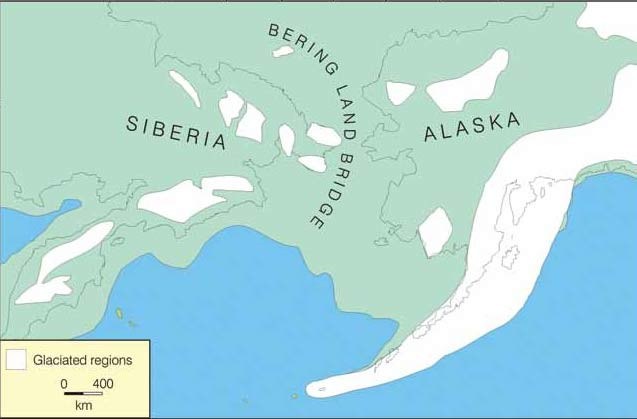
Bering Land Bridge during lower sea level
Wildlife movement fits into this. Animals may move short-term away from fires or floods, migrate seasonally as a periodic response, or shift range long-term if climate or habitat changes persist. Movement can fail if change is too fast or suitable habitat is missing.
Case Study and Data Patterns to Know
Mount St. Helens is the named case you should know. The 1980 eruption caused a lateral blast, ash fall, landslides, and mudflows. Forests were knocked down or buried, and streams and lakes filled with sediment and debris. Effects varied with topography and with survival of roots, seeds, burrowing animals, and intact patches.
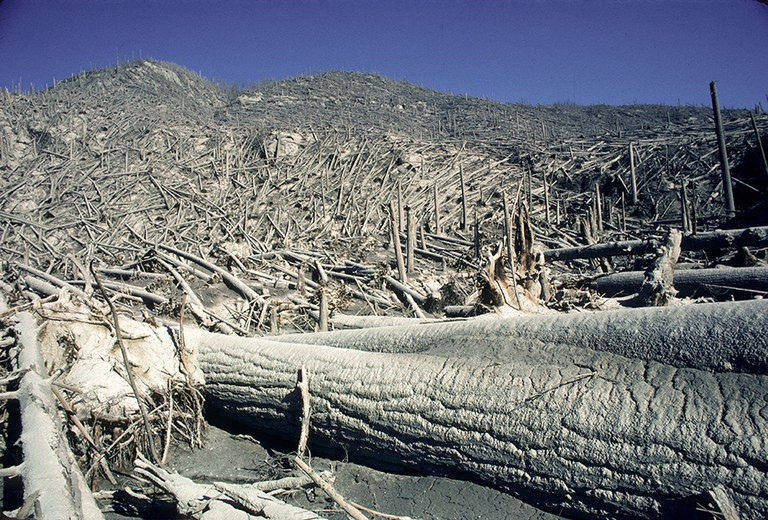
Mount St. Helens blast zone after the 1980 eruption
Disturbance data questions usually want this order:
- Name the variable.
- Describe the pattern over time or distance.
- Note peaks, drops, lags, minima, or partial recovery.
- Explain the pattern using habitat or organism effects.
Common patterns:
- sharp drop, then partial recovery
- delayed biological response after immediate habitat damage
- damage decreases with distance from source
- surviving patches act as recolonization sources
Key Takeaways
Natural Disruption (Natural Disturbance)
An event or process that changes an ecosystem’s physical environment, resources, populations, species composition, or community structure without originating from human activity
Disturbance Regime
The characteristic pattern of disturbance type, frequency, intensity, extent, and season in an ecosystem
Mount St. Helens Eruption
The May 18, 1980 eruption whose blast, ash, landslides, and mudflows caused widespread but uneven habitat destruction while leaving some biological refuges
Natural Climate Change Over Geological Time
Long-term climate variation caused by factors such as orbital changes, solar variation, volcanism, plate movement, circulation, reflectivity, and natural greenhouse-gas changes
Glacial Ice–Sea-Level Relationship
More water stored in land ice lowers global sea level; melting glaciers and land-based ice sheets raises it
Intermediate Disturbance Hypothesis
The hypothesis that species diversity may peak at intermediate disturbance because moderate disruption limits competitive dominance without preventing many species from persisting
Periodic Process
A process that recurs in a generally regular and predictable pattern, though occurrences may vary in intensity
Episodic Process
A process that occurs as distinct events or bursts separated by intervals, often with uncertain exact timing
Random Process
A process without a predictable schedule or location at the scale considered, though it still has physical causes
Short-Term Migration
Temporary or seasonal movement away from unfavorable conditions or toward needed resources, often followed by a return
Long-Term Migration (Range Shift)
A lasting shift in a population’s geographic distribution as suitable habitat conditions move or remain altered
Resistance
An ecosystem’s ability to remain relatively unchanged when a disturbance occurs
Resilience
An ecosystem’s ability or rate of recovery after it has been changed by a disturbance
Notes
Natural Disruption (Natural Disturbance)
An event or process that changes an ecosystem’s physical environment, resources, populations, species composition, or community structure without originating from human activity
Disturbance Regime
The characteristic pattern of disturbance type, frequency, intensity, extent, and season in an ecosystem
Mount St. Helens Eruption
The May 18, 1980 eruption whose blast, ash, landslides, and mudflows caused widespread but uneven habitat destruction while leaving some biological refuges
Natural Climate Change Over Geological Time
Long-term climate variation caused by factors such as orbital changes, solar variation, volcanism, plate movement, circulation, reflectivity, and natural greenhouse-gas changes
Glacial Ice–Sea-Level Relationship
More water stored in land ice lowers global sea level; melting glaciers and land-based ice sheets raises it
Intermediate Disturbance Hypothesis
The hypothesis that species diversity may peak at intermediate disturbance because moderate disruption limits competitive dominance without preventing many species from persisting
Periodic Process
A process that recurs in a generally regular and predictable pattern, though occurrences may vary in intensity
Episodic Process
A process that occurs as distinct events or bursts separated by intervals, often with uncertain exact timing
Random Process
A process without a predictable schedule or location at the scale considered, though it still has physical causes
Short-Term Migration
Temporary or seasonal movement away from unfavorable conditions or toward needed resources, often followed by a return
Long-Term Migration (Range Shift)
A lasting shift in a population’s geographic distribution as suitable habitat conditions move or remain altered
Resistance
An ecosystem’s ability to remain relatively unchanged when a disturbance occurs
Resilience
An ecosystem’s ability or rate of recovery after it has been changed by a disturbance
