Topic 7.8 Notes – Noise Pollution
What Noise Pollution Is
Noise pollution is sound loud enough, long enough, or close enough to cause physiological stress, hearing loss, or ecological disruption. It counts as pollution because humans add this harmful energy to the environment.
A quick grounding point. In this unit, you’ve also seen primary and secondary air pollutants, which are chemical substances in the air. Noise is different. It is a physical environmental disturbance, not a chemical pollutant.
Whether sound becomes harmful noise depends on several things:
- Intensity in decibels (dB)
- Duration and how often exposure happens
- Distance from the source
- Pitch or frequency of the sound
- Whether it is continuous, intermittent, or sudden
- The sensitivity of the organism exposed
The decibel scale is one of the most testable reminders here.
- Decibels are logarithmic, not linear.
- An increase of 10 dB means 10 times greater sound intensity.
- You do not need to do APES math with dB here.
- Useful anchors:
- normal conversation is about 60 dB
- prolonged unprotected exposure around or above 85 dB increases hearing-loss risk
So the pattern to keep in your head is simple: louder sound + longer exposure + closer distance = greater harm.
Major Human Sources of Noise Pollution
Urban areas pack lots of sound sources into one place, which is why noise pollution is such a common city issue.
Transportation
This is often the largest urban source because it creates both steady background noise and sharp loud events.
- Road traffic includes engines, tires, horns, and braking
- Aircraft create noise during takeoffs, landings, and overflights
- Trains add engine, wheel, brake, and warning-signal noise
- Ships and boats produce engine and propeller noise, plus underwater sonar in some cases
Construction
Construction noise is often temporary at one site, but it can be very intense and repetitive.
- jackhammers
- pile drivers
- drills
- bulldozers
- compressors
- heavy trucks
Industrial activity
These sources often matter because exposure can be continuous or recurring.
- factories
- mines
- processing facilities
- warehouses
- generators
- ventilation systems
- pumps and compressors
Domestic activity
Each source may seem small by itself, but together they create persistent background noise in dense neighborhoods.
- lawn equipment
- power tools
- appliances
- heating and cooling systems
- amplified music
- neighborhood activity
Underwater human sources
- commercial shipping
- recreational boats
- military and navigational sonar
- seismic surveys
- offshore construction and pile driving
Effects on Humans and Wildlife
The cause-and-effect chain is straightforward:
- Human activity generates noise
- Sound travels through air or water
- Organisms are exposed
- Stress, hearing damage, or ecological disruption occurs
Common sources include transportation, construction, sirens, and loud recreation, like the urban examples shown here.
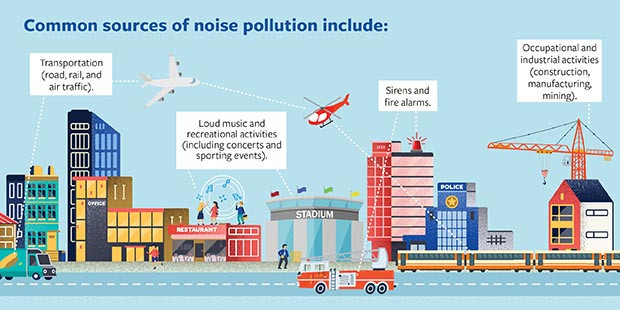
Common sources of noise pollution
Human effects
Noise pollution can cause:
- physiological stress
- sleep disruption
- difficulty concentrating
- reduced well-being
- hearing damage from intense or repeated exposure
- temporary or permanent hearing loss
Animal and ecosystem effects
Animals rely on sound for survival, so noise can do more than annoy them.
- stress changes behavior and uses up energy
- masking blocks important sounds
- communication between individuals
- mating and territorial signals
- hunting and echolocation
- predator warnings
- hearing damage reduces survival ability
- movement and migratory routes may change
Why masking matters
If background noise overlaps with important biological sounds, animals may not hear mates, prey, predators, or group signals. That can lower breeding success, feeding success, and survival.
Habitat-use changes
A place can still have trees, water, and shelter but function like degraded habitat if it is too noisy. Animals may avoid roads, airports, industrial zones, shipping lanes, or sonar areas.
Underwater Noise and Key Ecological Examples
Sound travels very efficiently through water, especially low-frequency sound, so impacts can happen far from the source. Marine mammals are especially vulnerable because they depend heavily on sound.
Marine mammals
- Whales may have long-distance communication masked by shipping noise
- Dolphins and toothed whales can have echolocation and navigation disrupted
A common example is ship noise spreading outward through the water and reaching animals far from the vessel.
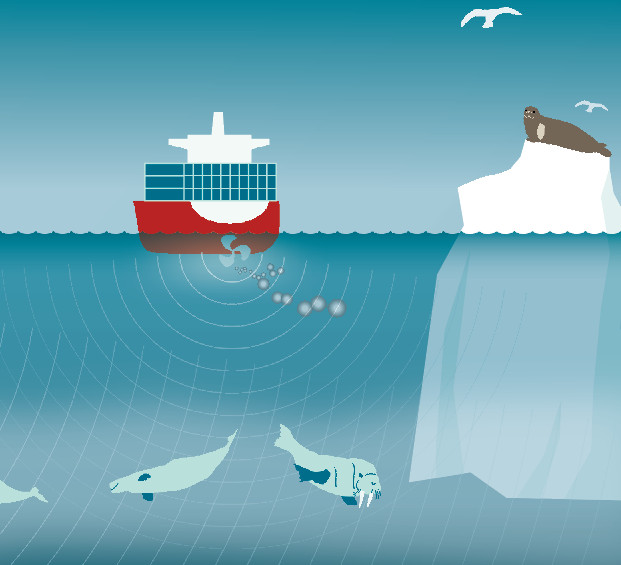
Underwater shipping noise
Illustrative examples
- Birds near roads may change song pitch, timing, or loudness
- Bats may hunt less effectively if noise interferes with echolocation
- Whales may have calls masked by commercial ship noise
- Marine mammals may avoid intense sonar areas, changing movement or migration routes
Possible outcomes include stress, avoidance behavior, reduced communication range, hearing damage, route changes, and in some sonar-linked cases, strandings.
Reducing Noise Pollution
The cleanest way to think about solutions is by where they act.
Source control
- quieter engines and machinery
- muffler maintenance
- quieter aircraft and ships
- reduced vehicle speeds
- limits on sonar or seismic activity
Time and land-use controls
- daytime-only construction
- limits on nighttime flights
- zoning and buffer distances between highways, airports, industry, homes, schools, hospitals, and sensitive habitat
Barriers and insulation
- highway sound barriers
- berms
- acoustic insulation
- double-glazed windows
- vegetation helps most when it is wide and dense, not just a thin row of trees
Personal protection
- earplugs and earmuffs protect individuals
- they do not solve community or ecosystem exposure
Key Takeaways
Noise Pollution
Human-generated sound at levels high enough to cause physiological stress, hearing loss, or ecological disruption
Decibel (dB)
A logarithmic unit of sound level; a 10 dB increase represents a tenfold increase in sound intensity
Masking
Interference in which background noise makes biologically important sounds difficult or impossible to detect, disrupting communication, hunting, or predator detection
Notes
Noise Pollution
Human-generated sound at levels high enough to cause physiological stress, hearing loss, or ecological disruption
Decibel (dB)
A logarithmic unit of sound level; a 10 dB increase represents a tenfold increase in sound intensity
Masking
Interference in which background noise makes biologically important sounds difficult or impossible to detect, disrupting communication, hunting, or predator detection
