Topic 5.6 Notes – Pest Control Methods
What Pest Control Methods Are
A pest is any organism that causes harm in a human setting. It is a context word, not one biological group. An insect, weed, fungus, or rodent can all be pests if they reduce harvest or spread disease.
The main reason pest control exists is simple:
- Less crop damage
- Higher crop yields
- More reliable food production
In this topic, you’re comparing two major methods:
- Chemical pesticides
- Genetically engineered pest- or disease-resistant crops
Both help farmers protect food. Both also create selection pressure, which means they favor some organisms over others and can lead to resistance over generations.
Types of Pest Control in This Topic
Chemical pesticides
A pesticide is any substance used to kill, repel, or control a pest. That word is broad.
A common mistake is treating pesticide and insecticide as the same thing. They are not. Insecticides are only one kind of pesticide.
The exam may name these types:
- Herbicides kill weeds that compete with crops for light, water, nutrients, and space.
- Fungicides control fungi and fungal spores that infect crops.
- Rodenticides control rodents such as rats and mice.
- Insecticides control insects that eat crops or spread disease.
Their big advantage is direct control. Farmers can reduce damage quickly and get more predictable yields. Their big problems show up later with non-target effects and resistance.
The image below shows the resistance problem. After pesticide use, the insects that survive are more likely to be resistant, so later generations contain a larger share of resistant individuals.
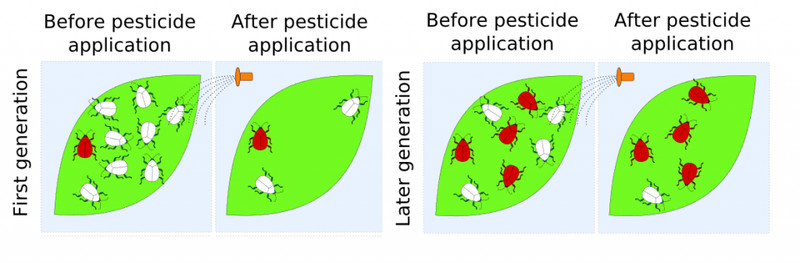
Pesticide resistance over generations
Genetically engineered resistant crops
These crops have protective traits built into their DNA, so the resistance is part of the plant itself instead of something sprayed on it.
Examples the exam may name:
- Bt corn and Bt cotton produce a protein toxic to certain insect larvae.
- Disease-resistant crop varieties resist infection by plant pathogens.
- Herbicide-resistant crops survive herbicide application while nearby weeds die. This is different from pest-resistant crops because the crop is resisting the chemical, not the pest itself.
These can reduce crop loss and sometimes reduce the need for sprayed pesticides. But resistance can still evolve, and heavy use of one variety can lower genetic diversity.
How These Methods Work and Why Resistance Evolves
Both methods work by killing or disadvantaging susceptible pests. That means the individuals without resistance are removed more often.
Resistance is an inherited ability to survive a control method.
Here is the sequence:
- A pest population already has genetic variation.
- A few individuals may already carry resistance alleles.
- The pesticide or engineered crop kills mostly susceptible individuals.
- Resistant individuals survive and reproduce.
- Resistance alleles become more common.
- The control method becomes less effective.
This applies to:
- insecticide-resistant insects
- herbicide-resistant weeds
- fungicide-resistant fungi
- rodenticide-resistant rodents
- pests resistant to Bt traits
The exam loves this correction: individuals do not get used to pesticides. Populations evolve across generations.
That same idea leads to the pesticide treadmill. A pesticide works well at first, then resistance rises, then more pesticide or a new one is used, then resistance builds again. Costs and environmental exposure keep increasing.
Benefits and Drawbacks of Chemical Pesticides
Benefits include:
- reducing crop losses
- increasing usable harvest
- improving crop appearance and market quality
- reducing storage losses
- controlling disease vectors that affect humans or livestock
Drawbacks matter a lot on tests:
- Pesticides can move by drift, runoff, and leaching.
- They can harm non-target organisms such as bees, natural pest predators, birds, fish, amphibians, and soil organisms.
- Rodenticides can cause secondary poisoning when predators or scavengers eat poisoned rodents.
- Broad-spectrum insecticides can kill beneficial insects and sometimes make pest problems worse later.
- Human exposure can affect farmworkers and nearby communities.
The classic example is DDT. It was an effective insecticide, but it caused major unintended ecological harm.
Benefits and Drawbacks of Genetically Engineered Resistant Crops
Benefits:
- reduce insect or disease damage
- increase or stabilize yields
- may reduce external pesticide spraying
- can provide more targeted control
Drawbacks:
- pests can evolve resistance to engineered traits, including Bt
- planting one widely used variety can reduce genetic diversity
- low genetic diversity increases vulnerability to new pests, pathogens, or stress
- monoculture means many plants share the same susceptibility
The comparison to lock in is this:
- Chemical pesticides are external applications. They act fast but have more movement and non-target risk.
- Engineered resistant crops have built-in protection. They may reduce spraying, but they can still select for resistance and can reduce crop genetic diversity.
Key Takeaways
Pest Control
Use of chemical substances or biological traits to reduce organisms that cause harm; it decreases crop losses and increases yields but creates environmental and evolutionary trade-offs
Pest
Any organism considered harmful in a particular human context, such as an insect, weed, fungus, or rodent that damages crops or stored food
Pesticide
A substance used to kill, repel, suppress, or otherwise control a pest; herbicides, fungicides, rodenticides, and insecticides are types
Herbicide
A pesticide that controls unwanted plants or weeds that compete with crops
Selective vs. Nonselective Herbicides
Selective herbicides affect particular plant groups while largely sparing the crop; nonselective herbicides damage most plants they contact
Fungicide
A pesticide that controls fungi or fungal spores by preventing colonization or interfering with fungal growth or reproduction
Rodenticide
A pesticide used to control rodents, especially those damaging field crops or stored food
Insecticide
A pesticide that controls insects that feed on crops or transmit disease
Broad-Spectrum Insecticide
An insecticide that kills many kinds of insects, including potentially beneficial pollinators, predators, and parasitoids
Pesticide Drift
Movement of pesticide spray droplets away from the application site by wind, potentially exposing neighboring habitats and non-target organisms
Non-Target Effects
Unintended harm from pest control to organisms other than the intended pest, such as pollinators, natural predators, wildlife, or soil organisms
Secondary Poisoning
Poisoning of a predator or scavenger after it consumes prey that was exposed to a pesticide, especially a rodenticide
Pesticide Resistance
Inherited ability to survive a pesticide dose that kills susceptible individuals; repeated use increases resistant individuals in the pest population
Artificial Selection
Evolution in which a human action determines which heritable traits are favored, as pesticide use favors resistant pests that survive and reproduce
Pesticide Treadmill
Cycle in which resistance reduces a pesticide’s effectiveness, prompting heavier, more frequent, or different chemical use that selects for further resistance
Genetic Engineering
Use of biotechnology to change an organism’s DNA, including adding crop traits that increase resistance to pests or diseases
Genetically Engineered Pest- or Disease-Resistant Crops
Crops whose DNA has been altered to carry protective traits against pests or pathogens, reducing crop damage and sometimes reducing pesticide applications
Bt Crops
Crops engineered with a Bacillus thuringiensis gene to produce a protein toxic to certain insect larvae, such as Bt corn and Bt cotton
Herbicide-Resistant Crops
Crops engineered to survive a particular herbicide so the chemical can kill weeds without killing the crop
Crop Genetic Diversity
Genetic variation among crop plants; planting a few closely related engineered varieties can reduce it and make the crop broadly vulnerable to a new threat
Resistance to Engineered Crop Defenses
Inherited ability of pests to survive a crop’s protective trait; repeated exposure favors survivors and increases resistance across generations
Notes
Pest Control
Use of chemical substances or biological traits to reduce organisms that cause harm; it decreases crop losses and increases yields but creates environmental and evolutionary trade-offs
Pest
Any organism considered harmful in a particular human context, such as an insect, weed, fungus, or rodent that damages crops or stored food
Pesticide
A substance used to kill, repel, suppress, or otherwise control a pest; herbicides, fungicides, rodenticides, and insecticides are types
Herbicide
A pesticide that controls unwanted plants or weeds that compete with crops
Selective vs. Nonselective Herbicides
Selective herbicides affect particular plant groups while largely sparing the crop; nonselective herbicides damage most plants they contact
Fungicide
A pesticide that controls fungi or fungal spores by preventing colonization or interfering with fungal growth or reproduction
Rodenticide
A pesticide used to control rodents, especially those damaging field crops or stored food
Insecticide
A pesticide that controls insects that feed on crops or transmit disease
Broad-Spectrum Insecticide
An insecticide that kills many kinds of insects, including potentially beneficial pollinators, predators, and parasitoids
Pesticide Drift
Movement of pesticide spray droplets away from the application site by wind, potentially exposing neighboring habitats and non-target organisms
Non-Target Effects
Unintended harm from pest control to organisms other than the intended pest, such as pollinators, natural predators, wildlife, or soil organisms
Secondary Poisoning
Poisoning of a predator or scavenger after it consumes prey that was exposed to a pesticide, especially a rodenticide
Pesticide Resistance
Inherited ability to survive a pesticide dose that kills susceptible individuals; repeated use increases resistant individuals in the pest population
Artificial Selection
Evolution in which a human action determines which heritable traits are favored, as pesticide use favors resistant pests that survive and reproduce
Pesticide Treadmill
Cycle in which resistance reduces a pesticide’s effectiveness, prompting heavier, more frequent, or different chemical use that selects for further resistance
Genetic Engineering
Use of biotechnology to change an organism’s DNA, including adding crop traits that increase resistance to pests or diseases
Genetically Engineered Pest- or Disease-Resistant Crops
Crops whose DNA has been altered to carry protective traits against pests or pathogens, reducing crop damage and sometimes reducing pesticide applications
Bt Crops
Crops engineered with a Bacillus thuringiensis gene to produce a protein toxic to certain insect larvae, such as Bt corn and Bt cotton
Herbicide-Resistant Crops
Crops engineered to survive a particular herbicide so the chemical can kill weeds without killing the crop
Crop Genetic Diversity
Genetic variation among crop plants; planting a few closely related engineered varieties can reduce it and make the crop broadly vulnerable to a new threat
Resistance to Engineered Crop Defenses
Inherited ability of pests to survive a crop’s protective trait; repeated exposure favors survivors and increases resistance across generations
