Topic 1.4 Notes – The Carbon Cycle
What the Carbon Cycle Is
Carbon moves among reservoirs, which are places where carbon is stored. It can be part of organic molecules in living things, like carbohydrates and proteins, or inorganic forms like carbon dioxide .
A core APES idea here is conservation of matter. Carbon atoms are not created or destroyed in the cycle. They are transferred and transformed.
Key vocabulary
- Reservoirs are storage locations for carbon.
- Fluxes are transfers of carbon from one reservoir to another.
- Source means more carbon is released than taken in over a certain time.
- Sink means more carbon is taken in than released over a certain time.
- Residence time is the average time carbon stays in a reservoir.
One common mistake is mixing up sink and reservoir. A reservoir is where carbon is. A sink describes net movement. The ocean is a reservoir all the time, but it is only a sink when it takes in more carbon than it releases.
Major Carbon Reservoirs
Here’s the full set you need to know. This carbon cycle diagram gives you the big-picture map of where carbon is stored before the table breaks the reservoirs down one by one.
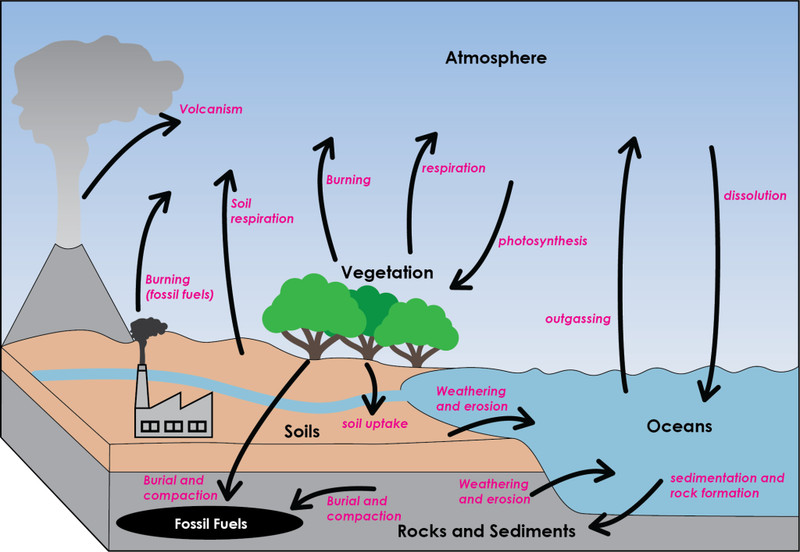
Carbon cycle reservoirs and major fluxes
| Reservoir | What carbon is stored as | Typical timescale |
|---|---|---|
| Atmosphere | mostly , some methane | short |
| Living organisms | biomass in producers, consumers, decomposers | short |
| Soils and dead organic matter | litter, detritus, soil organic matter | short to medium |
| Oceans | dissolved carbon in surface and deep water | short to long |
| Marine organisms and sediments | biomass, shells, skeletons, buried material | long |
| Sedimentary rock | carbonate rock like limestone | very long |
| Fossil fuels | coal, petroleum, natural gas | very long |
The atmosphere, living things, and surface ocean are part of faster movement. Rocks, deep ocean, and fossil fuels hold carbon much longer.
How Carbon Moves Through the Fast and Slow Cycles
The fast cycle moves carbon quickly among the atmosphere, organisms, soils, dead matter, and surface ocean.
Photosynthesis
Plants, algae, and phytoplankton take in and fix that carbon into organic molecules. This moves carbon from air or water into biomass.
Feeding and food webs
When organisms eat producers or other consumers, carbon moves through the food web. Feeding transfers carbon. It does not remove it from the cycle.
Cellular respiration
Plants, animals, and decomposers release carbon back as . Photosynthesis and respiration are complementary. One stores carbon in organic matter, the other returns it to air or water.
Death, waste, and decomposition
Dead matter and waste become detritus and soil carbon. Decomposers break this down and release . In low-oxygen conditions, they can produce methane.
- Faster decomposition happens in warm, moist, oxygen-rich places.
- Slower decomposition happens in cold, dry, or waterlogged places.
Ocean-atmosphere exchange
diffuses into and out of the surface ocean. Once dissolved, it can become bicarbonate and carbonate.
The slow cycle stores and moves carbon over thousands to millions of years.
Burial and fossil fuel formation
If dead organic matter is buried before full decomposition, heat and pressure can eventually form fossil fuels.
- Coal comes mostly from terrestrial plants.
- Petroleum and natural gas come largely from marine organisms.
Sedimentation and carbonate rock formation
Marine shells and skeletons settle, are buried, and can become carbonate rock such as limestone.
Geological release
Weathering, uplift, and volcanic activity slowly return stored carbon to the cycle.
Why Timescale Matters
Fast and slow cycles are connected. They are not separate systems. The same carbon atom can move quickly through a leaf, soil, and atmosphere, or stay locked in rock for millions of years.
This is where diagrams matter on tests. Boxes show stored carbon. Arrows show movement and process. A huge reservoir does not always mean a fast flux.
How Humans Alter the Carbon Cycle
Fossil-fuel combustion burns coal, petroleum, and natural gas and rapidly moves long-stored carbon into atmospheric . That carbon formed slowly but is released quickly.
Deforestation and land clearing do three things at once:
- reduce carbon stored in biomass
- reduce photosynthetic uptake of
- increase release through burning, decomposition, and disturbed soils
The bottom line is simple. Atmospheric carbon rises when carbon release exceeds uptake by natural sinks.
Key Takeaways
Carbon Cycle
Movement of conserved carbon atoms and carbon-containing molecules among organisms, air, water, soils, sediments, rocks, and fossil fuels
Carbon Reservoir
A location where carbon is stored, such as the atmosphere, organisms, soil, oceans, rocks, or fossil fuels
Carbon Flux
A transfer of carbon from one reservoir to another, usually expressed as a rate
Residence Time
The average amount of time carbon remains in a reservoir
Photosynthesis
Solar-powered transfer of inorganic carbon into producer biomass: 6CO₂ + 6H₂O + light → C₆H₁₂O₆ + 6O₂.
Carbon Fixation
Incorporation of inorganic carbon from carbon dioxide into organic molecules during photosynthesis
Cellular Respiration
Breakdown of organic compounds that transfers carbon back to air or water as CO₂: C₆H₁₂O₆ + 6O₂ → 6CO₂ + 6H₂O + energy
Decomposition
Breakdown of dead organisms and waste that releases carbon through decomposer respiration or leaves some carbon stored in soil
Ocean–Atmosphere Exchange
Two-way movement of CO₂ as atmospheric carbon dissolves into surface water and dissolved carbon returns to the atmosphere
Sedimentation
Settling and burial of organic matter or carbonate material into sediments, transferring carbon toward long-term storage
Carbonate Sedimentary Rock
A long-lived carbon reservoir, such as limestone, formed when buried carbonate material is compacted and cemented
Fossil Fuels
Coal, petroleum, and natural gas formed over millions of years from buried, incompletely decomposed organic matter under heat and pressure
Combustion
Oxidation of carbon-containing material that releases CO₂; burning fossil fuels rapidly transfers geological carbon to the atmosphere
Deforestation
Forest removal that decreases biomass storage and photosynthetic uptake while increasing carbon release through burning, decomposition, and soil disturbance
Carbon Source
A reservoir or process that releases more carbon than it takes in during a given period
Carbon Sink
A reservoir or process that takes in more carbon than it releases during a given period
Fast Carbon Cycle
Relatively rapid carbon exchanges among the atmosphere, surface ocean, organisms, dead organic matter, and soil
Slow Carbon Cycle
Long-term carbon movement and storage through burial, deep-ocean processes, sediments, rocks, fossil fuels, and geological activity
Notes
Carbon Cycle
Movement of conserved carbon atoms and carbon-containing molecules among organisms, air, water, soils, sediments, rocks, and fossil fuels
Carbon Reservoir
A location where carbon is stored, such as the atmosphere, organisms, soil, oceans, rocks, or fossil fuels
Carbon Flux
A transfer of carbon from one reservoir to another, usually expressed as a rate
Residence Time
The average amount of time carbon remains in a reservoir
Photosynthesis
Solar-powered transfer of inorganic carbon into producer biomass: 6CO₂ + 6H₂O + light → C₆H₁₂O₆ + 6O₂.
Carbon Fixation
Incorporation of inorganic carbon from carbon dioxide into organic molecules during photosynthesis
Cellular Respiration
Breakdown of organic compounds that transfers carbon back to air or water as CO₂: C₆H₁₂O₆ + 6O₂ → 6CO₂ + 6H₂O + energy
Decomposition
Breakdown of dead organisms and waste that releases carbon through decomposer respiration or leaves some carbon stored in soil
Ocean–Atmosphere Exchange
Two-way movement of CO₂ as atmospheric carbon dissolves into surface water and dissolved carbon returns to the atmosphere
Sedimentation
Settling and burial of organic matter or carbonate material into sediments, transferring carbon toward long-term storage
Carbonate Sedimentary Rock
A long-lived carbon reservoir, such as limestone, formed when buried carbonate material is compacted and cemented
Fossil Fuels
Coal, petroleum, and natural gas formed over millions of years from buried, incompletely decomposed organic matter under heat and pressure
Combustion
Oxidation of carbon-containing material that releases CO₂; burning fossil fuels rapidly transfers geological carbon to the atmosphere
Deforestation
Forest removal that decreases biomass storage and photosynthetic uptake while increasing carbon release through burning, decomposition, and soil disturbance
Carbon Source
A reservoir or process that releases more carbon than it takes in during a given period
Carbon Sink
A reservoir or process that takes in more carbon than it releases during a given period
Fast Carbon Cycle
Relatively rapid carbon exchanges among the atmosphere, surface ocean, organisms, dead organic matter, and soil
Slow Carbon Cycle
Long-term carbon movement and storage through burial, deep-ocean processes, sediments, rocks, fossil fuels, and geological activity
