Topic 4.4 Notes – Earth’s Atmosphere
What Earth’s Atmosphere Is
The atmosphere is the gravitationally bound envelope of gases surrounding Earth. It interacts with the geosphere (land), hydrosphere (water), and biosphere (living things), and it is the medium where weather and atmospheric circulation happen.
A few jobs of the atmosphere show up all over APES:
- It provides gases needed for photosynthesis and respiration.
- It helps control Earth’s temperature.
- It absorbs some harmful solar radiation, especially UV.
Two ways APES organizes the atmosphere here:
- by composition of gases
- by vertical layers based on temperature change with altitude
As altitude increases, the atmosphere gets less dense. Air pressure also decreases because there is less air above you pushing down. There is no sharp outer edge. The atmosphere gradually thins into space.
Atmospheric Composition
When APES gives atmospheric percentages, it usually means dry air, which leaves out water vapor because water vapor changes a lot.
Major gases in dry air
| Gas | Approximate amount | Why it matters |
|---|---|---|
| Nitrogen | 78% | Most abundant gas; organisms need nitrogen, but most cannot use atmospheric directly |
| Oxygen | 21% | Used in respiration, decomposition, and combustion; produced by photosynthesis |
| Argon | 0.93% | Inert noble gas; third most abundant gas |
| Carbon dioxide | 0.04% | Trace gas, but very important as a greenhouse gas |
A common APES trap is forgetting that argon is more abundant than carbon dioxide.
Percent and ppm
You may see carbon dioxide written as a percent or in ppm.
So:
Water vapor and trace materials
Water vapor is variable, from nearly 0% up to about 4%.
- enters through evaporation and transpiration
- leaves through condensation and precipitation
- important for weather, clouds, and the greenhouse effect
Other greenhouse gases you should recognize:
- carbon dioxide
- methane
- nitrous oxide
- water vapor
- ozone
Ozone depends on location:
- stratospheric ozone protects from UV
- tropospheric ozone is an air pollutant
The atmosphere also contains aerosols, which are tiny particles or droplets such as sea salt, dust, smoke, pollen, and soot. They are part of the atmosphere, but not part of the gas-percentage numbers.
The Atmospheric Layers
The five main layers, from the surface upward, are:
- troposphere
- stratosphere
- mesosphere
- thermosphere
- exosphere
These layers are defined by temperature gradients, not by gas composition. The pattern to memorize is down, up, down, up, which is exactly what the temperature line in the diagram shows:
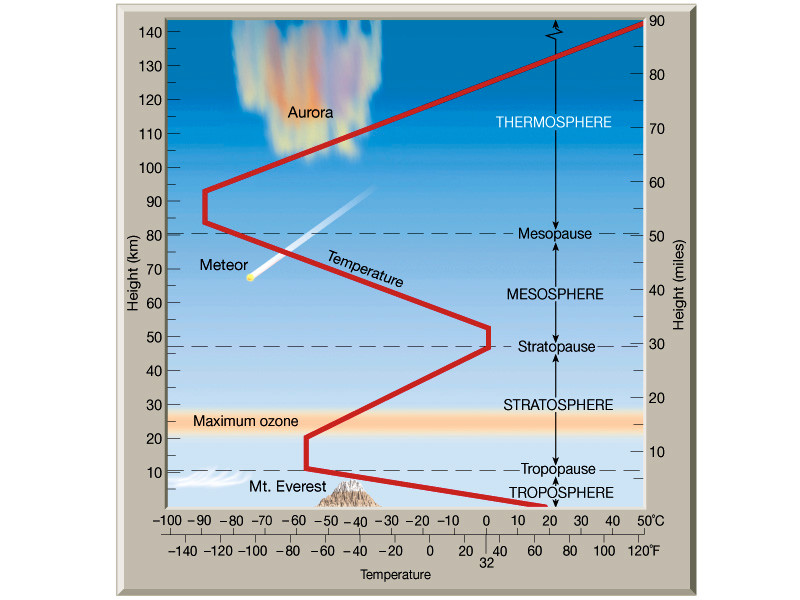
Atmospheric layers and temperature profile
- troposphere: temperature decreases
- stratosphere: temperature increases
- mesosphere: temperature decreases
- thermosphere: temperature increases
- exosphere: very thin outer atmosphere fading into space
Boundaries between layers are transition zones:
- tropopause
- stratopause
- mesopause
- thermopause or exobase
Key Features of Each Layer
Troposphere
Lowest layer, about 10 to 12 km. Most atmospheric mass, almost all water vapor, clouds, and weather. Average lapse rate is about per km.Stratosphere
About 10 to 12 km up to 50 km. Contains the ozone layer, mostly around 15 to 35 km. Ozone absorbs UV, so temperature rises with altitude.Mesosphere
About 50 km to 80 to 85 km. Temperature falls again. Coldest region is near the mesopause. Many meteoroids burn up here.Thermosphere
Begins around 80 to 85 km and extends several hundred km. Sparse particles absorb high-energy solar radiation, so temperature rises sharply. Auroras occur mainly here. Much of the ionosphere overlaps this layer.Exosphere
Outermost layer. Extremely low density. Hydrogen and helium become more important. It gradually merges with space.
How to Read an Atmosphere Diagram
On an exam diagram, identify the layers by the temperature trend first.
- Check the axes. Altitude goes up. Temperature may be shown in reverse.
- If temperature falls near the surface, that is the troposphere.
- If it rises above that, that is the stratosphere.
- If it falls again, that is the mesosphere.
- If it rises again, that is the thermosphere.
Helpful clues:
- weather and clouds = troposphere
- ozone layer = stratosphere
- meteors = mesosphere
- auroras and some satellites = thermosphere
- fading into space = exosphere
Key Takeaways
Earth’s Atmosphere
The gravitationally bound envelope of gases surrounding Earth
Dry Air
Atmospheric air with variable water vapor excluded; its standard composition is about 78% N₂, 21% O₂, 0.93% Ar, and 0.04% CO₂ by volume
Nitrogen (N₂)
The most abundant atmospheric gas, making up about 78% of dry air
Oxygen (O₂)
The second-most abundant atmospheric gas, making up about 21% of dry air
Argon (Ar)
An unreactive noble gas that makes up about 0.93% of dry air, making it the third-most abundant atmospheric gas
Carbon Dioxide (CO₂)
A trace atmospheric gas making up about 0.04% of dry air, or approximately 400 ppm
Water Vapor (H₂O)
A variable atmospheric gas ranging from nearly 0% to about 4%, concentrated mainly near the surface in warm, humid air
Trace Gases
Gases present in very small atmospheric concentrations that can still have major environmental effects
Aerosols
Solid particles or liquid droplets suspended in the atmosphere, such as dust, smoke, sea salt, pollen, and soot
Troposphere
The lowest layer, extending to about 10–12 km, where temperature decreases with altitude and nearly all weather occurs
Environmental Lapse Rate
The average decrease in tropospheric temperature with altitude, approximately 6.5°C per kilometer
Tropopause
The transition between the troposphere and stratosphere, near the altitude where temperature stops decreasing and begins increasing
Stratosphere
The layer from about 10–12 km to 50 km where temperature increases with altitude because ozone absorbs ultraviolet radiation
Ozone Layer
The ozone-rich region of the stratosphere, mainly about 15–35 km high, that absorbs most UV-C and much UV-B radiation
Stratopause
The transition between the stratosphere and mesosphere, near 50 km where temperature stops increasing and begins decreasing
Mesosphere
The layer from about 50 km to 80–85 km where temperature decreases with altitude and many small meteoroids burn up
Mesopause
The transition between the mesosphere and thermosphere and generally the coldest region of the atmospheric temperature profile
Thermosphere
The extremely thin layer above about 80–85 km where temperature increases as particles absorb high-energy ultraviolet radiation and X-rays
Ionosphere
A region overlapping the upper mesosphere and thermosphere that contains ions and free electrons produced by high-energy solar radiation
Thermopause or Exobase
The transition from the thermosphere to the exosphere, placed roughly 500–1,000 km high depending on the classification used
Exosphere
The outermost, extremely low-density layer, where particles are far apart and the atmosphere gradually merges with space
Notes
Earth’s Atmosphere
The gravitationally bound envelope of gases surrounding Earth
Dry Air
Atmospheric air with variable water vapor excluded; its standard composition is about 78% N₂, 21% O₂, 0.93% Ar, and 0.04% CO₂ by volume
Nitrogen (N₂)
The most abundant atmospheric gas, making up about 78% of dry air
Oxygen (O₂)
The second-most abundant atmospheric gas, making up about 21% of dry air
Argon (Ar)
An unreactive noble gas that makes up about 0.93% of dry air, making it the third-most abundant atmospheric gas
Carbon Dioxide (CO₂)
A trace atmospheric gas making up about 0.04% of dry air, or approximately 400 ppm
Water Vapor (H₂O)
A variable atmospheric gas ranging from nearly 0% to about 4%, concentrated mainly near the surface in warm, humid air
Trace Gases
Gases present in very small atmospheric concentrations that can still have major environmental effects
Aerosols
Solid particles or liquid droplets suspended in the atmosphere, such as dust, smoke, sea salt, pollen, and soot
Troposphere
The lowest layer, extending to about 10–12 km, where temperature decreases with altitude and nearly all weather occurs
Environmental Lapse Rate
The average decrease in tropospheric temperature with altitude, approximately 6.5°C per kilometer
Tropopause
The transition between the troposphere and stratosphere, near the altitude where temperature stops decreasing and begins increasing
Stratosphere
The layer from about 10–12 km to 50 km where temperature increases with altitude because ozone absorbs ultraviolet radiation
Ozone Layer
The ozone-rich region of the stratosphere, mainly about 15–35 km high, that absorbs most UV-C and much UV-B radiation
Stratopause
The transition between the stratosphere and mesosphere, near 50 km where temperature stops increasing and begins decreasing
Mesosphere
The layer from about 50 km to 80–85 km where temperature decreases with altitude and many small meteoroids burn up
Mesopause
The transition between the mesosphere and thermosphere and generally the coldest region of the atmospheric temperature profile
Thermosphere
The extremely thin layer above about 80–85 km where temperature increases as particles absorb high-energy ultraviolet radiation and X-rays
Ionosphere
A region overlapping the upper mesosphere and thermosphere that contains ions and free electrons produced by high-energy solar radiation
Thermopause or Exobase
The transition from the thermosphere to the exosphere, placed roughly 500–1,000 km high depending on the classification used
Exosphere
The outermost, extremely low-density layer, where particles are far apart and the atmosphere gradually merges with space
