Topic 9.4 Notes – Increases in the Greenhouse Gases
What Increased Greenhouse Gases Do
Greenhouse gases absorb outgoing infrared radiation and re-emit some of it back toward Earth’s surface. That is the greenhouse effect. You need this natural process because it keeps Earth warm enough for life.
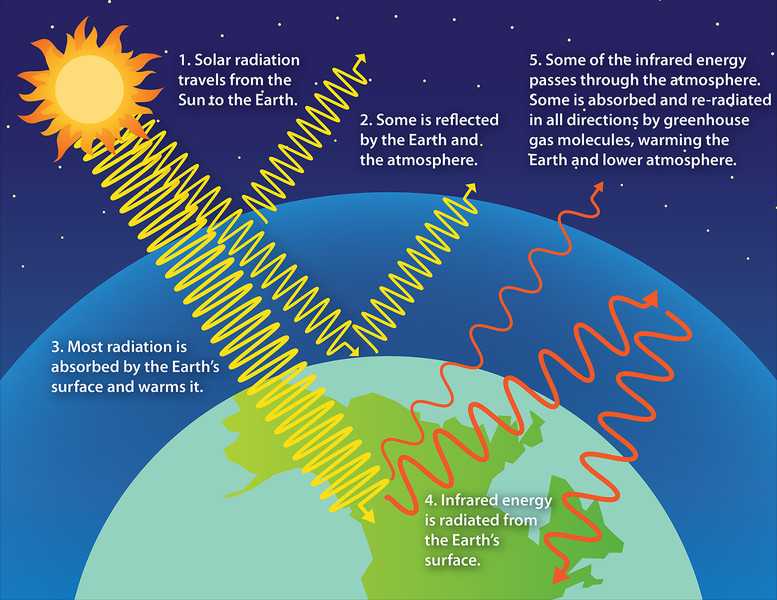
The greenhouse effect
The problem is the human-enhanced greenhouse effect. Human activity adds extra greenhouse gases, so more heat is retained in the atmosphere-ocean system.
Here’s the chain you should know cold:
- Humans increase greenhouse-gas emissions
- Atmospheric concentrations rise when emissions are greater than removal by sinks
- More outgoing infrared heat is trapped
- Earth warms
- Warming drives broader climate change
A few source terms are easy to mix up:
- Emissions means gases released into the air.
- Concentration means how much of that gas is present in the atmosphere.
- Climate means long-term average patterns, not one storm or one cold day.
Major human sources to remember:
- Fossil fuel burning for energy and transportation
- Deforestation and land-use change which reduce carbon uptake and often release stored carbon
- Agriculture especially methane and nitrous oxide sources
- Waste decomposition in landfills
- Industrial processes
- Synthetic chemicals such as some powerful greenhouse gases
Water vapor is a greenhouse gas, but on the AP exam it is usually treated as a feedback, not the main long-term human forcing. Warming increases water vapor, and that extra water vapor amplifies warming.
Major Threats from Increased Greenhouse Gases
The course puts special attention on three outcomes:
- Rising sea level
- Disease vectors spreading from the tropics toward the poles
- Changes in population dynamics and population movement
These connect with other threats too:
- Heat stress and heat-related illness
- Changes in precipitation and evaporation
- Water insecurity and food insecurity
Those linked threats matter because they can make migration, illness, and ecosystem stress even worse.
Rising Sea Level
Sea level rises for two main reasons.
The Two Main Causes
- Melting land ice adds water to the ocean
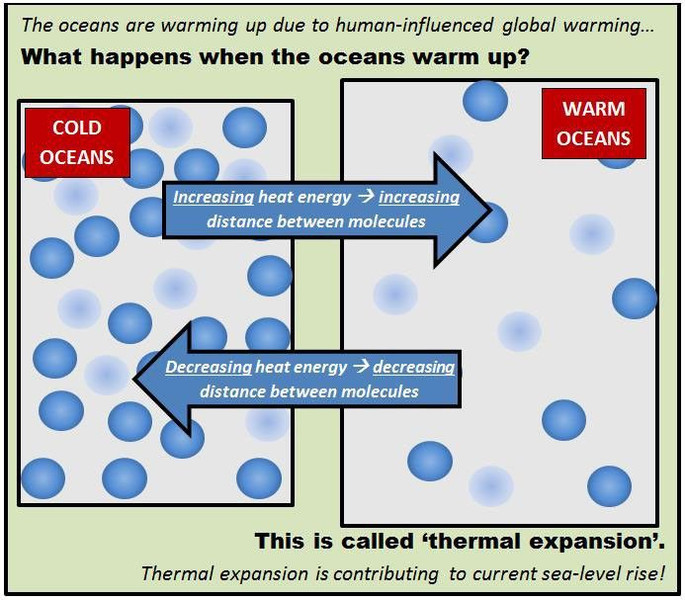
- Thermal expansion makes warmer seawater take up more space
Melting Land Ice
Glaciers and land-based ice sheets melt as temperatures rise. That meltwater flows into the ocean, increasing ocean volume.
One classic test trap is sea ice. Melting floating sea ice does not directly raise sea level the same way, because it is already in the water.
Thermal Expansion
As ocean water warms, it expands. No new water is added here. The same water simply occupies more volume.
Environmental and Human Effects
- Coastal flooding becomes more frequent, especially during high tides and storm surges
- Shoreline erosion removes land
- Low-lying land can be inundated
- Coastal wetlands may be lost or pushed inland
- Saltwater intrusion can contaminate aquifers, rivers, soils, and farmland
- Infrastructure damage can affect roads, buildings, and sewage systems
- Drinking water can become contaminated
- Coastal populations may be displaced
Disease Vectors and Range Expansion
A disease vector is an organism that transmits a pathogen between hosts. Important examples are mosquitoes and ticks. Diseases to know are malaria, dengue fever, West Nile virus disease, and Lyme disease.
Many vectors are ectotherms, so temperature strongly affects them.
- Greenhouse gases increase warming
- Places that were once too cold become suitable
- Vectors spread poleward, move to higher elevations, or stay active longer each year
- Humans and other animals face new exposure
- Disease incidence or range may increase
The map below gives one example by showing the modeled northward expansion of the yellow fever mosquito in the United States over time.
Climate is only part of the story. Precipitation, standing water, humidity, habitat, host availability, sanitation, travel, pesticide use, and public health also matter. So warming increases the potential for spread. It does not guarantee every disease increases everywhere.
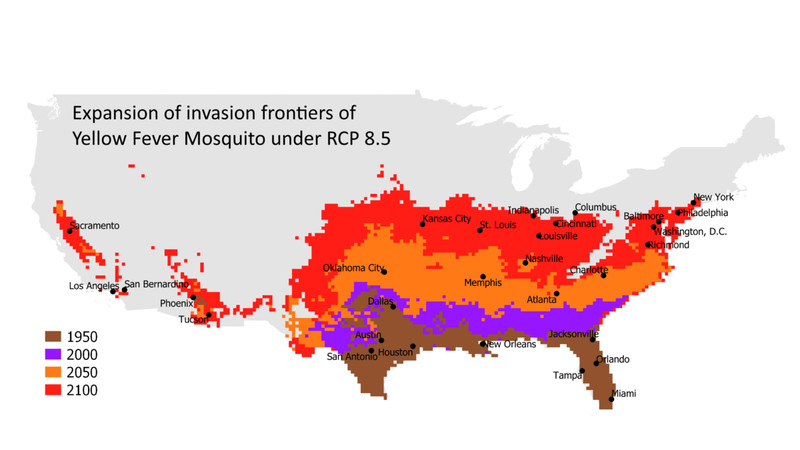
Modeled mosquito range expansion in the United States
How Population Dynamics Change
Population dynamics means changes in population size, density, distribution, age structure, birth rate, death rate, immigration, and emigration.
Sea-level rise can cause mortality, habitat loss, freshwater contamination, and forced emigration. Disease-vector expansion can raise illness and mortality and change host-pathogen interactions.
Populations may respond by:
- moving toward the poles
- moving to higher elevations
- shifting seasonal timing or migration
- declining where habitat becomes unsuitable
- increasing in newly suitable areas
Movement is often limited.
- Humans may face financial, political, or social barriers
- Species may be blocked by fragmentation, development, mountains, or coastlines
Receiving areas may then face higher population density and more pressure on housing, water, food, sanitation, and infrastructure.
On visual questions, give the full chain. Identify the trend, explain the mechanism, then state the human or environmental consequence.
Key Takeaways
Enhanced Greenhouse Effect (Human-Enhanced Greenhouse Effect)
Strengthening of the natural greenhouse effect as added greenhouse gases absorb and reemit more outgoing infrared radiation, raising global temperature
Global Warming
The long-term increase in Earth’s average temperature
Global Climate Change
Global warming and its associated long-term changes in precipitation, circulation, seasons, sea level, and extremes
Sea-Level Rise
An increase in ocean level caused principally by added water from melting land ice and the thermal expansion of warming seawater
Melting Land Ice
Melting glaciers and land-based ice sheets add water to the ocean and raise sea level, unlike melting floating sea ice
Thermal Expansion of Seawater
Warming lowers seawater’s density so the same mass occupies more volume, raising sea level without adding water
Disease Vector
An organism, such as a mosquito or tick, that carries and transmits a pathogen between hosts
Disease-Vector Range Expansion
Warming allows some vectors to survive at higher latitudes or elevations and remain active longer, potentially expanding disease exposure
Population Dynamics
Changes in population size, density, age structure, distribution, births, deaths, immigration, and emigration
Notes
Enhanced Greenhouse Effect (Human-Enhanced Greenhouse Effect)
Strengthening of the natural greenhouse effect as added greenhouse gases absorb and reemit more outgoing infrared radiation, raising global temperature
Global Warming
The long-term increase in Earth’s average temperature
Global Climate Change
Global warming and its associated long-term changes in precipitation, circulation, seasons, sea level, and extremes
Sea-Level Rise
An increase in ocean level caused principally by added water from melting land ice and the thermal expansion of warming seawater
Melting Land Ice
Melting glaciers and land-based ice sheets add water to the ocean and raise sea level, unlike melting floating sea ice
Thermal Expansion of Seawater
Warming lowers seawater’s density so the same mass occupies more volume, raising sea level without adding water
Disease Vector
An organism, such as a mosquito or tick, that carries and transmits a pathogen between hosts
Disease-Vector Range Expansion
Warming allows some vectors to survive at higher latitudes or elevations and remain active longer, potentially expanding disease exposure
Population Dynamics
Changes in population size, density, age structure, distribution, births, deaths, immigration, and emigration
