Topic 6.6 Notes – Nuclear Power
What Nuclear Power Is
Nuclear power plants make electricity from nuclear fission, not from burning fuel. That matters because there is no combustion in the reactor, so the plant does not directly release the usual air pollutants from fossil fuels during operation.
The fuel you need to know is U-235. In fission, a neutron hits a U-235 nucleus, and the nucleus splits into smaller nuclei. That split releases:
- heat that can be used to boil water
- radiation from unstable particles and nuclei
- more neutrons that can hit other U-235 atoms
Those extra neutrons create a chain reaction. In a reactor, that chain reaction is controlled so energy comes out steadily. In an uncontrolled release, energy is released dangerously fast.
A quick reminder on vocabulary:
- Radioactivity means an unstable nucleus gives off radiation and loses energy on its own.
- Fission splits large nuclei and is used in power plants.
- Fusion joins small nuclei and powers the Sun. It is not what current commercial nuclear plants use.
Even though uranium is very energy-dense, nuclear power is still nonrenewable because uranium is finite.
How a Nuclear Power Plant Generates Electricity
Here’s the basic flow from fuel to electricity. The diagram traces the reactor, steam system, turbine, generator, condenser, and cooling tower in one continuous process.
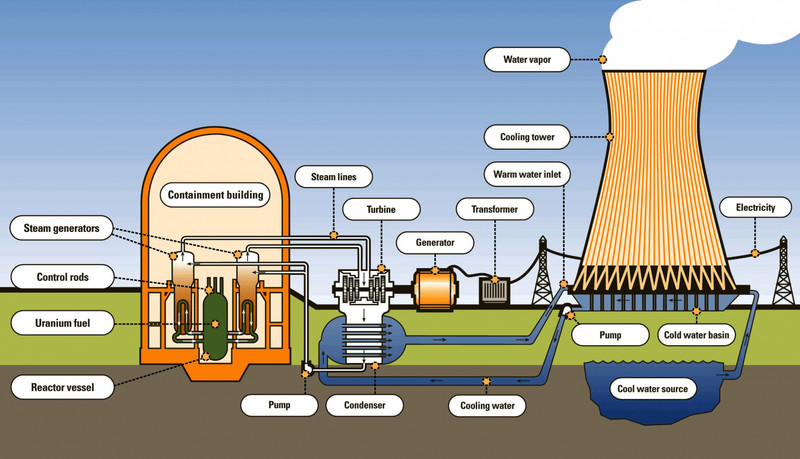
Nuclear power plant diagram
- Uranium is mined, processed, enriched, and sealed into fuel rods.
- In the reactor core, U-235 atoms undergo fission and release nuclear energy.
- That energy becomes thermal energy in the reactor and coolant.
- Water is heated into steam.
- Steam spins a turbine.
- The turbine turns a generator, which makes electricity.
- A condenser and cooling system cool the water so it can be reused.
Main parts to know:
- Fuel rods contain U-235 fuel.
- Control rods absorb neutrons and slow or regulate the chain reaction.
- Moderator is usually water and slows neutrons so fission is more likely.
- Coolant carries heat away from the core.
- Containment building helps limit radiation release.
One common test trap: cooling towers release water vapor, not smoke. The diagram labels this clearly at the top of the tower. Also, nuclear plants do not directly produce combustion air pollutants like coal plants do.
Radioactivity, Half-Life, and Nuclear Waste
Radioactive isotopes have unstable nuclei that emit ionizing radiation, which can damage cells and DNA. That is why nuclear waste has to be isolated from organisms and the environment.
Half-life is the time required for half of a radioactive sample to decay. Decay is exponential, not linear.
You may also see activity instead of amount:
Where:
- or = initial amount or activity
- = elapsed time
- = half-life
The graph here is the pattern to remember. Each half-life cuts the parent isotope remaining in half, so the curve drops quickly at first and then more slowly.
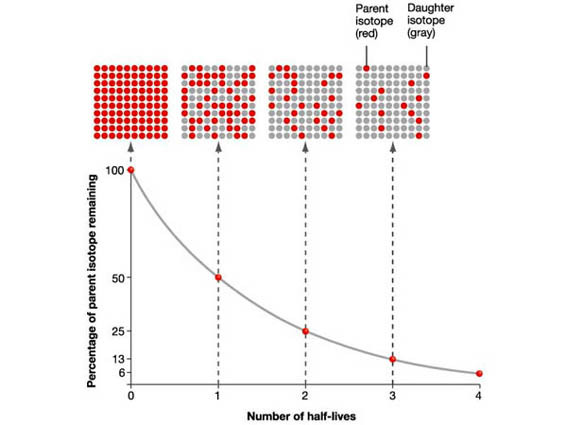
Radioactive decay over successive half-lives
A very common mistake is mixing up amount remaining and amount decayed. After 3 half-lives, remains, so 7/8 has decayed.
Why this matters here:
- U-235 has a very long half-life
- spent fuel stays hazardous for a long time
- no treatment makes radioactive waste immediately harmless
Storage methods:
- Spent-fuel pools cool and shield fuel right after removal
- Dry casks are safer interim storage
- Deep geologic disposal is the proposed permanent solution
Environmental Benefits and Costs
Nuclear power has a clear trade-off.
Benefits
- low direct air pollution during operation
- low operational greenhouse-gas emissions
- no direct emissions of sulfur dioxide, nitrogen oxides, particulate matter, or mercury
- reliable, high-output electricity
- very high energy density
Costs
- uranium mining and processing disturb land and can pollute water
- radioactive solid waste is hazardous
- plants need a lot of cooling water
- thermal pollution can harm aquatic ecosystems because warmer water holds less dissolved oxygen and can cause thermal shock
- accidents are low-probability but high-impact
So nuclear is cleaner than fossil fuels for routine air pollution, but it is not renewable, waste-free, or risk-free.
Major Nuclear Accidents and Their Environmental Effects
Three Mile Island
Equipment malfunction plus human error led to a partial core meltdown. Containment mostly worked, so radiation release was limited. There was major public fear and stricter regulation, but little clear population-wide health effect.
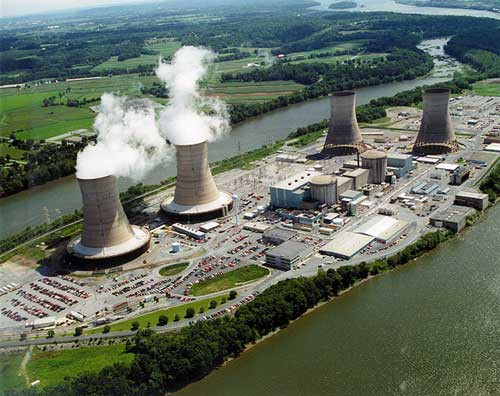
Three Mile Island nuclear power plant
Chernobyl
An unsafe test plus reactor design flaws caused explosions and fire. The reactor had no robust containment structure, so there was a massive atmospheric radiation release. Effects included worker and responder deaths, increased thyroid cancer, contaminated soil, water, and crops, and a long-term exclusion zone.
Fukushima Daiichi
An earthquake and tsunami knocked out backup power and cooling. That led to multiple meltdowns and hydrogen explosions. Radiation was released to air and water, including the ocean. Effects included evacuations, food and water restrictions, and long-term cleanup and decommissioning.
Shared effects show up a lot on tests:
- Short-term includes evacuation, contaminated food and water, and acute exposure at high doses.
- Long-term includes cancer risk, contaminated land and water, monitoring, decontamination, land-use limits, and displacement.
Key Takeaways
Nuclear Power
Electricity generation in which controlled U-235 fission releases heat, heat produces steam, and steam turns a turbine connected to a generator; it is nonrenewable because uranium is finite
Nuclear Fission
Splitting a large atomic nucleus such as U-235 into smaller nuclei, releasing heat, ionizing radiation, and additional neutrons
Uranium-235 (U-235)
The fissile uranium isotope used as reactor fuel; it has a half-life of about 704 million years
Uranium Enrichment
Processing natural uranium to increase its concentration of U-235 for use as reactor fuel
Fuel Rod
A long metal tube containing uranium fuel pellets; multiple rods are grouped in the reactor core
Nuclear Chain Reaction
A self-sustaining sequence in which neutrons released by fission cause additional nuclei to undergo fission
Control Rod
A neutron-absorbing rod inserted to slow a reactor’s chain reaction or withdrawn to increase its rate
Moderator
A material, commonly water, that slows neutrons so they are more likely to cause additional fission
Coolant
A fluid that carries thermal energy away from a reactor core
Containment Structure
A protective structure surrounding a reactor to limit the escape of radioactive material during an accident
Cooling Tower
A structure that transfers waste heat from cooling water to the atmosphere, releasing water vapor rather than combustion smoke
Radioactive Isotope (Radioisotope)
An isotope with an unstable nucleus that spontaneously emits radiation as it loses energy
Radioactivity / Radioactive Decay
The spontaneous loss of energy from an unstable nucleus through the emission of particles or electromagnetic radiation
Half-Life
The time required for half of the radioactive nuclei currently present in a sample to decay
Half-Life Calculation
Find n = t/T₁/₂, then calculate the amount remaining with N = N₀(1/2)ⁿ or A = A₀(1/2)ⁿ.
Decay Constant
A radioactive isotope’s fractional decay rate, related to half-life by λ = ln 2/T₁/₂.
Decay Heat
Heat produced by the continuing radioactive decay of fission products after a reactor’s chain reaction is reduced or stopped
Thermal Pollution
Human-caused warming of natural water, which lowers dissolved oxygen and can stress or kill aquatic organisms
Radioactive Waste
Hazardous solid material containing unstable isotopes that must be isolated from organisms and the environment while it remains radioactive
Spent Nuclear Fuel
Used reactor fuel that remains intensely radioactive and continues producing heat after removal from the reactor
Spent-Fuel Pool
A reinforced underwater storage pool in which water cools freshly removed spent fuel and shields its radiation
Dry-Cask Storage
Interim storage of cooled spent nuclear fuel in sealed steel-and-concrete containers that provide shielding and protection
Deep Geologic Disposal
Proposed long-term disposal in which sealed radioactive waste is placed deep underground in stable rock with little groundwater movement
Nuclear Reprocessing
Recovering usable materials from spent fuel; it may reduce some waste volume but creates additional waste and security concerns
Reactor-Core Meltdown
Overheating and melting of reactor fuel after adequate cooling is lost; it can damage containment and release radioactive material
Decommissioning
Dismantling or sealing a retired nuclear facility and safely managing its contaminated materials
Three Mile Island Accident
A 1979 Pennsylvania accident in which equipment and human failures caused a partial meltdown, but containment limited the radioactive release
Chernobyl Disaster
A 1986 reactor explosion and fire caused by design flaws and unsafe testing, producing a massive uncontained radioactive release and lasting contamination
Fukushima Daiichi Disaster
A 2011 earthquake-and-tsunami disaster that disabled power and cooling, causing multiple meltdowns, hydrogen explosions, and land and ocean contamination
Notes
Nuclear Power
Electricity generation in which controlled U-235 fission releases heat, heat produces steam, and steam turns a turbine connected to a generator; it is nonrenewable because uranium is finite
Nuclear Fission
Splitting a large atomic nucleus such as U-235 into smaller nuclei, releasing heat, ionizing radiation, and additional neutrons
Uranium-235 (U-235)
The fissile uranium isotope used as reactor fuel; it has a half-life of about 704 million years
Uranium Enrichment
Processing natural uranium to increase its concentration of U-235 for use as reactor fuel
Fuel Rod
A long metal tube containing uranium fuel pellets; multiple rods are grouped in the reactor core
Nuclear Chain Reaction
A self-sustaining sequence in which neutrons released by fission cause additional nuclei to undergo fission
Control Rod
A neutron-absorbing rod inserted to slow a reactor’s chain reaction or withdrawn to increase its rate
Moderator
A material, commonly water, that slows neutrons so they are more likely to cause additional fission
Coolant
A fluid that carries thermal energy away from a reactor core
Containment Structure
A protective structure surrounding a reactor to limit the escape of radioactive material during an accident
Cooling Tower
A structure that transfers waste heat from cooling water to the atmosphere, releasing water vapor rather than combustion smoke
Radioactive Isotope (Radioisotope)
An isotope with an unstable nucleus that spontaneously emits radiation as it loses energy
Radioactivity / Radioactive Decay
The spontaneous loss of energy from an unstable nucleus through the emission of particles or electromagnetic radiation
Half-Life
The time required for half of the radioactive nuclei currently present in a sample to decay
Half-Life Calculation
Find n = t/T₁/₂, then calculate the amount remaining with N = N₀(1/2)ⁿ or A = A₀(1/2)ⁿ.
Decay Constant
A radioactive isotope’s fractional decay rate, related to half-life by λ = ln 2/T₁/₂.
Decay Heat
Heat produced by the continuing radioactive decay of fission products after a reactor’s chain reaction is reduced or stopped
Thermal Pollution
Human-caused warming of natural water, which lowers dissolved oxygen and can stress or kill aquatic organisms
Radioactive Waste
Hazardous solid material containing unstable isotopes that must be isolated from organisms and the environment while it remains radioactive
Spent Nuclear Fuel
Used reactor fuel that remains intensely radioactive and continues producing heat after removal from the reactor
Spent-Fuel Pool
A reinforced underwater storage pool in which water cools freshly removed spent fuel and shields its radiation
Dry-Cask Storage
Interim storage of cooled spent nuclear fuel in sealed steel-and-concrete containers that provide shielding and protection
Deep Geologic Disposal
Proposed long-term disposal in which sealed radioactive waste is placed deep underground in stable rock with little groundwater movement
Nuclear Reprocessing
Recovering usable materials from spent fuel; it may reduce some waste volume but creates additional waste and security concerns
Reactor-Core Meltdown
Overheating and melting of reactor fuel after adequate cooling is lost; it can damage containment and release radioactive material
Decommissioning
Dismantling or sealing a retired nuclear facility and safely managing its contaminated materials
Three Mile Island Accident
A 1979 Pennsylvania accident in which equipment and human failures caused a partial meltdown, but containment limited the radioactive release
Chernobyl Disaster
A 1986 reactor explosion and fire caused by design flaws and unsafe testing, producing a massive uncontained radioactive release and lasting contamination
Fukushima Daiichi Disaster
A 2011 earthquake-and-tsunami disaster that disabled power and cooling, causing multiple meltdowns, hydrogen explosions, and land and ocean contamination
