Topic 8.7 Notes – Persistent Organic Pollutants (POPs)
What Persistent Organic Pollutants Are
POPs are synthetic, carbon-based chemicals that remain in the environment for a long time. Here, organic means carbon-based. It does not mean natural, safe, or “organic food” organic.
The two APES examples you need are:
- DDT = a synthetic insecticide
- PCBs = industrial chemicals used in equipment
What makes a chemical a POP is the combination of three properties:
- Persistence = it resists breakdown
- Fat solubility = it dissolves in fats and stays in organisms
- Long-range transport = it can move far by wind and water
That combination is the whole story of POPs. Their damage is often long-lasting, mobile, and tied to food webs, not just a quick local poisoning event.
A useful distinction people mix up a lot:
- Not every carbon-based pollutant is a POP.
- Not every persistent pollutant is organic.
Example: mercury can persist, but it is not organic because it is an element.
The Three Defining Properties of POPs
Persistence
A POP does not break down easily through:
- sunlight
- chemical reactions
- microbial action
Many have strong carbon-chlorine bonds, which slows degradation. Because of that, they can stay in:
- soil
- sediment
- water
- organisms
for years to decades.
That is why banning a POP does not instantly solve the problem. Old contamination can still be released by:
- erosion
- runoff
- disturbance of sediment
- changing environmental conditions
Fat Solubility and Retention
Lipophilic means “fat-loving.” POPs are lipophilic, so they dissolve in fat more easily than in water.
That means they:
- build up in adipose tissue and other lipid-rich tissues
- are poorly excreted compared with water-soluble pollutants
- can re-enter the bloodstream when stored fat is used during migration, starvation, or reproduction
- can pass to offspring through eggs or milk
This is what sets up bioaccumulation in individuals and biomagnification through food webs. Those are covered more directly in the next topic, but the reason they happen starts here.
Long-Range Transport
POPs can move through both air and water.
- In air, they move by evaporation or by sticking to airborne particles.
- In water, they move through runoff, rivers, currents, and contaminated sediment.
- They are redeposited by precipitation, settling, or condensation.
Some cycle over and over through evaporation, transport, and redeposition, which is why they can show up in remote places like the Arctic.
The diagram below pulls those pathways together by showing pollutants dispersing through air, depositing onto land and water, and then entering both terrestrial and aquatic food webs.
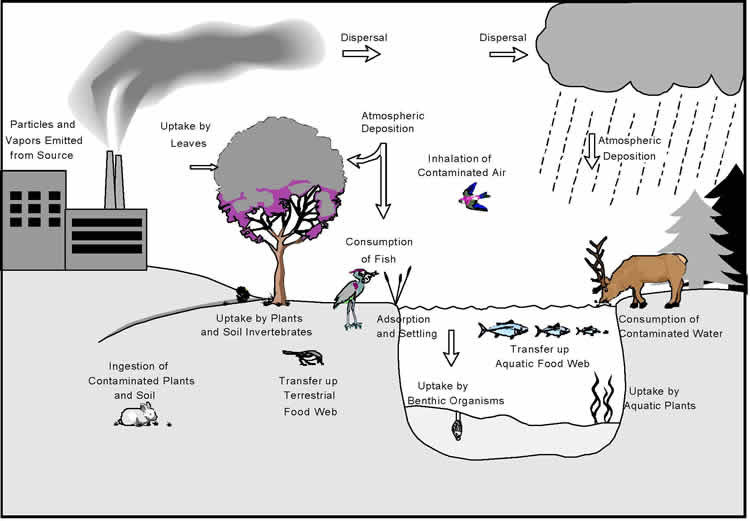
Pollutant transport and food web exposure pathways
How POPs Cause Ecosystem Harm
This usually gets tested as a cause-and-effect chain:
- A POP is released from agriculture or industry.
- Persistence keeps it in soil, water, sediment, or organisms.
- Transport spreads it near and far from the source.
- Organisms are exposed through food, water, air, soil, or sediment.
- Fat solubility causes storage in tissues, so body burden rises over time.
- The pollutant moves through feeding relationships.
- Effects appear in organisms, including problems with growth, development, reproduction, behavior, immune function, and survival.
At the ecosystem level, this leads to:
- chronic exposure instead of a one-time event
- repeated exposure from contaminated soil and sediment
- stronger effects at higher trophic levels
- population declines from lower reproductive success
- altered food webs
A classic AP idea is that damage can happen long after use stops and far from where release happened.
DDT and PCBs
DDT
DDT is a synthetic chlorinated insecticide used in agriculture and disease-vector control. It is persistent and fat-soluble, and its breakdown product DDE also persists.
Its classic effect is eggshell thinning in predatory birds, especially:
- eagles
- falcons
- pelicans
Adults were not always killed directly. Instead, reduced reproductive success caused population declines. The United States banned most uses in 1972, but residues stayed in soils, sediments, and organisms. Museum egg collections like the one shown here helped document these shell-thinning patterns over time. Some restricted malaria-control use shows the tradeoff between ecosystem protection and disease control.
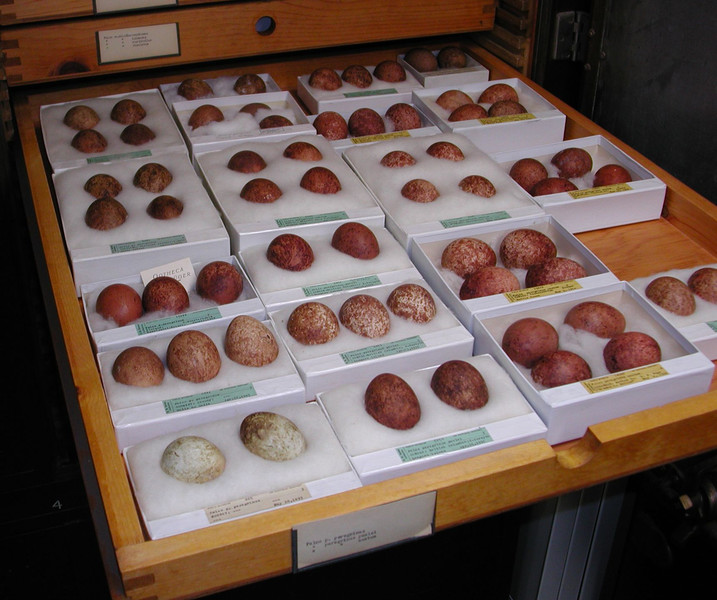
Falcon egg collections used to study DDT-related eggshell thinning
PCBs
PCBs are polychlorinated biphenyls, synthetic industrial chemicals used in:
- transformers
- capacitors
- hydraulic fluids
- other industrial equipment
They were useful because they were stable and heat-resistant, which is also why they became persistent pollutants. They enter the environment through leaks, spills, improper disposal, and contaminated industrial sites.
PCBs often enter waterways, bind to sediment, and stay there. That exposes:
- bottom-dwelling organisms
- fish
- wildlife
- humans who eat contaminated fish
Associated harms include reproductive, developmental, immune, and neurological effects.
What to Recognize in POP Questions
When you see a prompt, match the evidence to the property:
- Detected long after release = persistence
- High concentrations in fatty tissues = fat solubility and retention
- Found far downwind or downstream = long-range transport
If a question mentions DDT or PCBs, connect them to persistence, fat storage, food webs, and long-lasting ecosystem damage.
Key Takeaways
Persistent Organic Pollutants (POPs)
Synthetic carbon-based pollutants that resist breakdown, are generally fat-soluble, can be toxic, and can travel long distances through air or water before redeposition
Lipophilic (Fat-Soluble)
Dissolves readily in fats and oils, causing a pollutant to be retained in fatty tissues and eliminated poorly
DDT (Dichlorodiphenyltrichloroethane)
A persistent, fat-soluble chlorinated insecticide whose DDE breakdown product caused eggshell thinning and reduced reproduction in predatory birds
Polychlorinated Biphenyls (PCBs)
Persistent, fat-soluble industrial chemicals formerly used in electrical and other equipment that can cause reproductive, developmental, immune, and neurological harm
Notes
Persistent Organic Pollutants (POPs)
Synthetic carbon-based pollutants that resist breakdown, are generally fat-soluble, can be toxic, and can travel long distances through air or water before redeposition
Lipophilic (Fat-Soluble)
Dissolves readily in fats and oils, causing a pollutant to be retained in fatty tissues and eliminated poorly
DDT (Dichlorodiphenyltrichloroethane)
A persistent, fat-soluble chlorinated insecticide whose DDE breakdown product caused eggshell thinning and reduced reproduction in predatory birds
Polychlorinated Biphenyls (PCBs)
Persistent, fat-soluble industrial chemicals formerly used in electrical and other equipment that can cause reproductive, developmental, immune, and neurological harm
