Topic 1.7 Notes – The Hydrologic (Water) Cycle
What the Hydrologic Cycle Is
The hydrologic cycle is water moving through Earth in solid, liquid, and gas form. The water itself is still . It usually does not change chemical identity the way carbon or nitrogen does.
A few core ideas hold the whole topic together:
- The sun powers the cycle by driving evaporation and sublimation.
- Gravity brings water back to Earth as precipitation and moves it downhill as runoff and groundwater flow.
- Water is transferred and stored, not created or destroyed. That is conservation of matter.
- AP questions usually want reservoir interactions. Don’t just say “evaporation, condensation, precipitation.” Say from where to where.
This diagram is a good way to picture those reservoir-to-reservoir transfers before you learn the major storage locations in more detail.
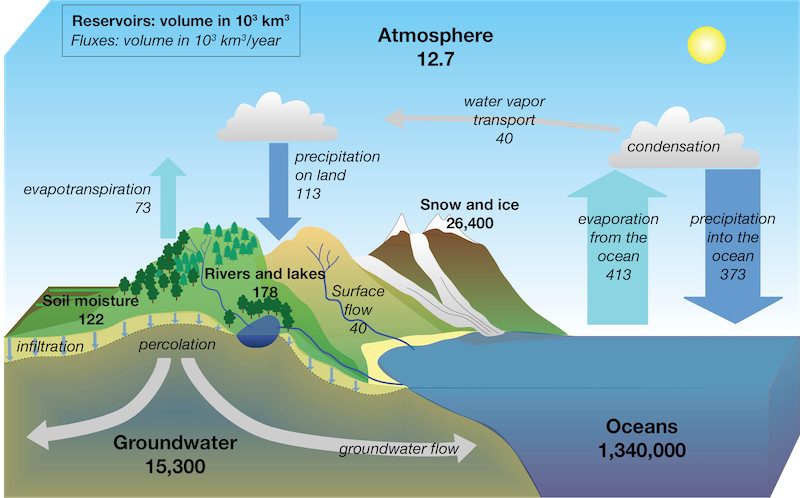
Hydrologic cycle reservoirs and flows
Major Reservoirs and Reservoir Roles
A reservoir is a place where water is stored. Major reservoirs are:
- Oceans which hold most of Earth’s water
- Atmosphere which stores water vapor and clouds
- Glaciers and ice caps which store most freshwater
- Groundwater in saturated soil and rock underground
- Lakes, rivers, wetlands
- Soil moisture
- Living organisms
A few numbers matter:
- About 97% of Earth’s water is saline
- About 3% is freshwater
- Most freshwater is in glaciers/ice caps or groundwater
Source and sink
A source releases water to another part of the system. A sink receives and stores it for a time. The same reservoir can be either one.
- Ocean as source → evaporation
- Ocean as sink → precipitation or river discharge into it
Flux and residence time
- Flux means the rate of water movement between reservoirs
- Residence time means the average time water stays in one reservoir
The atmosphere has a short residence time. Oceans, glaciers, and deep groundwater can hold water much longer.
Main Steps and Transfers in the Water Cycle
Water can enter the atmosphere by:
- Evaporation
Liquid water becomes water vapor from oceans, lakes, rivers, wetlands, and moist soil. - Transpiration
Plants release water vapor through stomata. - Evapotranspiration
The combined total of evaporation and transpiration. - Sublimation
Solid water changes directly to vapor from snow or ice.
In the atmosphere, water vapor condenses into droplets or ice crystals, forming clouds. Winds then move that water, often from ocean to land.
Water returns as precipitation:
- rain
- snow
- sleet
- hail
Once on land, water can take several paths:
- Interception by leaves and surfaces
- Infiltration into soil
- Percolation downward through soil and rock
- Groundwater recharge into saturated underground storage
- Plant uptake by roots
- Surface runoff into streams, rivers, lakes, wetlands, and oceans
Groundwater and surface water connect in both directions. Groundwater can discharge into streams, and surface water can seep into the ground.
What Controls the Path Water Takes
The path depends on land conditions.
More infiltration happens with:
- permeable soil
- vegetation
- dry ground
More runoff happens with:
- steep slopes
- saturated soil
- frozen ground
- compacted soil
- intense precipitation
- impermeable surfaces like pavement
Vegetation matters a lot. It increases interception, infiltration, uptake, and transpiration. If infiltration drops, runoff usually rises. Snowpack, glaciers, and ice delay water movement by storing it.
How Humans Alter the Water Cycle
Human activity changes where water goes and how fast.
- Deforestation lowers interception, root uptake, and transpiration. It often lowers infiltration and raises runoff, erosion, and flood risk.
- Urbanization adds pavement and roads, so infiltration and groundwater recharge fall. Runoff becomes faster, flood risk rises, and later stream baseflow can drop.
- Irrigation and groundwater pumping move water from rivers, reservoirs, or aquifers onto fields. If pumping exceeds recharge, groundwater storage declines.
- Dams and reservoirs change the timing and location of flow and can increase evaporation from stored surface water.
- Climate change can raise evaporation, shift precipitation, reduce snowpack, and change melt timing.
- Pollution usually changes water quality, not whether water cycles. Moving water carries nutrients, sediment, and pollutants between reservoirs.
Key Takeaways
Hydrologic Cycle (Water Cycle)
The continuous, sun-powered movement of water in solid, liquid, and gaseous phases among the atmosphere, oceans, surface water, soil, groundwater, ice, and organisms
Reservoir
A location where water is stored; oceans are the largest reservoir, while ice caps and groundwater are much smaller
Source and Sink
A source releases water to another reservoir, while a sink receives and temporarily stores it; a reservoir’s role depends on the transfer
Flux
The rate at which water moves between reservoirs
Residence Time
The average length of time water remains in a reservoir
Evaporation
The solar-powered conversion of liquid water to water vapor
Transpiration
The release of water vapor from plants, primarily through stomata in their leaves
Evapotranspiration
The combined transfer of water vapor to the atmosphere through evaporation and plant transpiration
Sublimation
The direct conversion of solid water to water vapor without first becoming liquid
Condensation
The conversion of water vapor to liquid water, producing cloud droplets as moist air cools
Precipitation
Water falling from the atmosphere to Earth’s surface as rain, snow, sleet, or hail
Interception
The temporary capture of precipitation by leaves, branches, plant litter, or other surfaces before it reaches the ground
Infiltration
The entry of water from the ground surface into soil
Percolation
The downward movement of water through soil and permeable rock after infiltration
Groundwater
Water stored in the pores and fractures of soil, sediment, and rock
Groundwater Recharge
The addition of water to a saturated underground groundwater zone
Baseflow
Groundwater discharge that maintains streamflow between precipitation events
Surface Runoff
Water that flows across the land surface toward streams, rivers, lakes, wetlands, and oceans
Notes
Hydrologic Cycle (Water Cycle)
The continuous, sun-powered movement of water in solid, liquid, and gaseous phases among the atmosphere, oceans, surface water, soil, groundwater, ice, and organisms
Reservoir
A location where water is stored; oceans are the largest reservoir, while ice caps and groundwater are much smaller
Source and Sink
A source releases water to another reservoir, while a sink receives and temporarily stores it; a reservoir’s role depends on the transfer
Flux
The rate at which water moves between reservoirs
Residence Time
The average length of time water remains in a reservoir
Evaporation
The solar-powered conversion of liquid water to water vapor
Transpiration
The release of water vapor from plants, primarily through stomata in their leaves
Evapotranspiration
The combined transfer of water vapor to the atmosphere through evaporation and plant transpiration
Sublimation
The direct conversion of solid water to water vapor without first becoming liquid
Condensation
The conversion of water vapor to liquid water, producing cloud droplets as moist air cools
Precipitation
Water falling from the atmosphere to Earth’s surface as rain, snow, sleet, or hail
Interception
The temporary capture of precipitation by leaves, branches, plant litter, or other surfaces before it reaches the ground
Infiltration
The entry of water from the ground surface into soil
Percolation
The downward movement of water through soil and permeable rock after infiltration
Groundwater
Water stored in the pores and fractures of soil, sediment, and rock
Groundwater Recharge
The addition of water to a saturated underground groundwater zone
Baseflow
Groundwater discharge that maintains streamflow between precipitation events
Surface Runoff
Water that flows across the land surface toward streams, rivers, lakes, wetlands, and oceans
