Topic 6.7 Notes – Energy from Biomass
What Biomass Energy Is
Biomass is organic material from recently living organisms that people use as fuel. The energy in biomass started as solar energy. Producers like plants captured sunlight through photosynthesis and stored it as chemical energy.
That is why biomass is often called renewable. But renewable only means it can be replaced on a human time scale.
- It is renewable only if new biomass grows back about as fast as people use it.
- Renewable does not mean sustainable.
- A forest can regrow in theory.
- If trees are cut faster than they regrow, the use is not sustainable.
Major biomass sources
- Wood, charcoal, and other forest products used for heating and cooking
- Crop residues such as corn stalks, rice husks, and sugarcane bagasse left after harvest
- Crops grown specifically for fuel such as corn or sugarcane
- Animal manure
- Organic portions of municipal waste
- Methane-rich biogas from landfills, sewage treatment, or anaerobic digestion
- Liquid biofuels, especially ethanol
Main uses
- Direct heat
- Electricity generation
- Transportation fuel
How Biomass Produces Energy
Some biomass is just burned directly. That gives heat for cooking, home heating, or industrial use.
Biomass power plants
A biomass power plant works a lot like a fossil fuel power plant. In the diagram, biomass is burned to heat water, make steam, and spin a turbine connected to a generator.
- Biomass is burned in a combustion chamber
- The heat boils water
- The steam turns a turbine
- The turbine drives a generator
- Electricity is produced
- Exhaust gases leave through a chimney or smokestack, and ash stays behind as solid waste
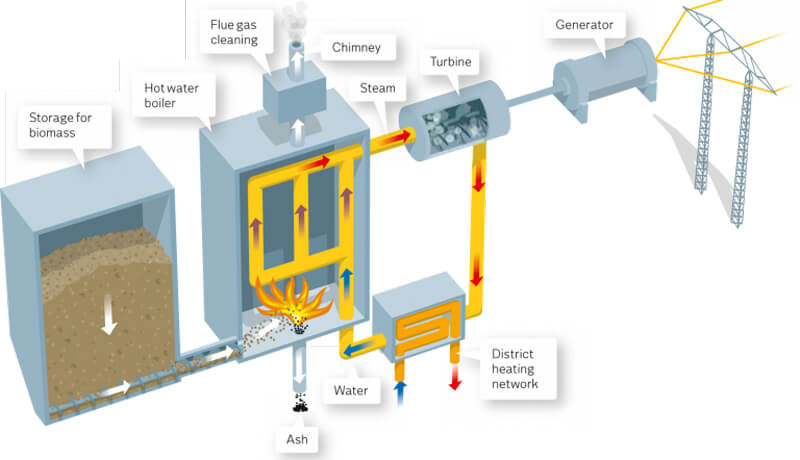
Biomass power plant
The energy changes are:
Biogas and ethanol
- Biogas is methane-rich gas. It can be burned directly for heat or used in engines/turbines for electricity.
- Ethanol is a liquid fuel. It is mainly used as a gasoline additive or substitute, not in steam-electric plants.
Environmental Effects of Biomass Use
Here is the main trade-off. Biomass can be low-cost, local, and storable, but the way it is burned and harvested can create major environmental problems.
Air pollutants from biomass combustion
Carbon dioxide
A greenhouse gas. Biomass is only called carbon neutral if regrowth captures the released carbon. If forests are cleared or harvest is unsustainable, that offset does not fully happen.Carbon monoxide
Forms during incomplete combustion. It is dangerous because it lowers the blood’s ability to carry oxygen. This is a major indoor hazard with open fires or bad ventilation.Nitrogen oxides
Produced during high-temperature combustion. They help cause photochemical smog, ground-level ozone, and acid deposition.Particulate matter
Smoke and soot damage the respiratory and cardiovascular systems and reduce visibility. Wet fuel and inefficient burning make this worse.Volatile organic compounds (VOCs)
Often released during incomplete combustion. With and sunlight, they help form ozone and smog.
Land effects from harvesting biomass
If people use too much fuelwood, this causal chain can happen:
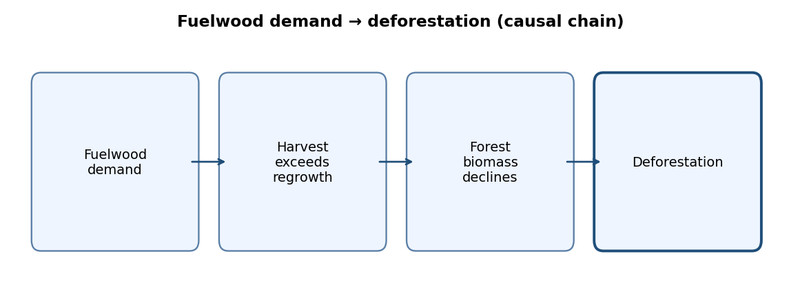
Fuelwood demand and deforestation
fuelwood demand → harvest exceeds regrowth → forest biomass declines → deforestation
Major results of deforestation:
- Habitat destruction and biodiversity loss
- Soil erosion
- More runoff and sediment transport
- Less carbon storage
- Disrupted nutrient and water cycling
Why source matters
- Waste and residue biomass usually has lower land-use impact.
- Dedicated fuel crops can compete with food production and natural habitat.
- Fuel crops may need land, water, fertilizer, pesticides, and transportation.
Ethanol and Why Its Trade-Offs Matter
Ethanol is an alcohol fuel made by fermenting plant sugars.
- Corn is the main feedstock in the United States
- Sugarcane is the main feedstock in Brazil
It can replace gasoline or be blended with it. When ethanol burns, it releases , but that carbon was recently taken from the atmosphere by plants.
That does not mean ethanol has no climate impact.
- It does not introduce additional carbon via combustion the way fossil fuels do
- It still does release
- Its overall greenhouse effect depends on the full life cycle
EROI
Energy return on energy investment compares energy out to energy in.
Ethanol has a low EROI, which means the net energy gain is small because production takes a lot of energy.
Energy inputs include:
- fertilizer production
- farm machinery
- irrigation
- harvesting
- transportation
- fermentation
- distillation
How to Reduce Biomass Impacts
Better biomass systems depend on both the source and the technology.
- Sustainable harvesting
- replanting
- managed woodlots
- rotation of harvest areas
- avoiding old-growth forest removal
- Use wastes and residues instead of clearing forests or planting more fuel crops
- Improve combustion efficiency with better cookstoves and boilers
- Ventilation and chimneys reduce indoor exposure
- Pollution controls at large facilities can reduce particulate emissions
- Improve ethanol systems by cutting fossil-fuel inputs, using renewable energy in processing, and using nonfood or waste feedstocks
The best APES conclusion is simple. Biomass can help, but its environmental value depends on source, harvest rate, combustion method, and full life-cycle impacts.
Key Takeaways
Biomass
Recently living organic material used as fuel; it stores chemical energy originally captured from sunlight through photosynthesis
Biogas
Methane-rich fuel produced by anaerobic decomposition of organic matter and burned for heat or electricity
Sustainable Biomass Harvesting
Harvesting biomass no faster than it regrows and in ways that avoid resource depletion and unacceptable environmental damage
Carbon Neutrality of Biomass
The conditional balancing of combustion CO₂ by CO₂ absorbed during regrowth; land-use change and fossil-energy inputs can prevent full life-cycle neutrality
Ethanol
An alcohol biofuel made by fermenting plant sugars and used as a substitute for or additive to gasoline
Energy Return on Energy Investment (EROI)
Usable energy obtained ÷ energy required to produce the fuel; ethanol has a low EROI and therefore a relatively small net energy gain
Notes
Biomass
Recently living organic material used as fuel; it stores chemical energy originally captured from sunlight through photosynthesis
Biogas
Methane-rich fuel produced by anaerobic decomposition of organic matter and burned for heat or electricity
Sustainable Biomass Harvesting
Harvesting biomass no faster than it regrows and in ways that avoid resource depletion and unacceptable environmental damage
Carbon Neutrality of Biomass
The conditional balancing of combustion CO₂ by CO₂ absorbed during regrowth; land-use change and fossil-energy inputs can prevent full life-cycle neutrality
Ethanol
An alcohol biofuel made by fermenting plant sugars and used as a substitute for or additive to gasoline
Energy Return on Energy Investment (EROI)
Usable energy obtained ÷ energy required to produce the fuel; ethanol has a low EROI and therefore a relatively small net energy gain
