Topic 2.6 Notes – Adaptations
What Adaptations Are
An adaptation is a heritable trait that increases survival and reproductive success in a particular environment. Heritable means it can be passed from parent to offspring.
A few parts of that definition matter a lot:
- Populations adapt, not individuals. One organism does not evolve bigger lungs or a thicker coat during its lifetime because it needs to.
- Natural selection acts on phenotypes. That means the visible or functional traits of organisms. But a population only changes over generations if those trait differences are genetic and inherited.
- Biological fitness means reproductive success. An organism that lives longer but leaves fewer offspring is not more fit in the evolutionary sense.
- Adaptations are environment-specific. Thick fur helps in cold places and can be a problem in hot ones.
- Adaptation happens through small genetic shifts over generations. Alleles linked to helpful traits become more common bit by bit.
That leads straight into the different forms an adaptation can take.
Types of Adaptations
Structural adaptations
These are physical features that improve survival or reproduction.
Examples you should know:
- Insulating fur helps animals keep heat in cold climates.
- Camouflage helps organisms avoid predators or sneak up on prey.
- Beak shape matched to food source helps birds use certain foods better than others.
The exam likes the idea that the same structure can help in one setting and hurt in another.
Physiological adaptations
These are internal processes or chemical functions.
Examples:
- Concentrated urine in desert mammals helps conserve water.
- Salinity tolerance in salt marsh organisms helps them live in salty conditions.
- Low-oxygen metabolic function helps survival where oxygen is limited.
Be careful with acclimation. If one individual temporarily adjusts to heat or low oxygen, that is not evolutionary adaptation by itself.
Behavioral adaptations
These are inherited patterns of action that improve fitness.
Examples:
- Seasonal migration
- Nocturnal activity in hot deserts
- Courtship behaviors
- Feeding behaviors
A short-term behavior change by one organism is just a response. It only counts as adaptation if inherited behavior becomes more common over generations.
How Natural Selection Produces Adaptation
This sequence is one of the most testable parts of the topic.
- Variation exists in a population.
- Some variation is heritable.
- The environment creates a selective pressure.
- Some individuals survive or reproduce more successfully.
- Those individuals leave more offspring.
- Helpful alleles and traits become more common.
- The population becomes better suited to that environment.
The snail diagram ties those steps together into one example, especially variation, selection, and inheritance across generations.
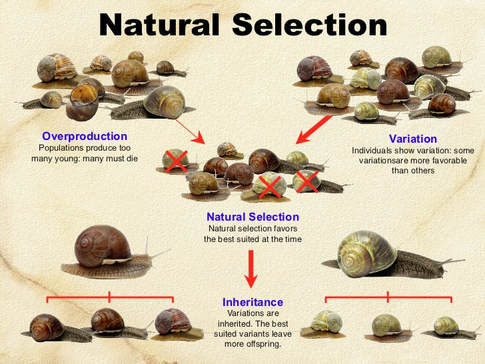
Natural selection in a snail population
Two classic mistakes to avoid:
- The environment does not give organisms traits they need.
- Mutations are random, not caused by need.
Genetic diversity matters because more variation means a better chance that some individuals already have a useful trait. A bottleneck reduces diversity, so adaptation becomes less likely. Still, diversity does not guarantee success. The trait must improve reproductive success, and the population has to survive long enough for selection to act.
How Populations Respond to Environmental Change
Alter behavior or physiology
Individuals may change feeding time, use shelter, or shift activity periods. This can help immediately, but it is not evolution by itself.
Move
Populations may disperse, migrate, or shift range to cooler latitudes or higher elevations. Movement shows response to change, but movement alone does not prove genetic adaptation.
Perish
Some individuals die or fail to reproduce. If death is nonrandom and linked to a heritable trait, natural selection can happen. If almost everyone dies no matter their traits, adaptation is unlikely.
What affects the outcome:
- rate and size of environmental change
- generation time
- population size
- genetic variation
- tolerance limits
- habitat availability and barriers
Possible outcomes include short-term adjustment, migration, adaptation, decline, local disappearance, or extinction.
The Galápagos Finch Example and How to Read the Data
The classic example is the medium ground finch, Geospiza fortis, on Daphne Major during the 1977 drought.
The drought reduced small, soft seeds. Large, hard seeds remained. Finches already differed in heritable beak depth. Birds with larger, deeper beaks could crack the remaining seeds better, so they survived and reproduced more. In the next generation, average beak depth increased.
This kind of graph tracks that population change across years. The jump after the late-1970s drought is the key pattern to notice.
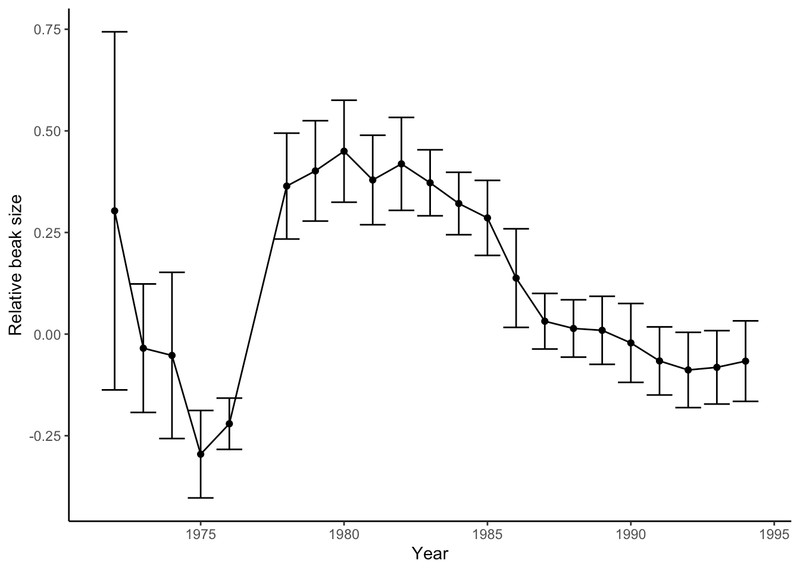
Relative beak size in Galápagos finches over time
How to read the data:
- Beak depth vs survival probability shows selection during that event.
- Before-drought vs survivor distributions shifted toward deeper beaks also shows selection.
- Change in mean beak depth in the next generation is the evidence for adaptation, and that is the kind of pattern this time-series graph is showing.
That last distinction shows up on MCQs all the time. Selection during one event is not the same thing as inherited population change across generations.
Key Takeaways
Adaptation (Evolutionary Adaptation; Genetic Adaptation)
A heritable characteristic, produced by natural selection over generations, that improves survival and reproduction under particular environmental conditions
Natural Selection
The process by which heritable traits that increase reproductive success under current conditions become more common in a population over generations
Selective Pressure
An environmental condition that causes individuals with some heritable traits to survive or reproduce more successfully than others
Biological Fitness
An individual's reproductive contribution to later generations, rather than simply its strength, health, or lifespan
Structural Adaptation
A heritable physical feature that increases survival or reproduction under particular environmental conditions
Physiological Adaptation
A heritable internal chemical or biological function that increases survival or reproduction under particular conditions
Behavioral Adaptation
A heritable tendency to perform an action that increases survival or reproduction, rather than a temporary behavioral adjustment
Acclimation
A temporary physiological adjustment by an individual to environmental change, not an inherited population-level adaptation
Notes
Adaptation (Evolutionary Adaptation; Genetic Adaptation)
A heritable characteristic, produced by natural selection over generations, that improves survival and reproduction under particular environmental conditions
Natural Selection
The process by which heritable traits that increase reproductive success under current conditions become more common in a population over generations
Selective Pressure
An environmental condition that causes individuals with some heritable traits to survive or reproduce more successfully than others
Biological Fitness
An individual's reproductive contribution to later generations, rather than simply its strength, health, or lifespan
Structural Adaptation
A heritable physical feature that increases survival or reproduction under particular environmental conditions
Physiological Adaptation
A heritable internal chemical or biological function that increases survival or reproduction under particular conditions
Behavioral Adaptation
A heritable tendency to perform an action that increases survival or reproduction, rather than a temporary behavioral adjustment
Acclimation
A temporary physiological adjustment by an individual to environmental change, not an inherited population-level adaptation
