Topic 6.4 Notes – Distribution of Natural Energy Resources
What the Distribution of Natural Energy Resources Means
When APES says distribution, it means the physical pattern of where a resource occurs in Earth’s crust. That is different from how much is extracted or used.
Keep these terms straight:
- Distribution = where the resource exists
- Deposit = a natural concentration in one location
- Reserve = the recoverable part of a known deposit with current technology and economics
- Production = how much is extracted
- Consumption = how much is used
- Access = whether people can actually obtain and use it
This distinction gets tested a lot. A country can have a big deposit but low production if extraction is expensive, difficult, or restricted. A production map or reserve map is not the same as a map of geologic occurrence.
The biggest idea here is simple. Uneven distribution comes from geologic history, not from today’s political borders or present climate.
Why Geologic History Controls Where Resources Are Found
Resources form through a chain of geologic events, and that chain only happened in certain places.
- Source material forms or collects in a particular environment.
- Burial, heat, pressure, chemical change, tectonics, or fluids transform it.
- Rock structures preserve, trap, or concentrate it.
- Those conditions were uneven across Earth, so deposits are uneven too.
Major controls include:
- Ancient environments such as swamps, shallow seas, lakes, and sedimentary basins
- Burial history over time, including depth, heat, and pressure
- Rock type such as source rock, reservoir rock, and cap rock
- Tectonic activity such as folding, faulting, uplift, volcanism, and basin formation
- Erosion and exposure, which can bring deposits closer to the surface
For fossil fuels, those controls often show up as geologic traps that let oil and natural gas accumulate in certain rock layers instead of spreading out everywhere.
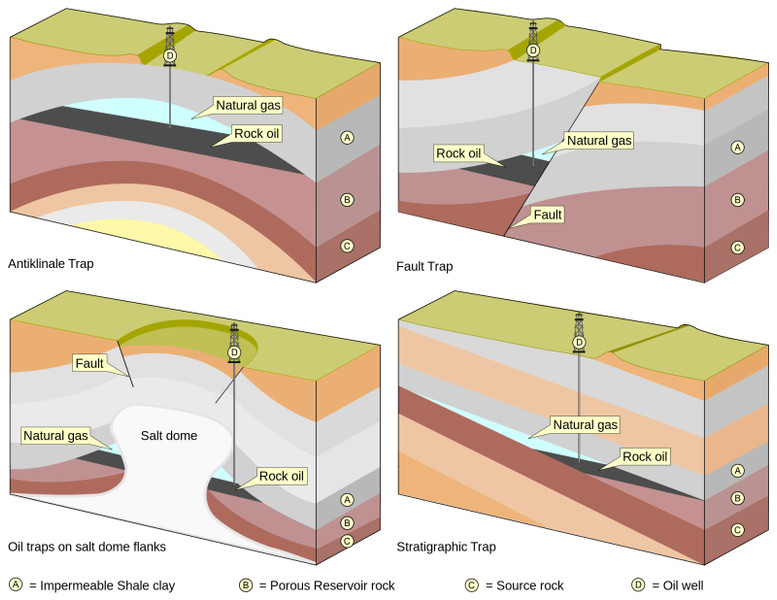
Common petroleum traps
Current surface conditions can fool you. A desert today may contain oil from an ancient shallow sea. A cold region today may contain coal from ancient equatorial wetlands.
Where the Major Energy Resources Occur
Coal
Coal forms from plant material in ancient wetlands and swamps. Low oxygen slows decomposition, then burial and pressure turn peat into coal. Coal usually occurs in sedimentary layers called coal seams.
- Standard example: Appalachian coalfields
- Major regions: China, India, Russia, Australia, South Africa, eastern United States
Crude oil
Crude oil forms mainly from marine microorganisms such as algae and plankton in low-oxygen seas, lakes, or coastal areas. After burial, hydrocarbons form and migrate into porous rock, then get trapped under cap rock.
- Standard example: Persian Gulf region
- Major regions: Middle East, Russia, United States, Venezuela, Canada, North and West Africa, North Sea, Central Asia
- Heavy oil and bitumen examples: Alberta oil sands and Venezuela’s Orinoco Belt
Natural gas
Natural gas is mostly methane. It forms from buried organic matter, often in the same sedimentary basins as oil. In a trap, gas usually sits above oil because it is less dense. It can also occur in shale or separate reservoirs.
- Major regions: Russia and Central Asia, Middle East, United States, Canada, parts of Africa and Europe
Uranium ore and other ores
An ore is rock with enough useful material to recover economically. Uranium matters here because it fuels nuclear power. Ores form through magma cooling, hydrothermal fluids, sedimentary concentration, weathering and erosion, and metamorphism with tectonics.
- Major uranium regions: Kazakhstan, Canada, Australia, Namibia, parts of the United States and Central Asia
How to Read Resource Maps and Cross-Sections
Always identify what a map shows first. Is it deposits, reserves, or production?
Good map reading does three things:
- Describe the pattern
Resource locations usually appear clustered, not uniform. - Explain the geology
Connect coal to ancient swamps, and oil and gas to sedimentary basins and traps. - State a human consequence
Export potential, import dependence, or unequal access.
For cross-sections, remember:
- Oil and gas: source rock deep below, porous reservoir rock, cap rock above, gas over oil over water, traps made by folds or faults
- Coal: seams follow sedimentary layers, then folding, faulting, or uplift may distort or expose them
Why Uneven Distribution Matters for Human Energy Systems
Uneven deposits create unequal domestic energy availability.
- Resource-rich countries may export
- Resource-poor countries may import
- Access also depends on technology, wealth, pipelines, ports, infrastructure, trade routes, and policy
A large deposit does not guarantee high production or energy independence. The chain to remember is:
geologic history → deposits → availability → use shaped by economics and technology
Key Takeaways
Natural Resource
Material or energy found in nature that humans can use
Deposit
A natural concentration of a resource in a particular location
Reserve
The known portion of a resource that can be recovered under current economic and technological conditions
Natural Energy Resource Distribution
The nonuniform pattern of resource deposits created by regional differences in geologic history and formation conditions
Coal
Fuel formed from buried plants in ancient oxygen-poor wetlands, concentrated in sedimentary seams such as those of Appalachia
Crude Oil
Liquid hydrocarbons formed from buried aquatic organisms and concentrated in trapped reservoirs within sedimentary basins
Natural Gas
Mostly methane formed from buried organic matter, often found with oil in sedimentary traps or within low-permeability shale
Ore
Rock containing a useful substance at a concentration high enough to make recovery potentially worthwhile
Uranium Ore
Uranium-bearing rock concentrated enough for potential recovery, with important deposits in Kazakhstan, Canada, Australia, Namibia, and parts of the United States and Central Asia
Source Rock
Organic-rich rock in which burial and heating generate oil or natural gas
Reservoir Rock
Porous, permeable rock into which oil or natural gas migrates and accumulates
Cap Rock (Seal)
Impermeable rock that prevents oil and natural gas from migrating out of a reservoir
Geologic Trap
A rock structure, such as a fold or fault, that concentrates migrating oil and gas beneath a seal
Notes
Natural Resource
Material or energy found in nature that humans can use
Deposit
A natural concentration of a resource in a particular location
Reserve
The known portion of a resource that can be recovered under current economic and technological conditions
Natural Energy Resource Distribution
The nonuniform pattern of resource deposits created by regional differences in geologic history and formation conditions
Coal
Fuel formed from buried plants in ancient oxygen-poor wetlands, concentrated in sedimentary seams such as those of Appalachia
Crude Oil
Liquid hydrocarbons formed from buried aquatic organisms and concentrated in trapped reservoirs within sedimentary basins
Natural Gas
Mostly methane formed from buried organic matter, often found with oil in sedimentary traps or within low-permeability shale
Ore
Rock containing a useful substance at a concentration high enough to make recovery potentially worthwhile
Uranium Ore
Uranium-bearing rock concentrated enough for potential recovery, with important deposits in Kazakhstan, Canada, Australia, Namibia, and parts of the United States and Central Asia
Source Rock
Organic-rich rock in which burial and heating generate oil or natural gas
Reservoir Rock
Porous, permeable rock into which oil or natural gas migrates and accumulates
Cap Rock (Seal)
Impermeable rock that prevents oil and natural gas from migrating out of a reservoir
Geologic Trap
A rock structure, such as a fold or fault, that concentrates migrating oil and gas beneath a seal
