Topic 8.14 Notes – Pollution and Human Health
How Pollution Causes Human Health Problems
A pollutant does not hurt people just by existing. It has to move through an exposure pathway.
The chain to remember is:
source → environmental medium → human exposure → route into body → dose → health effect
The diagram below gives you the big picture. A source can move through air, soil, water, or food before it reaches people.
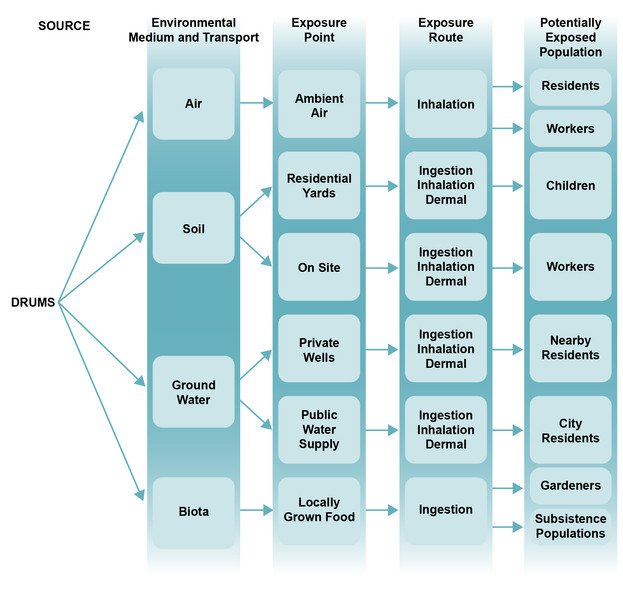
For this topic, the main routes into the body are:
- Ingestion when you swallow contaminated water or food
- Inhalation when you breathe in polluted air or fibers
The figure also includes dermal exposure, but AP Environmental Science questions in this topic usually focus most on ingestion and inhalation.
Risk depends on a few things working together:
- Concentration of the pollutant
- Duration and frequency of exposure
- Route of entry because breathing something in is different from swallowing it
- Individual susceptibility such as age, genetics, asthma, or overall health
Health effects can be:
- Acute which appear quickly after exposure
- Chronic which develop after repeated exposure or much later
A latency period is the delay between exposure and detectable illness. Mesothelioma is the classic long-latency example.
There are also two ways pollution can affect health:
- Direct effects when the pollutant itself damages tissue
- Indirect effects when pollution creates conditions that spread a disease-causing agent
That direct versus indirect idea shows up clearly in the three required examples.
Key Pollution Source and Health Effect Pairings
Untreated sewage and dysentery
Untreated sewage in rivers and streams can carry pathogens from human waste. Dysentery is a serious intestinal infection that causes severe diarrhea, often with blood or mucus.
The pathway is fecal-oral:
- Sewage contaminates water or food.
- A person ingests it.
- Pathogens infect the intestinal tract.
- Dysentery develops.
The important distinction is easy to miss on tests. Sewage is the pollution source. The pathogens in the sewage are the immediate cause of disease.
Prevention includes wastewater treatment, disinfection of wastewater and drinking water, sanitation and handwashing, and keeping sewage separate from drinking-water supplies.
Asbestos and mesothelioma
Mesothelioma is a cancer of the mesothelium, usually the lining around the lungs. Asbestos is a fibrous silicate mineral once used in insulation, roofing, floor tiles, cement products, brakes, shipbuilding, and construction.
The image shows the needle-like fibers that make asbestos so hazardous once they become airborne and inhaled.
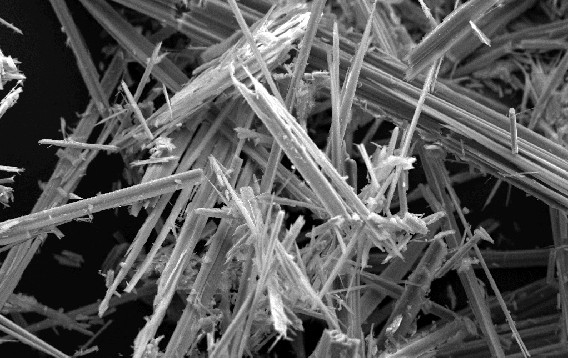
Asbestos fibers
The main exposure route is inhalation. Fibers become airborne when asbestos-containing material is cut, broken, sanded, demolished, or disturbed. Friable asbestos is most dangerous because it crumbles easily and releases fibers.
High-risk groups include miners, insulation workers, shipyard workers, construction and demolition workers, manufacturing workers, and family members exposed from contaminated clothing. The disease often appears decades later, which makes causation harder to trace.
Prevention means inspecting older buildings, using licensed abatement professionals, leaving stable asbestos undisturbed when appropriate, and using dust control, protective gear, safe disposal, and air monitoring.
Tropospheric ozone and respiratory damage
Tropospheric ozone is ground-level ozone in the lower atmosphere. At high levels, it damages respiratory tissue and reduces lung function.
Common effects include:
- coughing
- chest discomfort
- throat irritation
- shortness of breath
- worsened asthma
It is a secondary pollutant. It forms when nitrogen oxides (NOx) and volatile organic compounds (VOCs) react in sunlight. Major precursor sources include motor vehicles, power plants, fuel combustion, industrial activity, and evaporating fuels. Levels are often highest in hot, sunny urban areas.
Keep the atmospheric layers straight here. Ground-level ozone in the troposphere is the harmful kind, but ozone in the stratosphere helps block UV radiation.
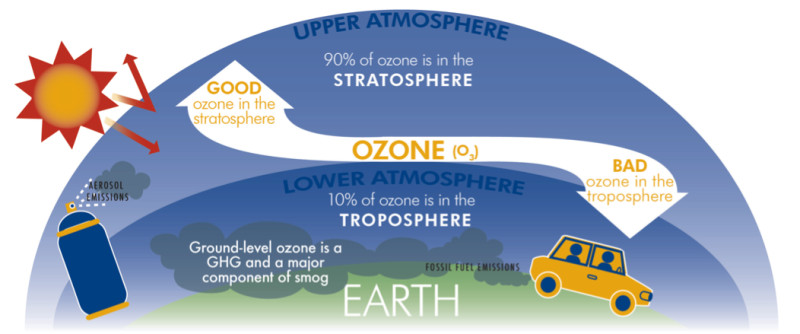
Good ozone vs. bad ozone
At-risk groups include children, older adults, people with asthma, outdoor workers, and athletes. One of the most tested distinctions in Unit 8 is this one: tropospheric ozone is harmful; stratospheric ozone is protective. Prevention targets NOx and VOC emissions, not ozone directly.
Why Cause and Effect Is Hard to Prove
People are exposed to many pollutants at once through air, water, food, workplaces, housing, and products. So an association between pollution and disease does not automatically prove causation.
A confounding variable is something else that affects the outcome. The standard example is smoking in studies of lung disease.
Other problems include poor memory of past exposure, pollution varying across time and place, community monitoring not matching personal exposure, individual differences, long latency periods, diseases with multiple causes, and small samples for rare diseases.
How Scientists Investigate Pollution and Health
Because exposing people to dangerous pollutants on purpose is unethical, scientists rely on observational evidence such as epidemiology, environmental monitoring, medical records, occupational histories, laboratory evidence, and animal studies.
Common study designs
- Cohort study
Starts with exposed and less-exposed groups, then compares disease rates over time. - Case-control study
Starts with people who have a disease and people who do not, then looks backward for exposure differences. This is especially useful for rare diseases with long latency, such as mesothelioma.
What strengthens a causal claim
- exposure happens before disease
- more exposure leads to greater effect
- results repeat across studies and populations
- there is a biologically plausible mechanism
- confounding variables are addressed
What to look for in a solid study
A good study has a clearly defined exposed group, an appropriate comparison group, a measurable health outcome, a way to estimate exposure, control of confounding variables, and a large sample size with replication.
Key Takeaways
Exposure Pathway
The sequence from a pollutant source through an environmental medium and route of entry to an internal dose and health effect
Acute Health Effect
A health effect that develops shortly after exposure
Chronic Health Effect
A health effect that develops after repeated exposure or becomes apparent only after a long time
Latency Period (Latency)
The time between exposure to a hazard and the appearance of detectable illness
Statistical Association vs. Causation
An association is an observed relationship between exposure and illness; causation means the exposure produces the illness, which association alone does not prove
Confounding Variable
A factor associated with both a suspected exposure and a health outcome that can distort their apparent relationship
Epidemiology
The study of the patterns and causes of health outcomes in populations
Cohort Study
A study that begins with exposed and less-exposed groups and compares their occurrence of disease over time
Case-Control Study
A study that begins with people with and without a disease and looks backward for differences in previous exposure
Dysentery
A serious intestinal infection characterized by severe diarrhea, often containing blood or mucus, caused by ingesting pathogens from water or food contaminated by untreated sewage
Fecal-Oral Route
Transmission in which pathogens from fecal contamination are ingested in contaminated water or food
Mesothelioma
Cancer of the tissue lining internal organs, usually around the lungs, caused principally by asbestos exposure
Asbestos
A group of fibrous silicate minerals whose airborne fibers can be inhaled, lodge around the lungs, and contribute to mesothelioma
Friable Asbestos
Asbestos-containing material that can be crumbled or reduced to powder and therefore readily releases airborne fibers
Tropospheric Ozone
Ground-level O₃, a reactive secondary air pollutant that irritates respiratory tissue and reduces lung function
Notes
Exposure Pathway
The sequence from a pollutant source through an environmental medium and route of entry to an internal dose and health effect
Acute Health Effect
A health effect that develops shortly after exposure
Chronic Health Effect
A health effect that develops after repeated exposure or becomes apparent only after a long time
Latency Period (Latency)
The time between exposure to a hazard and the appearance of detectable illness
Statistical Association vs. Causation
An association is an observed relationship between exposure and illness; causation means the exposure produces the illness, which association alone does not prove
Confounding Variable
A factor associated with both a suspected exposure and a health outcome that can distort their apparent relationship
Epidemiology
The study of the patterns and causes of health outcomes in populations
Cohort Study
A study that begins with exposed and less-exposed groups and compares their occurrence of disease over time
Case-Control Study
A study that begins with people with and without a disease and looks backward for differences in previous exposure
Dysentery
A serious intestinal infection characterized by severe diarrhea, often containing blood or mucus, caused by ingesting pathogens from water or food contaminated by untreated sewage
Fecal-Oral Route
Transmission in which pathogens from fecal contamination are ingested in contaminated water or food
Mesothelioma
Cancer of the tissue lining internal organs, usually around the lungs, caused principally by asbestos exposure
Asbestos
A group of fibrous silicate minerals whose airborne fibers can be inhaled, lodge around the lungs, and contribute to mesothelioma
Friable Asbestos
Asbestos-containing material that can be crumbled or reduced to powder and therefore readily releases airborne fibers
Tropospheric Ozone
Ground-level O₃, a reactive secondary air pollutant that irritates respiratory tissue and reduces lung function
