Topic 9.10 Notes – Human Impacts on Biodiversity
What Human Impacts on Biodiversity Are
Biodiversity can decline in three connected ways:
- Genetic diversity means variation within a species or population. Fewer alleles means less ability to adapt.
- Species diversity means both the number of species and how evenly they are represented.
- Ecosystem diversity means the variety of habitats, communities, and ecological processes.
Biodiversity loss is broader than extinction. It also includes:
- Local extirpation when a species disappears from one area but still exists elsewhere
- Population decline even if the species is still present
- Lower species richness or evenness
- Loss of genetic variation
- Replacement of diverse systems with simplified ones like monocultures
Why this matters:
- Lower stability and resilience when conditions change
- Reduced productivity
- Weaker ecosystem services such as pollination, water purification, and nutrient cycling
The big idea tying the topic together is that human pressures often hit biodiversity at the same time, not one by one.
The HIPPCO Causes of Biodiversity Loss
HIPPCO stands for the six main human pressures.
Habitat destruction
This is when habitat is removed, converted, or degraded so native species cannot use it well.
Common causes include:
- agriculture
- urban development
- roads and pipelines
- logging
- mining
- reservoirs and other infrastructure
Degradation means the habitat still exists physically but is lower quality. A forest with noise, light, contamination, or selective logging may still be there, but many species can no longer thrive. Specialists usually suffer more than generalists because specialists need narrower conditions.
Roads, trails, and utility corridors can also split habitat and create edge effects, where conditions near the opening differ from the forest interior.
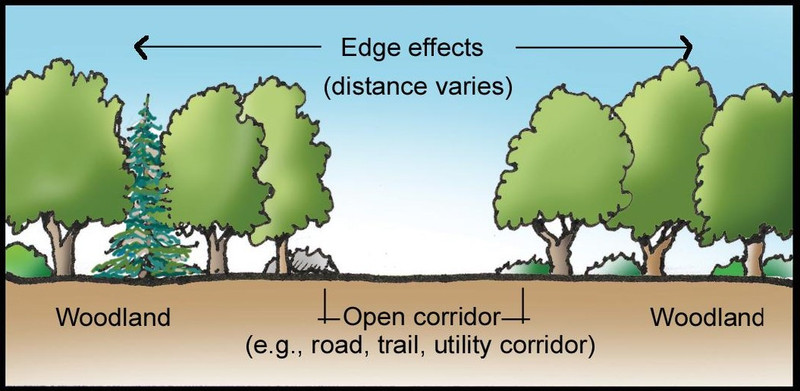
Edge effects along a habitat corridor
Invasive species
These are nonnative species that establish and cause ecological harm. They reduce biodiversity through:
- competition
- predation
- disease spread
- habitat alteration
- food-web disruption
Example:
- Burmese python in the Florida Everglades. This invasive predator reduces native mammal and bird populations.
Population growth
As human population grows, demand rises for land, food, water, energy, transportation, and materials. That increases habitat conversion, pollution, emissions, and extraction. Impact depends on per-capita consumption and technology too, not just number of people.
Pollution
Pollution can kill organisms, disrupt reproduction and development, and degrade habitat quality.
Examples you should know:
- pesticides kill nontarget species
- excess nitrogen and phosphorus cause eutrophication and low oxygen
- plastics cause ingestion and entanglement
- sediment buries habitat and blocks light
- acid deposition changes soil and water chemistry
- noise disrupts communication and migration
- artificial light disorients nocturnal and migratory species
Persistent pollutants can bioaccumulate in one organism and biomagnify up the food chain.
Climate change
Climate change alters habitat through:
- temperature change
- precipitation change
- sea level rise
- shifting seasonal timing
This can force range shifts and create phenology mismatches, where linked species no longer line up in timing.
Examples:
- loss of Arctic sea ice
- coastal squeeze, when rising seas push habitat inland but development blocks that movement
Overexploitation
This means harvesting organisms faster than they can recover.
Examples include:
- overfishing
- hunting and poaching
- logging beyond regrowth rates
- wildlife trade
Example:
- North Atlantic cod fisheries collapse
Habitat Fragmentation and Why Scale Matters
Habitat fragmentation happens when a large continuous habitat is broken into smaller isolated patches.
Main causes:
- roads
- pipelines
- agriculture
- urban development
- logging
Main effects:
- smaller patch size
- greater isolation
- less movement and gene flow
- more inbreeding risk
- more edge habitat and stronger edge effects
- more human access, hunting, invasives, and disturbance
Edge effects mean edge areas get more sunlight, wind, temperature swings, noise, pollutants, light, predators, invasive species, and roadkill, with lower humidity than interior habitat.
Species respond differently. What matters includes home-range size, dispersal ability, specialization, need for interior habitat, migratory behavior, reproductive rate, and tolerance of roads or people. There is no single fragmentation threshold that harms every species.
Domestication and Reduced Genetic Diversity
Domestication means humans manage and selectively breed organisms for desired traits. That can shrink genetic diversity if reproduction comes from a small number of commercial lines.
Risks of low genetic diversity:
- fewer alleles
- less adaptability
- greater disease vulnerability
Examples:
- honeybee colonies
- domestic livestock
A species can stay abundant and still lose genetic diversity. That distinction gets tested.
How Biodiversity Loss Can Be Reduced
Protected areas
These include parks, reserves, refuges, and marine protected areas.
- Benefit: limit habitat conversion and extraction, protect breeding and feeding areas
- Limits: need enough size, funding, enforcement, and the right habitat inside boundaries
- Unintended issue: conflicts with local communities, or climate change may shift habitat outside the protected area
Habitat corridors
Corridors connect isolated patches and improve movement and gene flow. Wildlife crossings are part of this.
Example:
- Banff National Park overpasses and underpasses with fencing
Drawbacks include cost, poor design, and possible spread of invasive species, disease, or fire.
Sustainable land use
Examples:
- selective logging
- streamside buffer zones
- agroforestry and shade-grown crops
- rotational grazing
- clustered development
- road placement that avoids critical habitat
These reduce damage, but they usually do not preserve original biodiversity completely.
Habitat restoration
This can include replanting natives, removing invasives, restoring hydrology, reconnecting floodplains, rebuilding dunes or reefs, and reintroducing species. It can improve function, but it is slow, expensive, and uncertain.
Key Takeaways
Genetic Diversity
Variation among individuals and populations of the same species
Species Diversity
The number of species in a community and their relative abundance
Ecosystem Diversity
The variety of habitats, communities, and ecological processes in a region
HIPPCO
The major causes of biodiversity loss: habitat destruction, invasive species, population growth, pollution, climate change, and overexploitation
Habitat Destruction
Removal or extensive conversion of a natural habitat so its native organisms can no longer use it
Habitat Degradation
Loss of habitat quality that reduces support for the original community even though the habitat remains physically present
Habitat Conversion (Land Conversion)
Replacement of a natural ecosystem with a human land use, often creating a simpler and less diverse system
Biological Homogenization
Increasing similarity among communities as widespread disturbance-tolerant species replace locally specialized species
Habitat Fragmentation
Division of a large, continuous habitat into smaller, more isolated patches
Matrix
The developed or altered land surrounding and separating habitat patches
Edge Effects
Changes in environmental conditions and species interactions near a habitat boundary compared with the interior
Coastal Squeeze
Loss of coastal habitat when sea-level rise pushes it inland but development or barriers prevent its migration
Phenology
The seasonal timing of biological events such as migration, flowering, breeding, and insect emergence
Overexploitation
Harvesting or using organisms faster than their populations can replace themselves
Domestication
Human management and breeding of organisms for desired traits, often narrowing genetic diversity when reproduction relies on a few lines
Protected Area
A terrestrial or aquatic region where development, harvesting, or other damaging activities are restricted
Habitat Corridor
A strip or network of suitable habitat connecting isolated patches and permitting movement, recolonization, and gene flow
Wildlife Crossings (Wildlife Overpasses and Underpasses)
Structures that allow animals to cross roads safely, reconnecting habitat and reducing vehicle collisions
Sustainable Land Use
Use of land and biological resources in ways that reduce habitat damage while allowing populations and ecological processes to persist
Habitat Restoration
Returning a degraded ecosystem toward its former structure, functions, and species composition
Notes
Genetic Diversity
Variation among individuals and populations of the same species
Species Diversity
The number of species in a community and their relative abundance
Ecosystem Diversity
The variety of habitats, communities, and ecological processes in a region
HIPPCO
The major causes of biodiversity loss: habitat destruction, invasive species, population growth, pollution, climate change, and overexploitation
Habitat Destruction
Removal or extensive conversion of a natural habitat so its native organisms can no longer use it
Habitat Degradation
Loss of habitat quality that reduces support for the original community even though the habitat remains physically present
Habitat Conversion (Land Conversion)
Replacement of a natural ecosystem with a human land use, often creating a simpler and less diverse system
Biological Homogenization
Increasing similarity among communities as widespread disturbance-tolerant species replace locally specialized species
Habitat Fragmentation
Division of a large, continuous habitat into smaller, more isolated patches
Matrix
The developed or altered land surrounding and separating habitat patches
Edge Effects
Changes in environmental conditions and species interactions near a habitat boundary compared with the interior
Coastal Squeeze
Loss of coastal habitat when sea-level rise pushes it inland but development or barriers prevent its migration
Phenology
The seasonal timing of biological events such as migration, flowering, breeding, and insect emergence
Overexploitation
Harvesting or using organisms faster than their populations can replace themselves
Domestication
Human management and breeding of organisms for desired traits, often narrowing genetic diversity when reproduction relies on a few lines
Protected Area
A terrestrial or aquatic region where development, harvesting, or other damaging activities are restricted
Habitat Corridor
A strip or network of suitable habitat connecting isolated patches and permitting movement, recolonization, and gene flow
Wildlife Crossings (Wildlife Overpasses and Underpasses)
Structures that allow animals to cross roads safely, reconnecting habitat and reducing vehicle collisions
Sustainable Land Use
Use of land and biological resources in ways that reduce habitat damage while allowing populations and ecological processes to persist
Habitat Restoration
Returning a degraded ecosystem toward its former structure, functions, and species composition
