Topic 2.3 Notes – Island Biogeography
What Island Biogeography Is
Island biogeography is the study of where organisms live on islands, how they interact, and how island communities are put together.
A few words matter a lot here:
- Species richness means the number of different species present.
- Colonization means a species arrives and successfully establishes a population. Arrival alone is not enough.
- Local extinction means a species disappears from that island, even if it still exists somewhere else.
- Source pool means the mainland or other area that can send colonists.
- Endemic species are native to and found only in one place.
- Turnover means some species are lost and replaced by others over time.
The big picture is that islands are dynamic. They are not fixed collections of species. They gain species through colonization and lose species through extinction, and many island species got there because organisms arrived from somewhere else in the past.
The classic island biogeography model summarizes that idea by showing colonization rates falling as the number of species increases and extinction rates rising as more species are present. It also highlights two patterns you should know for APES. Islands closer to the source pool tend to have higher colonization rates, and smaller islands tend to have higher extinction rates.
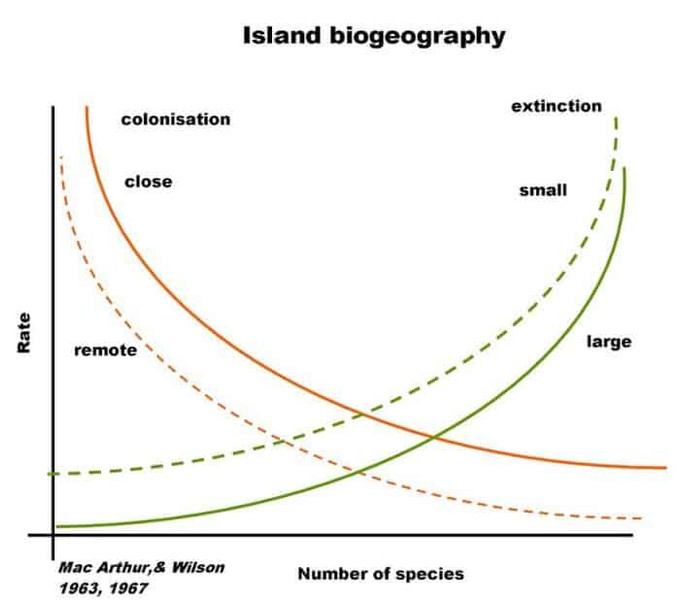
Island biogeography model
How Species Reach and Establish on Islands
Organisms can reach islands in several ways:
- Wind can carry seeds, spores, insects, and tiny organisms.
- Birds and other animals can transport seeds on their bodies or after eating fruit.
- Floating debris such as logs, vegetation, and storm rafts can carry organisms across water.
- Self-powered movement includes flying or swimming species.
- Humans move species intentionally or by accident.
Whether colonization succeeds depends on more than travel. The species must:
- survive after arrival
- reproduce successfully
- find enough habitat, food, territory, and suitable climate
- handle competition and predation
- arrive in enough numbers to form a population
Island history matters too:
- New volcanic islands begin mostly empty and are colonized gradually.
- Continental islands may already have some species when they become separated.
The Equilibrium Model of Island Biogeography
The classic model says species richness is controlled by a balance between immigration rate and extinction rate.
The equilibrium number of species is often written as .
The graphs below show that basic idea first, then how island size shifts the equilibrium point.
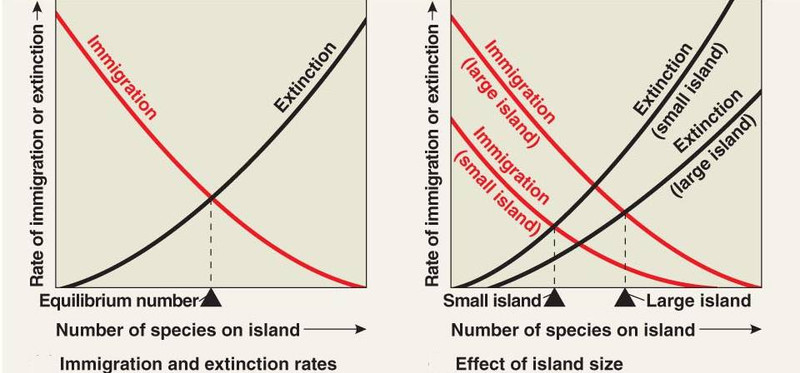
Island biogeography equilibrium graphs
Colonization curve
The colonization, or immigration, curve slopes downward.
- If an island has few species, many species from the source pool could still arrive.
- As richness increases, fewer new species remain to colonize.
Extinction curve
The extinction curve slopes upward.
- More species means more competition for limited resources and space.
- Smaller populations are easier to wipe out by chance events or disturbance.
How to read the graph
- Below , colonization is greater than extinction, so richness tends to rise.
- Above , extinction is greater than colonization, so richness tends to fall.
Focus on the left panel for this core equilibrium model. The right panel previews the size effect explained in the next section.
One easy AP trap is thinking equilibrium means nothing changes. It doesn’t. Richness can stay about the same while species identities change through turnover.
How Distance and Size Affect Species Richness
Size and distance change those two curves.
Distance from the mainland or source pool
A near island has a higher colonization rate than a far island, so its colonization curve sits higher.
- Near islands are easier to reach.
- More immigrants can also create a rescue effect, where new arrivals support declining populations.
- Far islands still can be colonized, just less often.
Island size
A large island has a lower extinction rate than a small island.
- more space and resources
- more habitat types
- larger populations
- one disturbance is less likely to eliminate the whole population
In graphs, the small-island extinction curve lies above the large-island curve.
Comparing combinations
- Large, near islands usually have the highest species richness.
- Small, far islands usually have the lowest.
- Small, near vs large, far cannot always be predicted without more information.
Why Isolation Favors Unique Species
Isolation reduces gene flow, which is movement of genes between populations. Over time, mutation, natural selection, and genetic drift can make island populations diverge enough to become new species.
Adaptive radiation happens when one ancestral species splits into many species adapted to different niches.
- Darwin’s finches of the Galápagos Islands are the classic example. Different islands and food sources favored different beak shapes.
Many island species become specialists because islands often have limited food, habitat, and territory.
- Specialists have narrow niches.
- They often have small populations and small ranges.
- Many are endemic, so extinction on that island can mean global extinction.
That helps explain why invasive species are such a big problem. Invasive species are introduced species that establish, spread, and cause harm. Invasive generalists often outcompete native specialists.
A common sequence is:
- an introduced generalist establishes
- it overlaps in resource use
- competition increases
- specialist populations decline
- extinction risk rises
- Introduced goats on oceanic islands are the standard example. They eat a wide variety of vegetation and can damage habitat used by native island species.
Key Takeaways
Island Biogeography
The study of organisms’ distribution, ecological relationships, and community structure on islands
Species Richness
The number of different species present in an area
Community Structure
Which species are present in a community and the ecological relationships among them
Colonization
The successful establishment of a population by a species arriving from elsewhere
Local Extinction
The disappearance of a species from an island or other area while it continues to exist elsewhere
Source Pool
The collection of species in a mainland or other source area that could potentially reach an island
Endemic Species
A species native to and naturally found only in a particular geographic area
Species Turnover
The continuing replacement of some species by others through colonization and local extinction
Equilibrium Model of Island Biogeography
A model in which island species richness tends to stabilize where the colonization and local-extinction rates are equal
Equilibrium Species Richness (S*)
The predicted number of island species at the intersection of the colonization and extinction curves
Rescue Effect
Immigration that reinforces a declining population or restores it after a decline, reducing local-extinction risk
Geographic Isolation
Physical separation that reduces gene flow and allows populations to diverge over generations
Adaptive Radiation
The evolution of multiple species from one ancestral population as descendants adapt to different ecological roles
Specialist
A species with a narrow ecological niche that uses limited resources, habitats, or environmental conditions
Generalist
A species with a broad ecological niche that can use varied resources or tolerate a wide range of conditions
Introduced Species
A species moved by people, intentionally or accidentally, outside its native range
Invasive Species
An introduced species that establishes, spreads, and causes ecological, economic, or other harm
Notes
Island Biogeography
The study of organisms’ distribution, ecological relationships, and community structure on islands
Species Richness
The number of different species present in an area
Community Structure
Which species are present in a community and the ecological relationships among them
Colonization
The successful establishment of a population by a species arriving from elsewhere
Local Extinction
The disappearance of a species from an island or other area while it continues to exist elsewhere
Source Pool
The collection of species in a mainland or other source area that could potentially reach an island
Endemic Species
A species native to and naturally found only in a particular geographic area
Species Turnover
The continuing replacement of some species by others through colonization and local extinction
Equilibrium Model of Island Biogeography
A model in which island species richness tends to stabilize where the colonization and local-extinction rates are equal
Equilibrium Species Richness (S*)
The predicted number of island species at the intersection of the colonization and extinction curves
Rescue Effect
Immigration that reinforces a declining population or restores it after a decline, reducing local-extinction risk
Geographic Isolation
Physical separation that reduces gene flow and allows populations to diverge over generations
Adaptive Radiation
The evolution of multiple species from one ancestral population as descendants adapt to different ecological roles
Specialist
A species with a narrow ecological niche that uses limited resources, habitats, or environmental conditions
Generalist
A species with a broad ecological niche that can use varied resources or tolerate a wide range of conditions
Introduced Species
A species moved by people, intentionally or accidentally, outside its native range
Invasive Species
An introduced species that establishes, spreads, and causes ecological, economic, or other harm
