Topic 4.7 Notes – Solar Radiation and Earth’s Seasons
What Insolation Is
Insolation means incoming solar radiation. It is Earth’s main outside energy source, and it warms land and water and drives most atmospheric processes.
What matters here is how much solar energy reaches Earth’s surface at different places and times. Two controls matter most:
- Angle of the Sun’s rays
- Number of daylight hours
Keep these terms separate:
- Insolation = incoming solar energy
- Intensity = solar energy received per unit area
- Direct rays = concentrated on a smaller area, so intensity is higher
- Oblique rays = spread over a larger area, so intensity is lower
Quick grounding so the season part makes sense:
- Earth’s rotation causes day and night.
- Earth’s revolution around the Sun, combined with axial tilt, causes the yearly seasonal pattern.
Why Latitude Changes Solar Intensity
Earth is curved, so sunlight does not hit every latitude at the same angle. In the diagram, the most direct rays strike near 0°, and the rays spread out more toward higher latitudes.
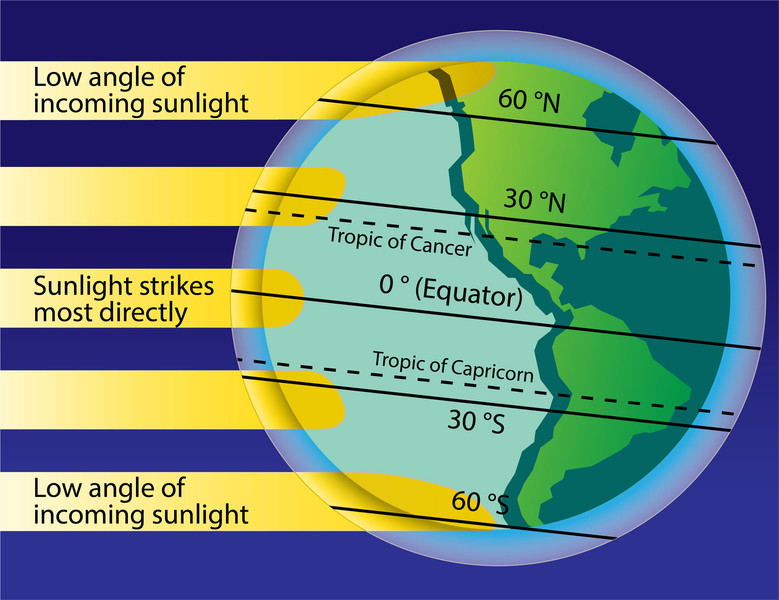
Latitude and sun angle
Equatorial regions
Near the equator, sunlight is more direct for most of the year.
- The same beam of sunlight is concentrated onto a smaller surface area.
- That gives the equator the highest average solar radiation per unit area.
Higher latitudes
At mid-latitudes and poles, sunlight arrives at a more oblique angle.
- The same beam is spread across a larger area.
- Intensity per unit area is lower.
- Sunlight also travels through more atmosphere, which increases scattering and absorption before it reaches the surface.
What to lock in
- Solar radiation generally decreases from the equator toward the poles.
- This happens because of sun angle, not because the equator is much closer to the Sun.
- The latitude directly under the incoming rays gets the greatest intensity.
The subsolar point
The subsolar point is the latitude where the Sun is directly overhead at solar noon.
- It moves during the year between 23.5° N and 23.5° S.
- It is not always at the equator.
How Earth’s Tilt Causes the Seasons
Earth’s axis is tilted about 23.5°. As Earth revolves around the Sun, that axis keeps pointing in the same general direction in space.
Here’s the chain you need to know:
- A hemisphere is tilted toward the Sun.
- It gets a higher sun angle and more direct rays.
- It also gets longer daylight hours.
- Daily insolation increases.
- That hemisphere has summer.
The opposite chain gives winter:
- A hemisphere is tilted away from the Sun.
- It gets a lower sun angle and more oblique rays.
- It has fewer daylight hours.
- Daily insolation decreases.
- That hemisphere has winter.
So the most solar radiation at a location happens around its longest summer day, and the least happens around its shortest winter day.
A common exam trap is seasons by distance. They are caused by axial tilt, not Earth-Sun distance. Earth is actually closest to the Sun in early January and farthest in early July.
Solstices and Equinoxes
These are the four main points in the yearly solar cycle. This seasons diagram shows Earth at the June and December solstices and the March and September equinoxes, with the axis staying tilted 23.5° in the same direction throughout the orbit.
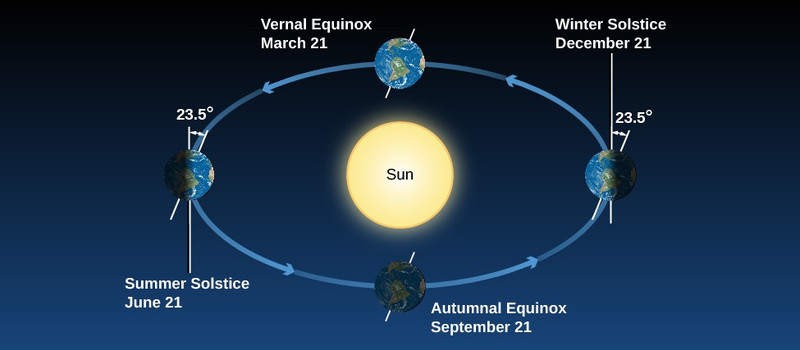
Solstices
Solstices are the extremes of day length and seasonal solar angle.
- June solstice
- Northern Hemisphere tilted toward the Sun
- Longest day in the Northern Hemisphere
- Shortest day in the Southern Hemisphere
- Subsolar point at Tropic of Cancer, 23.5° N
- December solstice
- Southern Hemisphere tilted toward the Sun
- Longest day in the Southern Hemisphere
- Shortest day in the Northern Hemisphere
- Subsolar point at Tropic of Capricorn, 23.5° S
Equinoxes
During equinoxes, neither hemisphere is tilted toward the Sun.
- Day and night are about 12 hours each
- Subsolar point is at the equator
- March equinox = spring in the Northern Hemisphere, autumn in the Southern Hemisphere
- September equinox = autumn in the Northern Hemisphere, spring in the Southern Hemisphere
What Graphs and Diagrams Usually Show
A seasons diagram is testing whether you can connect tilt → sun angle → day length → season.
A daylight-hours graph usually shows:
- The equator stays near 12 hours of daylight all year.
- Higher latitudes have the biggest seasonal swings.
- Northern and Southern Hemisphere patterns are reversed.
This kind of graph is a quick way to spot all three patterns at once.
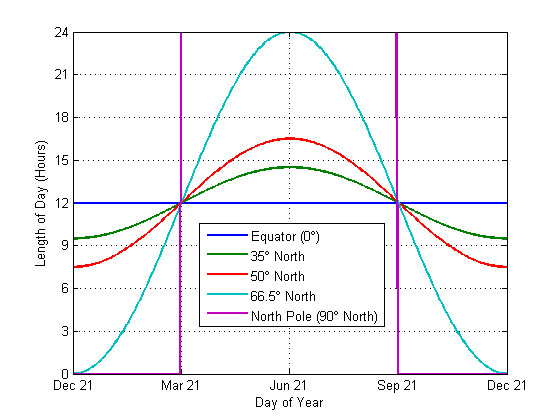
Day length by latitude over the year
Polar examples show up a lot. In this graph, focus on the 66.5° North and North Pole lines to see how extreme the seasonal change becomes at high latitude.
- Arctic Circle, 66.5° N
- Antarctic Circle, 66.5° S
- At solstices, these can have 24 hours of daylight or 24 hours of darkness, depending on hemisphere and season.
Key Takeaways
Insolation (Incoming Solar Radiation)
Solar energy received by Earth, the principal external energy source driving surface warming and most atmospheric processes
Solar Intensity
The amount of solar energy received per unit of surface area
Direct vs. Oblique Solar Rays
Direct rays strike nearly perpendicularly and concentrate energy, while oblique rays strike at a slant and spread energy over a larger area
Subsolar Point
The location where sunlight strikes Earth perpendicularly and the Sun is directly overhead at solar noon
Earth’s Axial Tilt
Earth’s rotational axis is tilted about 23.5° from perpendicular to its orbital plane, causing seasonal changes in sun angle and day length
Solstice
A point in Earth’s annual orbit marking an extreme in seasonal solar angle and day length
June Solstice
Around June 20–22, the Northern Hemisphere has its longest day, the Southern Hemisphere its shortest, and the subsolar point is at 23.5° N.
December Solstice
Around December 20–22, the Southern Hemisphere has its longest day, the Northern Hemisphere its shortest, and the subsolar point is at 23.5° S.
Equinox
A point when neither hemisphere is tilted toward the Sun, the subsolar point is at the equator, and day and night are approximately equal
March Equinox
Around March 19–21, an equinox beginning astronomical spring in the Northern Hemisphere and autumn in the Southern Hemisphere
September Equinox
Around September 21–23, an equinox beginning astronomical autumn in the Northern Hemisphere and spring in the Southern Hemisphere
Notes
Insolation (Incoming Solar Radiation)
Solar energy received by Earth, the principal external energy source driving surface warming and most atmospheric processes
Solar Intensity
The amount of solar energy received per unit of surface area
Direct vs. Oblique Solar Rays
Direct rays strike nearly perpendicularly and concentrate energy, while oblique rays strike at a slant and spread energy over a larger area
Subsolar Point
The location where sunlight strikes Earth perpendicularly and the Sun is directly overhead at solar noon
Earth’s Axial Tilt
Earth’s rotational axis is tilted about 23.5° from perpendicular to its orbital plane, causing seasonal changes in sun angle and day length
Solstice
A point in Earth’s annual orbit marking an extreme in seasonal solar angle and day length
June Solstice
Around June 20–22, the Northern Hemisphere has its longest day, the Southern Hemisphere its shortest, and the subsolar point is at 23.5° N.
December Solstice
Around December 20–22, the Southern Hemisphere has its longest day, the Northern Hemisphere its shortest, and the subsolar point is at 23.5° S.
Equinox
A point when neither hemisphere is tilted toward the Sun, the subsolar point is at the equator, and day and night are approximately equal
March Equinox
Around March 19–21, an equinox beginning astronomical spring in the Northern Hemisphere and autumn in the Southern Hemisphere
September Equinox
Around September 21–23, an equinox beginning astronomical autumn in the Northern Hemisphere and spring in the Southern Hemisphere
