Topic 9.3 Notes – The Greenhouse Effect
What the Greenhouse Effect Is
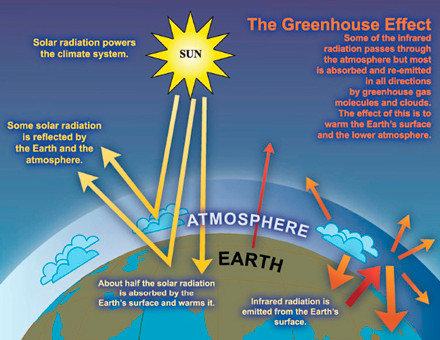
Earth gets shortwave solar radiation from the Sun. Some of that energy is reflected back to space by clouds, atmospheric particles, ice, snow, and other light-colored surfaces. The rest is absorbed by land and water, which warm up.
A warm Earth then gives off longwave infrared radiation. That outgoing infrared is what greenhouse gases interact with.
This diagram ties those steps together.
Greenhouse effect diagram
Greenhouse gases absorb some of this outgoing infrared and re-emit it in all directions, including back toward Earth’s surface. That slows Earth’s energy loss to space and warms the surface and lower atmosphere.
A few easy-to-mix-up points matter here:
- They do not hold heat forever. Energy still escapes to space.
- They do not act like mirrors. They absorb and re-radiate infrared.
- Most nitrogen and oxygen do not absorb terrestrial infrared well, so trace gases can still have a huge warming effect.
The natural greenhouse effect is necessary. Without it, Earth would average about . With it, Earth averages about . That difference makes liquid water and life possible.
The Principal Greenhouse Gases
The five you need are carbon dioxide, methane, water vapor, nitrous oxide, and CFCs.
Carbon dioxide
- Natural sources include respiration, decomposition, ocean release, volcanic activity, and fires.
- Human sources include fossil fuel combustion, deforestation and land-use change, biomass burning, and cement production.
- CO is the reference gas for global warming potential.
Methane
- Forms mainly from anaerobic decomposition, which means decomposition with little or no oxygen.
- Human sources include ruminant digestion, manure, landfills, rice paddies, and leaks from natural gas, petroleum, and coal systems.
Water vapor
- Enters the air by evaporation, transpiration, and sublimation.
- It is a major part of the natural greenhouse effect.
- It does not significantly drive long-term climate change because it has a short residence time in the atmosphere.
Nitrous oxide
- Natural source is microbial nitrogen cycling in soils and water.
- Human sources include synthetic fertilizers, manure, agricultural soils, some industry, and fuel or biomass combustion.
Chlorofluorocarbons
- CFCs are synthetic and have no important natural source.
- Uses you should know: refrigerants, aerosol propellants, foam-blowing agents, industrial solvents.
- They are greenhouse gases and also involved in ozone depletion, which is a different process.
How the Enhanced Greenhouse Effect Happens
The enhanced greenhouse effect is the same mechanism as the natural one, just stronger because greenhouse gas concentrations rise.
- Shortwave solar radiation enters the atmosphere.
- Some is reflected to space, and much is absorbed by land and water.
- Earth’s surface warms and emits longwave infrared radiation.
- Greenhouse gases absorb and re-emit some of that infrared.
- If greenhouse gas concentrations increase, less infrared escapes directly to space at first.
- Earth now has an energy imbalance. More energy comes in than goes out.
- The surface and lower atmosphere warm until outgoing energy again balances incoming energy.
Global Warming Potential and Relative Potency
Global warming potential compares the warming effect of the same mass of a gas to carbon dioxide over a set time period.
- CO has a GWP of .
- Ranking from highest to lowest GWP is CFCs > nitrous oxide > methane > carbon dioxide.
- Water vapor is usually left out of this ranking because it does not stay in the atmosphere long.
High GWP means stronger warming per unit mass. It does not automatically mean the gas causes the most total warming. Carbon dioxide has the lowest listed GWP, but it is still a major driver because humans emit it in very large amounts.
High-Value Distinctions to Keep Straight
- Greenhouse effect means the warming mechanism itself. Climate change includes the long-term changes caused by an enhanced greenhouse effect.
- Potency means warming per unit mass. Total impact also depends on how much of the gas is emitted.
- Water vapor matters a lot naturally, but it is not a major direct cause of persistent climate change in APES.
- Greenhouse warming involves outgoing infrared radiation.
- Ozone depletion involves loss of stratospheric ozone and more incoming ultraviolet radiation reaching Earth.
- CFCs connect to both topics, which is why students often mix them up.
Key Takeaways
Greenhouse Gas
An atmospheric gas that absorbs and re-emits outgoing infrared radiation; the principal greenhouse gases are carbon dioxide, methane, water vapor, nitrous oxide, and CFCs
Greenhouse Effect (Natural Greenhouse Effect)
Natural process in which greenhouse gases absorb and re-emit outgoing infrared radiation, slowing energy loss and keeping Earth’s surface about 33°C warmer and habitable
Enhanced Greenhouse Effect
Additional warming caused when increased concentrations of long-lived greenhouse gases further slow the loss of infrared energy to space
Carbon Dioxide (CO₂)
Greenhouse gas released naturally by respiration, decomposition, oceans, volcanoes, and fires and by fossil-fuel combustion, deforestation, biomass burning, and cement production; its GWP is 1
Methane (CH₄)
Greenhouse gas produced mainly by anaerobic decomposition, ruminants, manure, landfills, rice paddies, wetlands, and fossil-fuel leakage; its GWP exceeds CO₂’s but is below N₂O’s and CFCs’.
Water Vapor (H₂O Vapor)
Natural greenhouse gas that cycles rapidly through evaporation, condensation, and precipitation; its short atmospheric residence time means it does not accumulate and is not a major direct driver of long-term climate change
Nitrous Oxide (N₂O)
Greenhouse gas produced naturally by microbial nitrogen transformations and increased mainly by fertilizers, manure, agricultural soils, industry, and combustion; its GWP is below CFCs’ but above methane’s and CO₂’s
Chlorofluorocarbons (CFCs)
Long-lived synthetic carbon-, chlorine-, and fluorine-containing gases formerly used as refrigerants, propellants, foam-blowing agents, and solvents; they have the highest GWP in the required ranking
Global Warming Potential (GWP)
Warming caused by a given mass of gas relative to the same mass of CO₂ over a specified period; CO₂ = 1, and the required ranking is CFCs > N₂O > CH₄ > CO₂.
Notes
Greenhouse Gas
An atmospheric gas that absorbs and re-emits outgoing infrared radiation; the principal greenhouse gases are carbon dioxide, methane, water vapor, nitrous oxide, and CFCs
Greenhouse Effect (Natural Greenhouse Effect)
Natural process in which greenhouse gases absorb and re-emit outgoing infrared radiation, slowing energy loss and keeping Earth’s surface about 33°C warmer and habitable
Enhanced Greenhouse Effect
Additional warming caused when increased concentrations of long-lived greenhouse gases further slow the loss of infrared energy to space
Carbon Dioxide (CO₂)
Greenhouse gas released naturally by respiration, decomposition, oceans, volcanoes, and fires and by fossil-fuel combustion, deforestation, biomass burning, and cement production; its GWP is 1
Methane (CH₄)
Greenhouse gas produced mainly by anaerobic decomposition, ruminants, manure, landfills, rice paddies, wetlands, and fossil-fuel leakage; its GWP exceeds CO₂’s but is below N₂O’s and CFCs’.
Water Vapor (H₂O Vapor)
Natural greenhouse gas that cycles rapidly through evaporation, condensation, and precipitation; its short atmospheric residence time means it does not accumulate and is not a major direct driver of long-term climate change
Nitrous Oxide (N₂O)
Greenhouse gas produced naturally by microbial nitrogen transformations and increased mainly by fertilizers, manure, agricultural soils, industry, and combustion; its GWP is below CFCs’ but above methane’s and CO₂’s
Chlorofluorocarbons (CFCs)
Long-lived synthetic carbon-, chlorine-, and fluorine-containing gases formerly used as refrigerants, propellants, foam-blowing agents, and solvents; they have the highest GWP in the required ranking
Global Warming Potential (GWP)
Warming caused by a given mass of gas relative to the same mass of CO₂ over a specified period; CO₂ = 1, and the required ranking is CFCs > N₂O > CH₄ > CO₂.
