Topic 6.9 Notes – Hydroelectric Power
What Hydroelectric Power Is
Hydroelectric power uses moving water to spin a turbine connected to a generator, which makes electricity.
The basic dam setup below gives you the big picture before you get into the energy changes.
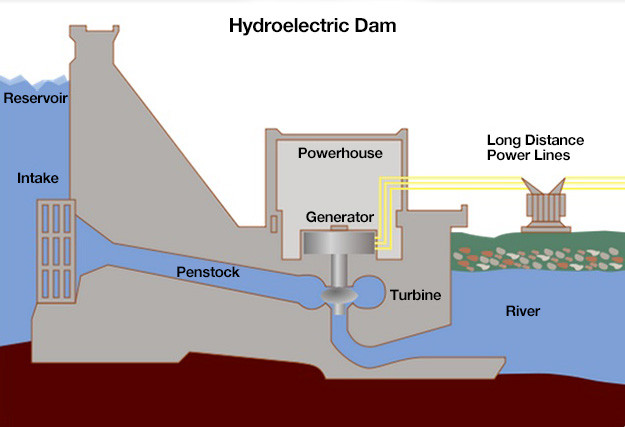
The energy changes happen in a chain:
- Gravitational potential energy sits in water held at a higher elevation.
- As water moves downhill, that becomes kinetic energy.
- Flowing water spins a turbine, creating mechanical energy.
- The generator turns that mechanical energy into electrical energy.
A couple of APES reminders matter here:
- Renewable means the water source is naturally replenished by the hydrologic cycle. Water is not burned like coal or oil.
- Hydropower does not only mean dams. Any system using moving water to turn a turbine counts.
- Clean in this course means no direct air pollution or waste during generation. It does not mean no environmental impact.
That last point sets up the whole topic. Hydropower avoids fuel combustion, but the way humans control water can strongly change ecosystems.
Main Types of Hydroelectric Systems
Reservoir dam systems
A dam built across a river creates a reservoir. The stored water sits higher than the river below, creating head, which means vertical drop.
Water moves through:
- reservoir
- intake
- penstock
- turbine
- generator
- river below the dam
Because water is stored, reservoir systems give the most control over when electricity is generated. That matters on grids when demand changes quickly.
They can also provide other services:
- flood control
- irrigation water
- drinking water
- navigation
- recreation
Run-of-river and small-stream systems
These systems use a river’s natural flow, or divert part of that flow through a turbine.
- They have little or no water storage
- They usually flood less land than large reservoir projects
- Their output depends more on current streamflow
So if drought hits or the dry season lowers flow, electricity production drops more directly.
Tidal energy
Tidal energy uses moving seawater to turn turbines.
Two forms you should know:
- underwater tidal turbines
- tidal barrages built across an estuary or bay
Tides are driven by the gravitational pull of the Moon and Sun. That makes tidal energy highly predictable, but it only works in suitable coastal places.
What Determines Hydroelectric Output and How It Works
The biggest factors are:
- flow rate of water
- head or vertical drop
- efficiency of the turbine and generator
General rule:
- more flowing water + greater head = more electricity
For a reservoir system, the sequence is straightforward:
- Water is stored behind the dam.
- Water is released through the intake and penstock.
- Moving water spins the turbine.
- The generator produces electricity.
- Water returns downstream.
Reservoir systems can respond quickly to changing demand because operators can release stored water when needed. Run-of-river systems have less control because they store little water. Tidal systems are predictable, but there are fewer places to build them.
Advantages of Hydroelectric Power
Hydropower’s main advantage is that it generates electricity without burning fuel.
That means no direct release of:
- sulfur dioxide
- nitrogen oxides
- particulate matter
- mercury
- carbon dioxide from combustion
It also produces:
- no coal ash
- no radioactive waste from generation
Other advantages:
- renewable because river flow and tides are replenished
- low operational greenhouse gas emissions compared with fossil fuels
- reliable and controllable in reservoir systems
- can support flood control, water supply, irrigation, navigation, and recreation
This is the kind of evidence you’d use on an FRQ when justifying hydropower as an environmental solution.
Environmental Costs and Trade-Offs
The core APES trade-off is simple. Hydropower avoids air pollution from combustion, but the structures used to control water can damage ecosystems and communities.
Habitat and river disruption
Reservoirs can flood:
- terrestrial habitats
- riparian habitats
- wetlands
- river habitats
Dams also fragment rivers and block fish migration.
- Pacific Northwest dams and salmon migration is the classic example.
- Common mitigation includes fish ladders, fish elevators, bypass channels, and intake screens.
A fish ladder like the one shown here is designed to help migratory fish move past a dam in stages.
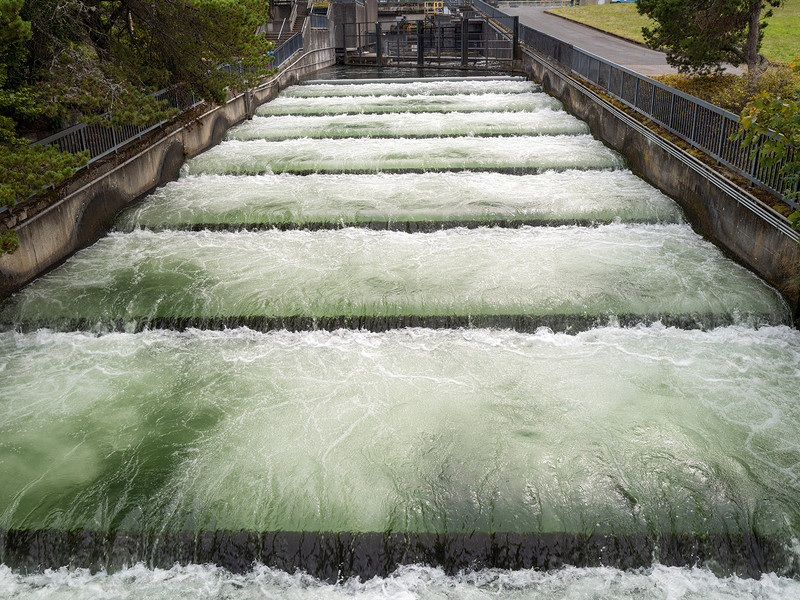
Fish ladder at a dam
Changes downstream
Dams change natural river patterns.
- Altered flow regimes can disrupt wetlands, flood pulses, and species life cycles.
- Sediment gets trapped in reservoirs, which reduces reservoir capacity and deprives downstream habitats of sediment and nutrients.
- Released water may have different temperature and dissolved oxygen levels than natural river water.
Human and economic costs
- Construction is expensive
- Large projects use a lot of land
- Communities, farmland, forests, and cultural sites may be flooded or displaced
- Reservoirs can increase evaporation losses
- Dam failure can cause catastrophic flooding
Type comparisons and examples
| System | Main benefit | Main drawback |
|---|---|---|
| Reservoir dam | Most control, many extra services | Greatest flooding and displacement |
| Run-of-river | Less land flooded | Less dependable in low flow |
| Tidal | Predictable renewable power | Can alter estuaries, salinity, sediment, marine habitat |
Illustrative examples you should know:
- Hoover Dam on the Colorado River
- Three Gorges Dam on the Yangtze River
Key Takeaways
Hydroelectric Power (Hydropower)
Renewable electricity generation in which moving water turns a turbine connected to a generator, without burning fuel
Conventional Reservoir Hydropower
A dam stores elevated water in a reservoir and releases it through turbines to generate electricity
Head
The vertical elevation difference through which water falls in a hydroelectric system; greater head generally permits greater power output
Run-of-River Hydropower
Hydroelectric generation that uses or diverts a river’s natural flow with little or no water storage
Tidal Energy
Renewable energy from rising, falling, or flowing tides used to turn turbines
Tidal Barrage
A barrier across an estuary or bay that directs water through turbines as the tide rises or falls
River Fragmentation
Loss of river connectivity when a dam blocks organism movement, especially migration between feeding and spawning habitats
Sediment Trapping
The settling of river sediment in a reservoir, reducing storage capacity and depriving downstream ecosystems of sediment and nutrients
Notes
Hydroelectric Power (Hydropower)
Renewable electricity generation in which moving water turns a turbine connected to a generator, without burning fuel
Conventional Reservoir Hydropower
A dam stores elevated water in a reservoir and releases it through turbines to generate electricity
Head
The vertical elevation difference through which water falls in a hydroelectric system; greater head generally permits greater power output
Run-of-River Hydropower
Hydroelectric generation that uses or diverts a river’s natural flow with little or no water storage
Tidal Energy
Renewable energy from rising, falling, or flowing tides used to turn turbines
Tidal Barrage
A barrier across an estuary or bay that directs water through turbines as the tide rises or falls
River Fragmentation
Loss of river connectivity when a dam blocks organism movement, especially migration between feeding and spawning habitats
Sediment Trapping
The settling of river sediment in a reservoir, reducing storage capacity and depriving downstream ecosystems of sediment and nutrients
